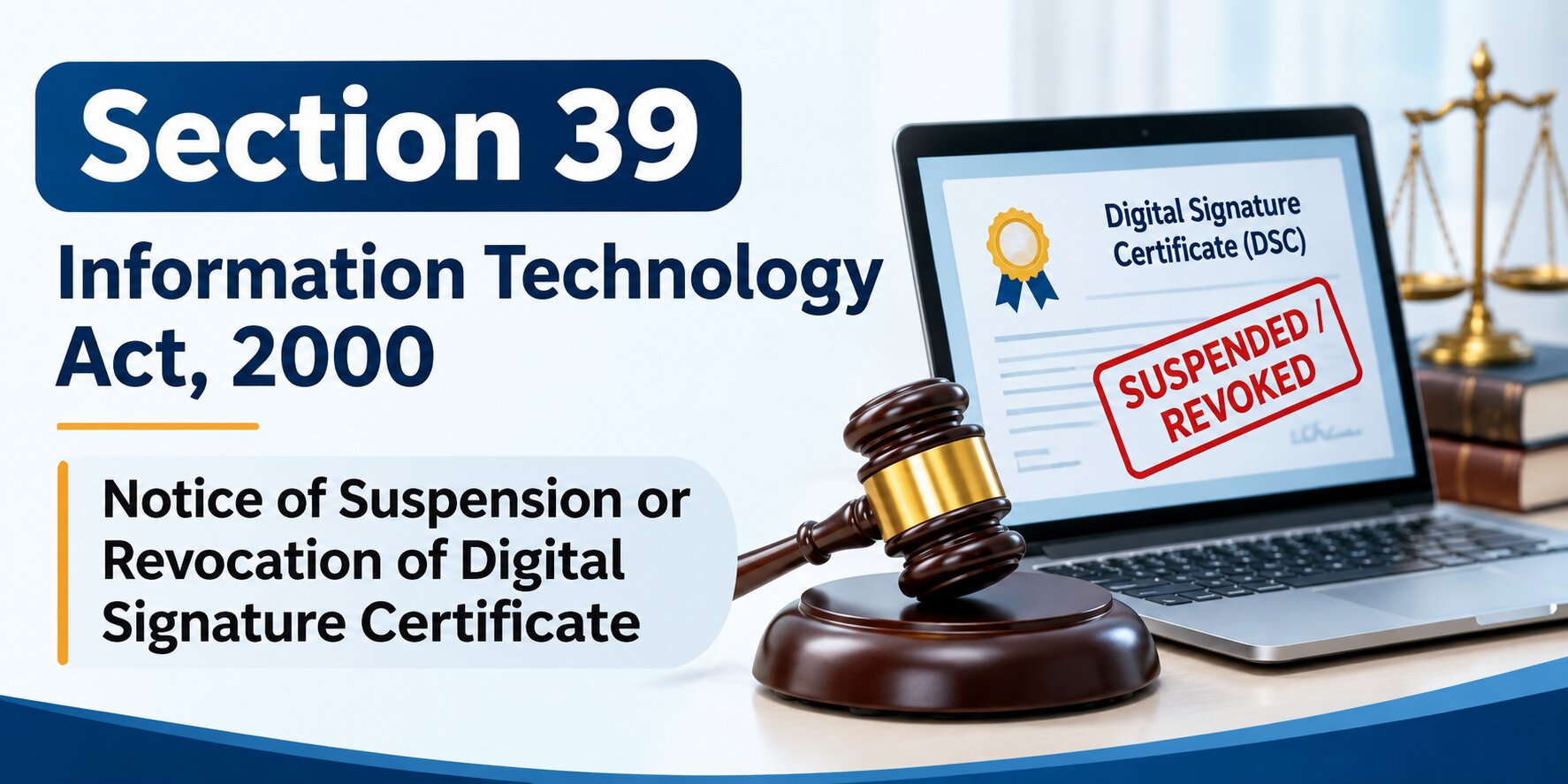
Section 39 of IT Act 2000: Notice of suspension or revocation
Section 39(1)
Where a Digital Signature Certificate is suspended or revoked under section 37 or section 38, the Certifying Authority shall publish a notice of such suspension or revocation, as the case may be, in the repository specified in the Digital Signature Certificate for publication of such notice.
Section 39(2)
Where one or more repositories are specified, the Certifying Authority shall publish notices of such suspension or revocation, as the case may be, in all such repositories.
Explained:
Section 39(1) – Publication of Notice of Suspension or Revocation
Section 39(1) provides that whenever a Digital Signature Certificate is suspended or revoked under Section 37 or Section 38, the Certifying Authority must publish a notice of that action in the repository specified in the certificate.
This subsection creates a statutory responsibility for the Certifying Authority. The purpose is to ensure that individuals, businesses, government departments and other users relying on a Digital Signature Certificate can become aware of its changed status.
For example, suppose a company director possesses a Digital Signature Certificate used for filing statutory documents with government authorities. If the certificate is subsequently revoked because its private key has been compromised, other persons should not continue relying on that certificate as though it were valid.
Publication of the revocation notice helps prevent unauthorised use and reduces the possibility of fraudulent electronic authentication.
The important elements of Section 39(1) are:
- Suspension or revocation: The provision applies when a certificate is suspended or revoked under Section 37 or Section 38.
- Responsibility of Certifying Authority: The authority issuing or administering the certificate must publish the notice.
- Specified repository: The notice must be published in the repository identified in the Digital Signature Certificate for this purpose.
- Public awareness: Publication enables users to verify whether the certificate continues to be valid.
Section 39(2) – Publication in All Specified Repositories
Section 39(2) deals with situations where more than one repository has been specified in a Digital Signature Certificate.
It clearly states that if one or more repositories are specified, the Certifying Authority must publish notices of suspension or revocation in all such repositories.
This requirement is important because information published in only one repository may not reach every person or organisation relying on the certificate.
For example, where a Digital Signature Certificate identifies three repositories for publishing suspension or revocation notices, the Certifying Authority cannot fulfil its statutory responsibility by publishing the notice in only one of them. The notice must be published in all specified repositories.
The main objective of this subsection is to ensure consistent availability of certificate-status information and prevent confusion among users.
Relationship Between Sections 37, 38 and 39
These three provisions should be read together because they establish the legal procedure relating to the suspension, revocation and notification of Digital Signature Certificates.
| Section | Subject | Purpose |
|---|---|---|
| Section 37 | Suspension of Digital Signature Certificate | Provides for temporary suspension |
| Section 38 | Revocation of Digital Signature Certificate | Provides for cancellation or withdrawal |
| Section 39 | Notice of suspension or revocation | Requires publication of the relevant notice |
Section 39 therefore acts as an important notification mechanism following action under Sections 37 and 38.
Important Judicial Decisions
There is limited reported judicial interpretation directly dealing with the specific publication obligations under Section 39. The following decisions provide relevant background on the Information Technology Act and the legal treatment of digital transactions.
1. State of Tamil Nadu v. Suhas Katti (2004)
This is an important early Indian cybercrime decision involving online harassment and the misuse of electronic communication. The accused was convicted under provisions of the Information Technology Act.
Relevance: The decision demonstrates the importance of maintaining trust and accountability in electronic systems. Although it does not directly interpret Section 39, it provides broader context for the need for reliable digital authentication and safeguards against misuse.
2. Shreya Singhal v. Union of India (2015) 5 SCC 1
The Supreme Court examined the constitutional validity of provisions of the Information Technology Act, particularly Section 66A, and considered aspects of intermediary liability under Section 79.
Relevance: The judgment emphasises the importance of interpreting the Information Technology Act consistently with constitutional principles and legal safeguards. It is not a direct ruling on Section 39, but is significant when understanding the wider legal framework governing digital activities.
3. Kent RO Systems Ltd. v. Amit Kotak (2017 SCC OnLine Del 7201)
The Delhi High Court examined the liability of an online marketplace in relation to allegedly infringing products listed by third-party sellers.
Relevance: The judgment discusses the responsibilities of digital platforms under the Information Technology Act. Although it does not decide the specific requirements of Section 39, it provides useful context regarding accountability and compliance in electronic environments.
Practical Importance of Section 39
Section 39 has considerable practical importance for individuals and organisations using Digital Signature Certificates.
- Prevention of fraudulent transactions: Publication of revocation notices helps prevent continued reliance on compromised certificates.
- Protection of businesses: Companies can verify certificate status before accepting electronically authenticated documents.
- Transparency: The repository provides a mechanism for communicating important changes in certificate status.
- Security of digital transactions: Timely notification reduces the risk of unauthorised electronic authentication.
- Legal compliance: Certifying Authorities must comply with their statutory publication obligations.
Conclusion
Section 39 of the Information Technology Act, 2000, plays an important role in maintaining the reliability and security of India’s digital signature infrastructure. By requiring Certifying Authorities to publish notices of suspension or revocation, it ensures that users have a means of checking changes in the status of Digital Signature Certificates.
Both subsections establish clear responsibilities. Section 39(1) requires publication in the specified repository, while Section 39(2) makes publication mandatory in every repository specified in the certificate.
Leave a Reply