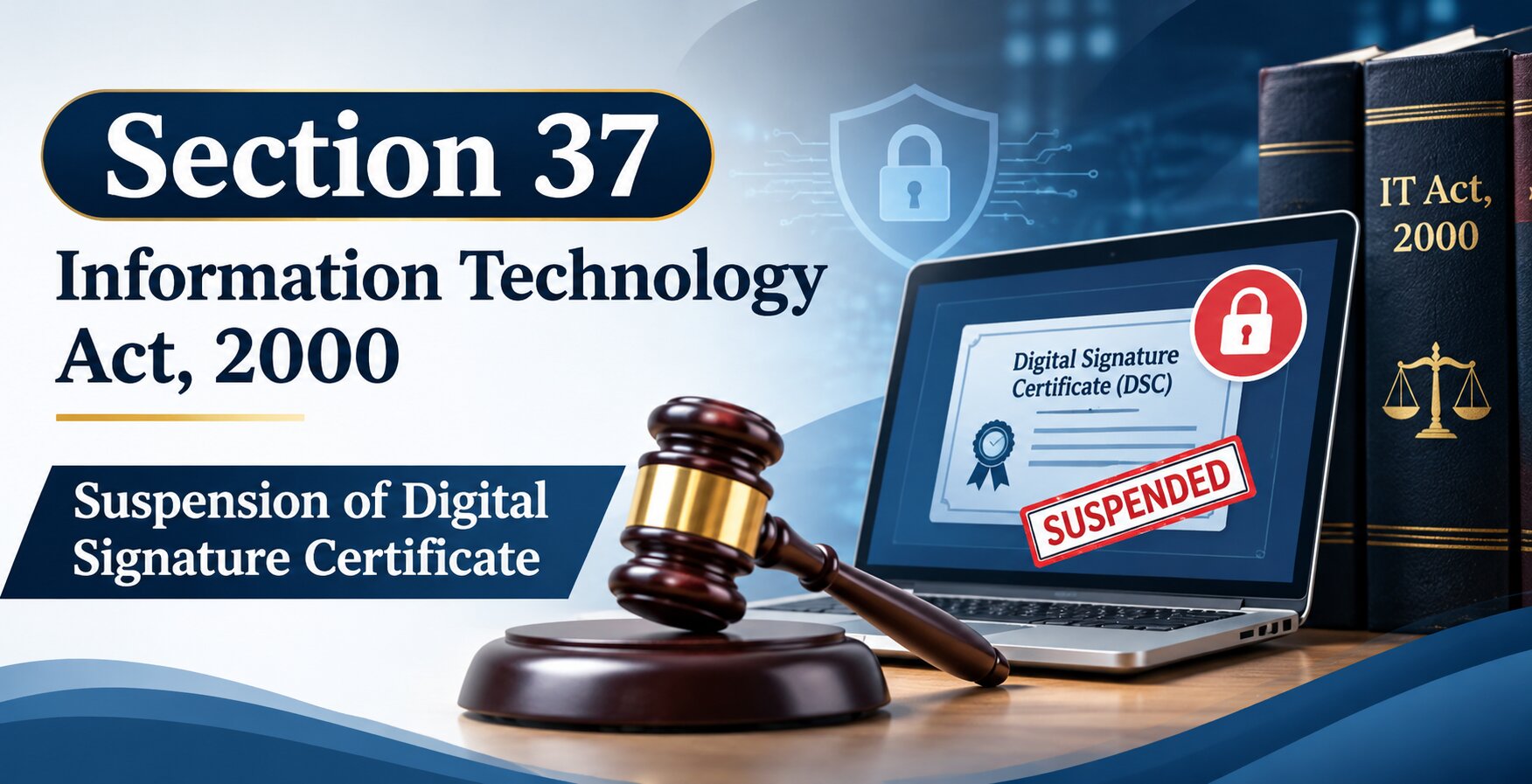
Section 37 of IT Act 2000: Legal recognition of electronic records
Section 37(1)
Subject to the provisions of sub-section (2), the Certifying Authority which has issued a Digital Signature Certificate may suspend such Digital Signature Certificate,—
(a) on receipt of a request to that effect from—
(i) the subscriber listed in the Digital Signature Certificate; or
(ii) any person duly authorised to act on behalf of that subscriber;
(b) if it is of opinion that the Digital Signature Certificate should be suspended in public interest.
Section 37(2)
A Digital Signature Certificate shall not be suspended for a period exceeding fifteen days unless the subscriber has been given an opportunity of being heard in the matter.
Section 37(3)
On suspension of a Digital Signature Certificate under this section, the Certifying Authority shall communicate the same to the subscriber.
Explained:
Section 37 contains three subsections. Each subsection explains the circumstances in which a Digital Signature Certificate may be suspended and the procedural protections available to the subscriber.
Section 37(1): Power of Certifying Authority to Suspend a Digital Signature Certificate
Subsection (1) authorises the Certifying Authority that issued a Digital Signature Certificate to suspend it under specified circumstances. The power is not unlimited and must be exercised subject to subsection (2).
There are two principal situations in which suspension can take place.
A. Section 37(1)(a): Suspension on Request
Under this provision, a Certifying Authority may suspend a certificate after receiving a request from:
- The subscriber whose name appears in the Digital Signature Certificate.
- A person duly authorised to act on behalf of that subscriber.
For example, suppose a company director holds a Digital Signature Certificate used for filing statutory documents. If the director suspects that the private key or associated authentication credentials have been misused, the subscriber may request suspension of the certificate.
Similarly, an authorised representative may submit the request on behalf of the subscriber, provided the representative has proper legal authority.
This provision gives subscribers an important safeguard by allowing them to seek suspension when they believe their electronic identity or authentication credentials may be at risk.
B. Section 37(1)(b): Suspension in Public Interest
The second circumstance allows the Certifying Authority to suspend a Digital Signature Certificate if it forms the opinion that suspension is necessary in the public interest.
This provision is intended to protect the security and reliability of electronic authentication systems. For instance, if circumstances indicate that a certificate is being used in a manner that may threaten the security of electronic transactions or cause harm to others, suspension may be considered.
The expression “public interest” provides a broader basis for intervention, but the power must be exercised lawfully and for a genuine public purpose.
Section 37(2): Opportunity of Being Heard and Fifteen-Day Limit
Subsection (2) is one of the most important safeguards under Section 37.
It provides that a Digital Signature Certificate cannot remain suspended for more than fifteen days unless the subscriber has been given an opportunity of being heard.
This means that the Certifying Authority cannot continue a suspension beyond the prescribed period without providing the subscriber an opportunity to present their explanation.
The provision reflects the principles of natural justice, particularly the principle of audi alteram partem, which means that no person should be condemned without being heard.
Important points under Section 37(2):
- The initial suspension is subject to the statutory fifteen-day safeguard.
- If suspension is to continue beyond fifteen days, the subscriber must be given an opportunity of being heard.
- The subscriber must have a fair opportunity to explain their position.
- The Certifying Authority should consider the relevant circumstances before taking further action.
It is important to understand that Section 37(2) does not automatically require suspension to end after fifteen days in every case. The statutory requirement is that an opportunity of hearing must be provided before suspension continues beyond that period.
Section 37(3): Communication of Suspension to Subscriber
Subsection (3) places an express obligation on the Certifying Authority to communicate the suspension to the subscriber.
This requirement is important because a subscriber must know that their Digital Signature Certificate has been suspended.
Without proper communication, the subscriber may continue attempting to use the certificate for electronic filings, business transactions or government services, without realising that it is no longer available for normal use.
For example, if a company’s DSC is suspended, the company may face difficulties submitting statutory documents electronically. Communication of suspension helps the subscriber take appropriate steps, understand the reason for the action and approach the Certifying Authority where necessary.
Thus, subsection (3) promotes transparency and accountability in the certificate suspension process.
Difference Between Suspension and Revocation of Digital Signature Certificate
Section 37 should be read along with Section 38 of the Information Technology Act, 2000. Although both provisions deal with the status of Digital Signature Certificates, they serve different purposes.
| Section 37 | Section 38 |
|---|---|
| Deals with suspension of a DSC. | Deals with revocation of a DSC. |
| Generally involves temporary disabling of a certificate. | Involves cancellation of a certificate. |
| Can be initiated on the subscriber’s request or in public interest. | Can be initiated on specified statutory grounds. |
| Provides a fifteen-day hearing safeguard. | Requires an opportunity of hearing before revocation under Section 38(3). |
| Suspension may be withdrawn according to applicable procedures. | A revoked certificate cannot simply be restored as an active certificate. |
Section 39 further requires the Certifying Authority to publish notice of suspension or revocation in the repository specified for that purpose. These provisions collectively help maintain the reliability of electronic authentication. India Code+2
Important Judgments
There is an important distinction between judgments directly interpreting Section 37 and judgments explaining general legal principles relevant to its application. The following decisions are relevant to understanding the procedural safeguards under this provision.
1. Maneka Gandhi v. Union of India (1978)
The Supreme Court of India emphasised the importance of fairness, reasonableness and non-arbitrariness in State action under Article 21 of the Constitution.
Relevance: This judgment provides a broader constitutional foundation for fair administrative decision-making. The principles are relevant when examining whether administrative action affecting a subscriber’s digital authentication rights is arbitrary or unfair.
2. Swadeshi Cotton Mills v. Union of India (1981)
The Supreme Court discussed the importance of natural justice and the requirement of providing an opportunity of hearing before taking certain adverse administrative decisions.
Relevance: Section 37(2) expressly incorporates an opportunity of hearing safeguard when suspension is to continue beyond fifteen days. The judgment helps explain the importance of procedural fairness in such situations.
3. Canara Bank v. Debasis Das (2003)
The Supreme Court explained the principles of natural justice and emphasised that an affected person should receive a fair opportunity to present their case where such a hearing is legally required.
Relevance: This principle is useful in understanding the protection provided under Section 37(2). A subscriber facing continued suspension should have a meaningful opportunity to explain their position.
Note: These are judgments on general principles of natural justice and administrative fairness, not direct judicial interpretations of Section 37.
Importance of Section 37
Section 37 has practical importance in several areas:
1. Income Tax Filing: Individuals and professionals using DSCs for electronic tax-related filings may need suspension if their authentication credentials are compromised.
2. GST Compliance: Businesses using digital authentication for GST-related submissions can seek suspension when their certificates are suspected of misuse.
3. Company Registration: Directors and authorised representatives using DSCs for MCA filings benefit from the protection provided by this provision.
4. E-Tendering: Suspension can help prevent further use of a certificate where there are genuine concerns about unauthorised access or misuse.
5. Cybersecurity: The provision supports the security and reliability of digital authentication by allowing certificates to be suspended in appropriate circumstances.
Conclusion
Section 37 of the Information Technology Act, 2000, provides an important legal mechanism for suspending Digital Signature Certificates in India. It empowers Certifying Authorities to suspend certificates either on a request from the subscriber or an authorised representative, or when suspension is considered necessary in the public interest.
At the same time, the provision protects subscribers through the fifteen-day safeguard under subsection (2) and the communication requirement under subsection (3). These requirements help balance cybersecurity concerns with the principles of natural justice.
For individuals, companies and professionals who depend on digital authentication, understanding Section 37 is essential. Reading Sections 37, 38 and 39 together provides a clearer understanding of suspension, revocation and notification of Digital Signature Certificates under Indian cyber law.
Leave a Reply