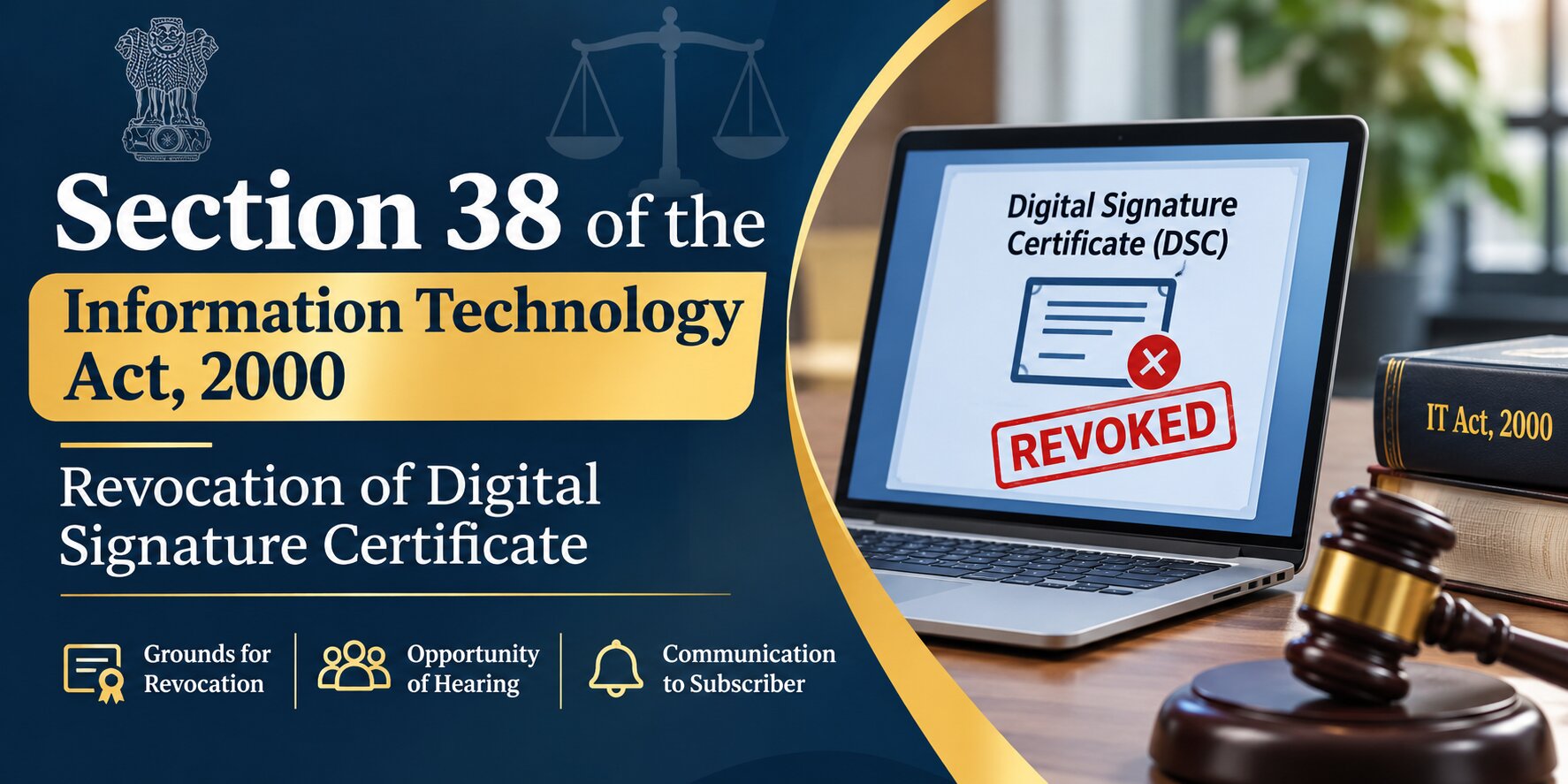
Section 38 of IT Act 2000: Revocation of Digital Signature Certificate.
Section 38(1)
A Certifying Authority may revoke a Digital Signature Certificate issued by it—
(a) where the subscriber or any other person authorised by him makes a request to that effect; or
(b) upon the death of the subscriber; or
(c) upon the dissolution of the firm or winding up of the company where the subscriber is a firm or a company.
Section 38(2)
Subject to the provisions of sub-section (3) and without prejudice to the provisions of sub-section (1), a Certifying Authority may revoke a Digital Signature Certificate which has been issued by it at any time, if it is of opinion that—
(a) a material fact represented in the Digital Signature Certificate is false or has been concealed;
(b) a requirement for issuance of the Digital Signature Certificate was not satisfied;
(c) the Certifying Authority’s private key or security system was compromised in a manner materially affecting the Digital Signature Certificate’s reliability;
(d) the subscriber has been declared insolvent or dead or where a subscriber is a firm or a company, which has been dissolved, wound-up or otherwise ceased to exist.
Section 38(3)
A Digital Signature Certificate shall not be revoked unless the subscriber has been given an opportunity of being heard in the matter.
Section 38(4)
On revocation of a Digital Signature Certificate under this section, the Certifying Authority shall communicate the same to the subscriber.
Explained:
Section 38(1) – Revocation on Specific Grounds
Sub-section (1) identifies three circumstances in which a Certifying Authority may revoke a Digital Signature Certificate. These circumstances relate to the request of the subscriber, the death of an individual subscriber and the dissolution or winding up of a business entity.
Section 38(1)(a) – Request by the Subscriber or Authorised Person
A Digital Signature Certificate may be revoked when the subscriber personally requests its cancellation. A person who has been duly authorised by the subscriber can also make such a request.
For example, if an individual no longer requires a Digital Signature Certificate or suspects that the associated private key has been compromised, the subscriber may approach the issuing Certifying Authority and request revocation.
This provision allows certificate holders to discontinue the use of their certificates when necessary.
Section 38(1)(b) – Death of the Subscriber
When an individual holding a Digital Signature Certificate dies, the Certifying Authority may revoke the certificate. This provision prevents the continued use of a certificate associated with a deceased individual.
The provision is particularly important where electronic signatures are used for financial transactions, official submissions and legal documentation.
Section 38(1)(c) – Dissolution of Firm or Winding Up of Company
This clause deals with Digital Signature Certificates issued in the name of firms or companies.
When a firm is dissolved or a company is wound up, the Certifying Authority may revoke its Digital Signature Certificate. This ensures that an entity that has ceased to exist does not continue using its digital identity for electronic transactions.
Section 38(2) – Additional Grounds for Revocation
Sub-section (2) provides further circumstances in which a Certifying Authority may revoke a Digital Signature Certificate. These grounds are intended to protect the reliability and security of electronic authentication.
Section 38(2)(a) – False or Concealed Material Information
If a material fact represented in the Digital Signature Certificate is false or has been deliberately concealed, the Certifying Authority may revoke the certificate.
For example, if an applicant provides incorrect identity information or conceals an important fact while obtaining a certificate, the authority may consider revocation.
Section 38(2)(b) – Failure to Satisfy Issuance Requirements
A Digital Signature Certificate may be revoked if the requirements prescribed for its issuance were not fulfilled.
This provision ensures that certificates are issued only after compliance with the applicable statutory and procedural requirements.
Section 38(2)(c) – Compromise of Private Key or Security System
This clause addresses cybersecurity risks associated with Digital Signature Certificates.
If the Certifying Authority’s private key or security system is compromised in a manner that materially affects the reliability of the certificate, the authority may revoke the certificate.
For instance, if a security breach enables an unauthorised person to interfere with the certificate authentication system, revocation may become necessary to protect electronic transactions.
Section 38(2)(d) – Insolvency, Death or Cessation of Existence
A Digital Signature Certificate may also be revoked when the subscriber has been declared insolvent or dead. Where the subscriber is a firm or company, revocation may take place when the entity has been dissolved, wound up or otherwise ceased to exist.
This clause protects the reliability of digital identities associated with individuals and business organisations.
Section 38(3) – Opportunity of Being Heard
Sub-section (3) provides an important procedural safeguard to subscribers.
It states that a Digital Signature Certificate cannot be revoked unless the subscriber has been given an opportunity of being heard in the matter.
This requirement reflects the principles of natural justice. Before taking a decision that adversely affects the subscriber, the Certifying Authority must provide an opportunity to explain the circumstances or respond to the allegations.
However, this safeguard must be read with the specific grounds for revocation and the circumstances of the case.
Section 38(4) – Communication of Revocation
Sub-section (4) requires the Certifying Authority to communicate the revocation of a Digital Signature Certificate to the subscriber.
Communication is important because the subscriber must know that the certificate has been revoked and should no longer be relied upon for electronic authentication.
It also helps prevent confusion regarding the validity and continued use of the certificate.
Important Judgments
There are judicial decisions concerning electronic records, digital transactions and authentication. Although the following judgments are not direct rulings interpreting Section 38, they provide useful legal context.
1. Anvar P.V. v. P.K. Basheer (2014)
The Supreme Court examined the admissibility of electronic records under Section 65B of the Indian Evidence Act, 1872.
The judgment clarified the importance of complying with statutory requirements when electronic records are produced as evidence.
Relevance: It highlights the importance of authenticity and reliability when electronic records are relied upon in legal proceedings.
2. Arjun Panditrao Khotkar v. Kailash Kushanrao Gorantyal (2020)
The Supreme Court further explained the requirements for proving electronic records under Section 65B of the Indian Evidence Act, 1872.
Relevance: The decision demonstrates that electronic records must satisfy applicable evidentiary requirements. Recognition or revocation of a Digital Signature Certificate and admissibility of electronic evidence are separate legal questions.
3. Trimex International FZE Ltd. v. Vedanta Aluminium Ltd. (2010)
The Supreme Court considered the formation of a commercial contract through electronic communications.
The judgment recognised that contractual agreements may be concluded through electronic communications when the essential elements of a valid contract are established.
Relevance: This decision provides broader context regarding the legal significance of electronic transactions and communications.
Difference Between Suspension and Revocation of Digital Signature Certificate
Section 37 deals with the suspension of a Digital Signature Certificate, whereas Section 38 deals with its revocation.
Suspension generally places the certificate’s use on hold and may be temporary. Revocation, on the other hand, terminates the certificate’s validity.
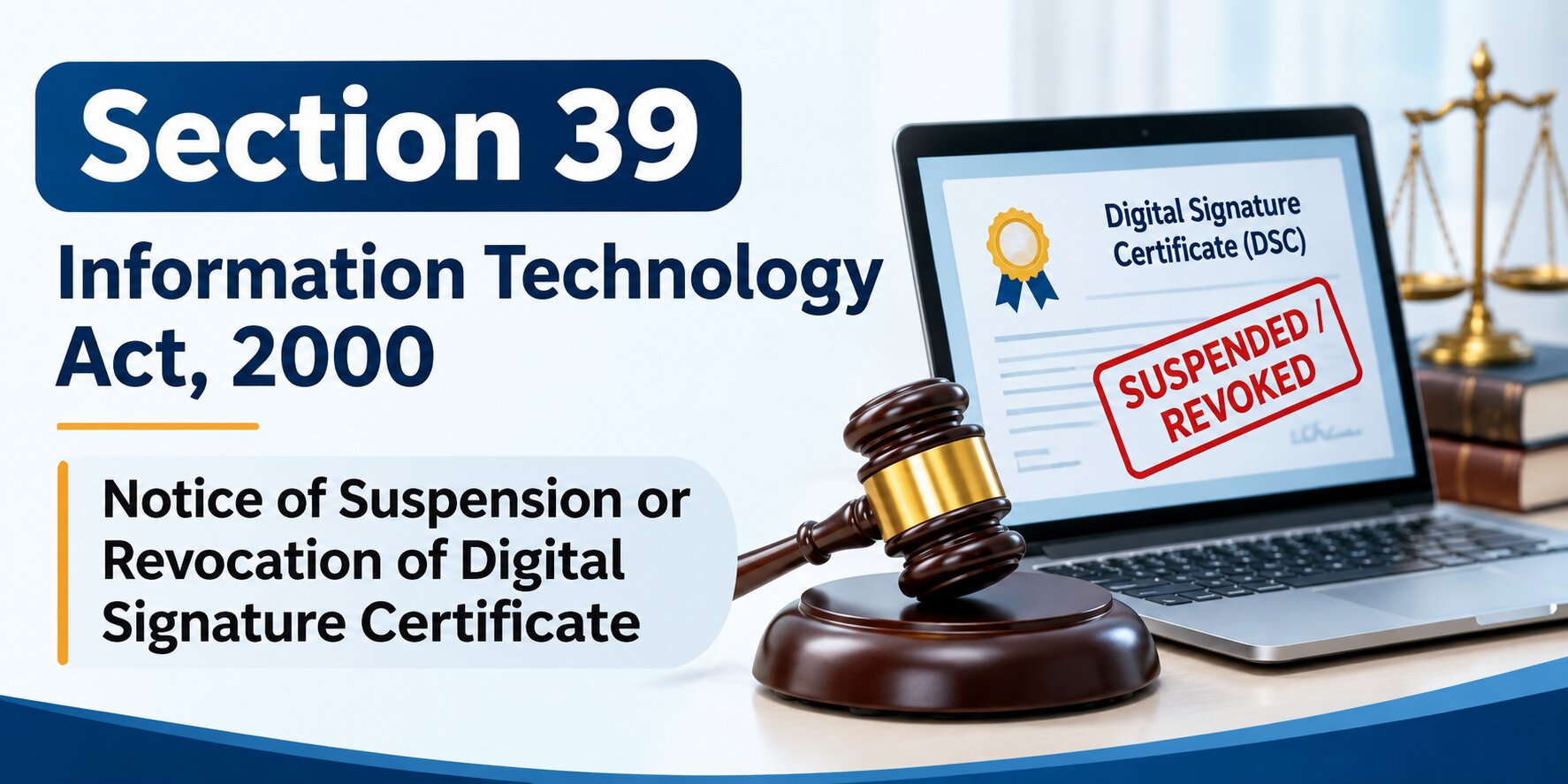
Section 39 further requires the Certifying Authority to publish notice of suspension or revocation in the specified repository. These provisions should be read together to understand the legal framework governing Digital Signature Certificates.
Conclusion
Section 38 of the Information Technology Act, 2000, plays an important role in maintaining the security and reliability of India’s digital authentication system. It empowers Certifying Authorities to revoke Digital Signature Certificates when statutory grounds arise, including false information, failure to satisfy issuance requirements, compromise of security systems and the death or dissolution of subscribers.
At the same time, the requirement of providing an opportunity of being heard under sub-section (3) protects subscribers against arbitrary revocation under sub-section (2). The obligation to communicate revocation under sub-section (4) further ensures transparency.
Understanding Section 38 along with Sections 37 and 39 is essential for individuals, companies, legal professionals and organisations that rely on Digital Signature Certificates for electronic transactions and statutory compliance.
Leave a Reply