
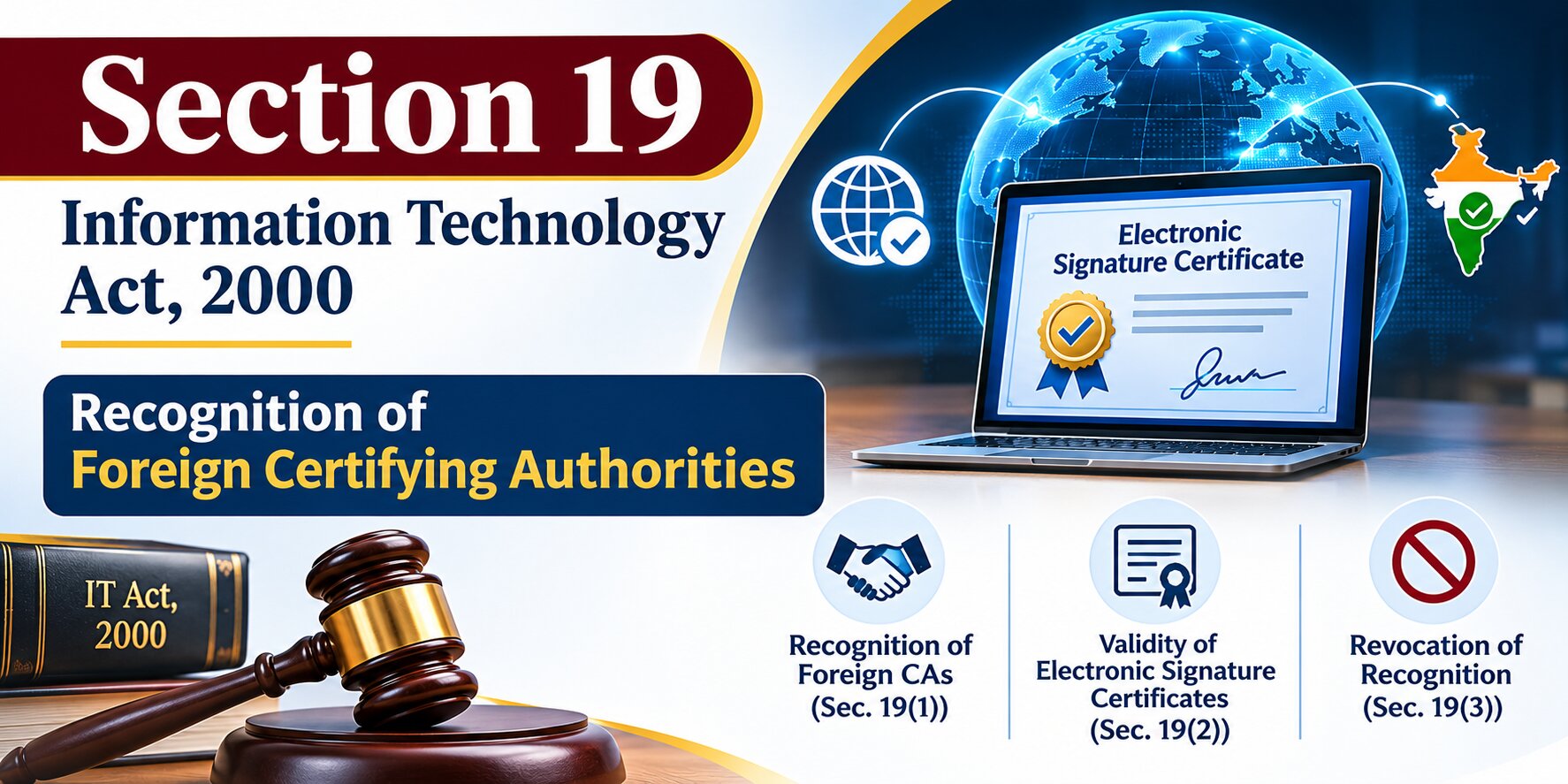
Section 19 of IT Act 2000: Recognition of foreign Certifying Authorities
Section 19(1)
Subject to such conditions and restrictions as may be specified by regulations, the Controller may with the previous approval of the Central Government, and by notification in the Official Gazette, recognise any foreign Certifying Authority as a Certifying Authority for the purposes of this Act.
Section 19(2)
Where any Certifying Authority is recognised under sub-section (1), the electronic signature Certificate issued by such Certifying Authority shall be valid for the purposes of this Act.
Section 19(3)
The Controller may, if he is satisfied that any Certifying Authority has contravened any of the conditions and restrictions subject to which it was granted recognition under sub-section (1) he may, for reasons to be recorded in writing, by notification in the Official Gazette, revoke such recognition.
Explained:
Section 19 contains three subsections. Each subsection deals with a different aspect of recognising and regulating foreign Certifying Authorities.
Section 19(1): Recognition of foreign Certifying Authorities
Subsection (1) empowers the Controller of Certifying Authorities to recognise a foreign Certifying Authority as a Certifying Authority under Indian law.
However, this recognition is subject to three important legal requirements.
A. Conditions and restrictions prescribed by regulations
The foreign Certifying Authority must comply with the conditions and restrictions specified under the applicable regulations. These conditions help ensure that foreign entities seeking recognition satisfy the required regulatory and security standards.
B. Previous approval of the Central Government
The Controller cannot independently recognise a foreign Certifying Authority without obtaining the previous approval of the Central Government. This requirement ensures government oversight before recognition is granted.
C. Notification in the Official Gazette
Recognition must be published through a notification in the Official Gazette. This provides formal public notice of the recognition and establishes the legal basis for treating the foreign organisation as a recognised Certifying Authority under the Act.
Example: Suppose a company operating outside India provides electronic signature certificates to international businesses. Even if the company is legally authorised in its home country, its certificates do not automatically acquire recognition under the Indian Information Technology Act. The recognition procedure under Section 19(1) must be followed.
Section 19(2): Validity of electronic signature certificates
Subsection (2) explains the legal consequence of recognition granted under subsection (1).
Once a foreign Certifying Authority receives recognition under Section 19(1), the electronic signature certificates issued by that authority become valid for the purposes of the Information Technology Act, 2000.
This provision is particularly relevant to international business transactions, cross-border commercial agreements and electronic documentation involving foreign organisations.
For example, an Indian company entering into an agreement with an overseas business may need to verify an electronic signature certificate issued by a foreign Certifying Authority. Section 19(2) provides the statutory basis for recognising certificates issued by an authority that has received recognition under subsection (1).
However, recognition of the issuing authority does not automatically resolve every question concerning the authenticity, validity or enforceability of an individual document. The applicable requirements governing the certificate and the underlying transaction must also be satisfied.
Section 19(3): Revocation of recognition
Subsection (3) empowers the Controller to revoke the recognition granted to a foreign Certifying Authority if it violates the conditions or restrictions subject to which recognition was granted.
The provision contains important procedural safeguards.
- Contravention: The foreign Certifying Authority must have violated a condition or restriction attached to its recognition.
- Satisfaction of the Controller: The Controller must be satisfied that such a violation has occurred.
- Reasons in writing: The Controller must record the reasons for revocation in writing.
- Official Gazette notification: The revocation must be formally notified in the Official Gazette.
This provision ensures that recognition is not permanent or unconditional. Foreign Certifying Authorities must continue complying with the applicable regulatory requirements to retain their recognised status.
For example, if a recognised foreign Certifying Authority fails to comply with the conditions imposed under the applicable regulations, the Controller may initiate the process of revoking its recognition in accordance with Section 19(3).
Importance of Section 19 in International Digital Transactions
Section 19 plays an important role in developing trust in electronic authentication across national boundaries. Its practical significance can be understood in the following areas.
1. Cross-border business agreements
International companies frequently enter into contracts through electronic platforms. Recognition of foreign Certifying Authorities helps facilitate the acceptance of qualifying electronic signature certificates in India.
2. International trade and commerce
Importers, exporters and multinational organisations exchange electronically authenticated documents. A recognised foreign Certifying Authority can support the authentication process for such transactions.
3. Electronic contracts
Businesses entering into agreements with overseas parties may use electronic signature certificates issued by recognised foreign authorities, subject to applicable contractual and statutory requirements.
4. Legal certainty
Section 19 establishes a formal recognition mechanism instead of allowing foreign electronic signature certificates to be accepted without regulatory scrutiny.
5. Security and regulatory supervision
The power to revoke recognition under subsection (3) provides an important safeguard against continued recognition of authorities that violate the applicable conditions.
Important Judgments
There is an important distinction between judgments directly interpreting Section 19 and decisions dealing with the broader legal recognition of electronic transactions. The following cases are relevant to understanding the surrounding legal principles. They should not be presented as direct rulings on the recognition of foreign Certifying Authorities.
1. Trimex International FZE Ltd. v. Vedanta Aluminium Ltd. (2010)
Court: Supreme Court of India.
The Supreme Court considered whether contractual negotiations conducted through email communications could result in a legally binding agreement.
The Court recognised that an agreement can be concluded through electronic communications when the essential elements of a valid contract are established.
Relevance to Section 19: The judgment demonstrates the legal significance of electronic communications in international commercial transactions. It provides useful background for understanding why reliable electronic authentication is important in cross-border business dealings. However, the decision did not directly interpret Section 19.
2. P.R. Transport Agency v. Union of India (2006)
Court: Allahabad High Court.
The case involved a dispute arising from an agreement communicated through electronic means, including email. The Court considered the legal implications of electronic communication in determining the jurisdiction of the court.
Relevance to Section 19: The decision illustrates the acceptance of electronic communication in commercial and governmental transactions. It is relevant to the broader development of electronic commerce in India, although it does not directly decide the recognition of foreign Certifying Authorities.
3. Anvar P.V. v. P.K. Basheer (2014)
Court: Supreme Court of India.
The Supreme Court examined the admissibility of electronic records under Section 65B of the Indian Evidence Act, 1872.
The judgment clarified that electronic records must satisfy the applicable statutory requirements before they can be admitted as evidence.
Relevance to Section 19: Recognition of an electronic signature certificate and admissibility of an electronic record in court are separate legal questions. This distinction is important when electronically authenticated documents issued through foreign entities are relied upon in Indian legal proceedings.
4. Arjun Panditrao Khotkar v. Kailash Kushanrao Gorantyal (2020)
Court: Supreme Court of India.
The Supreme Court clarified the requirements relating to certification of electronic evidence under Section 65B of the Indian Evidence Act, 1872.
Relevance to Section 19: The decision highlights the importance of maintaining the authenticity and evidentiary reliability of electronic records. Although it is not a direct interpretation of Section 19, it is useful when examining electronically authenticated documents in litigation.
Judicial note: These decisions address electronic contracts, communications and evidence. No direct judicial interpretation of all three subsections of Section 19 is asserted here.
Difference Between Section 19 and Section 21 of the IT Act, 2000
Both provisions deal with Certifying Authorities, but their purposes are different.
| Section | Subject | Main purpose |
|---|---|---|
| Section 19 | Recognition of foreign Certifying Authorities | Provides a mechanism to recognise foreign authorities under Indian law. |
| Section 21 | Licence to issue electronic signature certificates | Governs the licensing requirement for entities seeking to issue electronic signature certificates in India. |
Section 19 focuses on recognition of foreign Certifying Authorities, whereas Section 21 deals with licensing requirements for issuing electronic signature certificates.
Limitations and Legal Considerations Under Section 19
Although Section 19 facilitates recognition of foreign Certifying Authorities, certain legal considerations must be kept in mind.
- Recognition is not automatic: A foreign Certifying Authority cannot claim recognition under Indian law merely because it is authorised in another country.
- Government approval is mandatory: Previous approval of the Central Government is required before recognition.
- Regulatory compliance: Foreign Certifying Authorities must comply with the applicable conditions and restrictions.
- Possibility of revocation: Recognition may be withdrawn if the authority violates the conditions under which it was recognised.
- Validity of individual transactions: Recognition of a Certifying Authority does not automatically establish the enforceability of every document or agreement signed using its certificates.
These requirements ensure that foreign electronic signature services operate within the regulatory framework established by Indian law.
Conclusion
Section 19 of the Information Technology Act, 2000, provides an important legal mechanism for recognising foreign Certifying Authorities in India. It supports international electronic transactions by allowing qualifying electronic signature certificates issued by recognised foreign authorities to receive legal validity under the Act.
The three subsections establish a clear framework: Section 19(1) deals with recognition, Section 19(2) provides legal validity to certificates issued by recognised authorities, and Section 19(3) empowers the Controller to revoke recognition in cases of regulatory violations.

Leave a Reply