
Section 16 of IT Act 2000: Security procedures and practices
The Central Government may, for the purposes of sections 14 and 15, prescribe the security procedures and practices:
Provided that in prescribing such security procedures and practices, the Central Government shall have regard to the commercial circumstances, nature of transactions and such other related factors as it may consider appropriate.
Explained:
1. Power of the Central Government
Section 16 authorises the Central Government to prescribe security procedures and practices through rules. These procedures provide standards for protecting electronic records and electronic signatures.
The objective is to ensure that electronic authentication and digital transactions are conducted through reliable security mechanisms.
2. Security procedures relating to Section 14
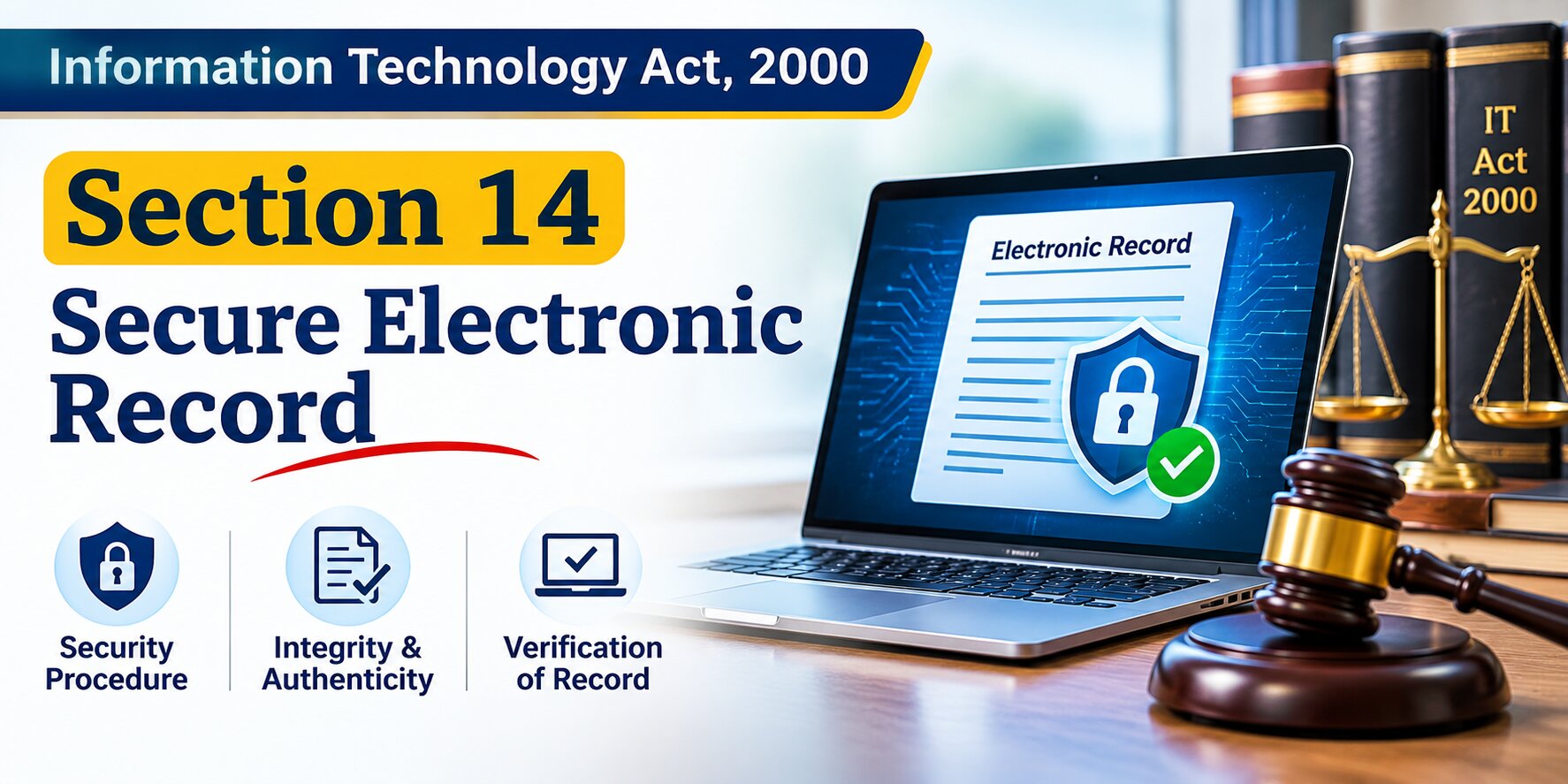
Section 14 deals with secure electronic records. Where a prescribed security procedure has been applied to an electronic record at a specific point in time, the record is treated as a secure electronic record from that point until verification.
Section 16 empowers the Government to prescribe the procedures relevant to this protection.
3. Security procedures relating to Section 15
Section 15 deals with secure electronic signatures. It requires the signature creation data to remain under the exclusive control of the signatory when the signature is affixed and to be stored and applied in the prescribed exclusive manner.
Section 16 supports this requirement by providing the framework for prescribing appropriate security practices.
4. Proviso: Commercial circumstances and nature of transactions
The proviso requires the Central Government to consider commercial circumstances, the nature of transactions and other relevant factors while prescribing security procedures.
This is important because different transactions involve different levels of security risks. A financial transaction, government filing and ordinary business communication may require different security safeguards.
Important Judgments
There are limited reported decisions directly interpreting Section 16. However, the following Supreme Court judgments are relevant to the broader principles of electronic-record security, authenticity and reliability.
1. Anvar P.V. v. P.K. Basheer (2014)
The Supreme Court examined the admissibility of electronic records under Section 65B of the Indian Evidence Act, 1872.
Relevance: The judgment highlighted the importance of safeguards when electronic records are produced as evidence, particularly because digital information can be altered or manipulated. Indian Kanoon+1
2. Arjun Panditrao Khotkar v. Kailash Kushanrao Gorantyal (2020)
The Supreme Court clarified the requirements for proving electronic records under Section 65B of the Indian Evidence Act, 1872.
Relevance: The decision reinforces the importance of proper certification and preservation of electronic evidence. It is relevant to understanding the wider importance of reliable security procedures, although it does not directly interpret Section 16. Indian Kanoon+1
Conclusion
Section 16 of the Information Technology Act, 2000, provides the Central Government with the authority to prescribe security procedures and practices for secure electronic records and electronic signatures. Its primary objective is to strengthen trust, authenticity and security in digital transactions.
By requiring consideration of commercial circumstances and the nature of transactions, the provision allows security standards to take account of different technological and business requirements.
Understanding Section 16 along with Sections 14 and 15 is essential for businesses, legal professionals and individuals dealing with electronic documents, digital signatures and online transactions.
Leave a Reply