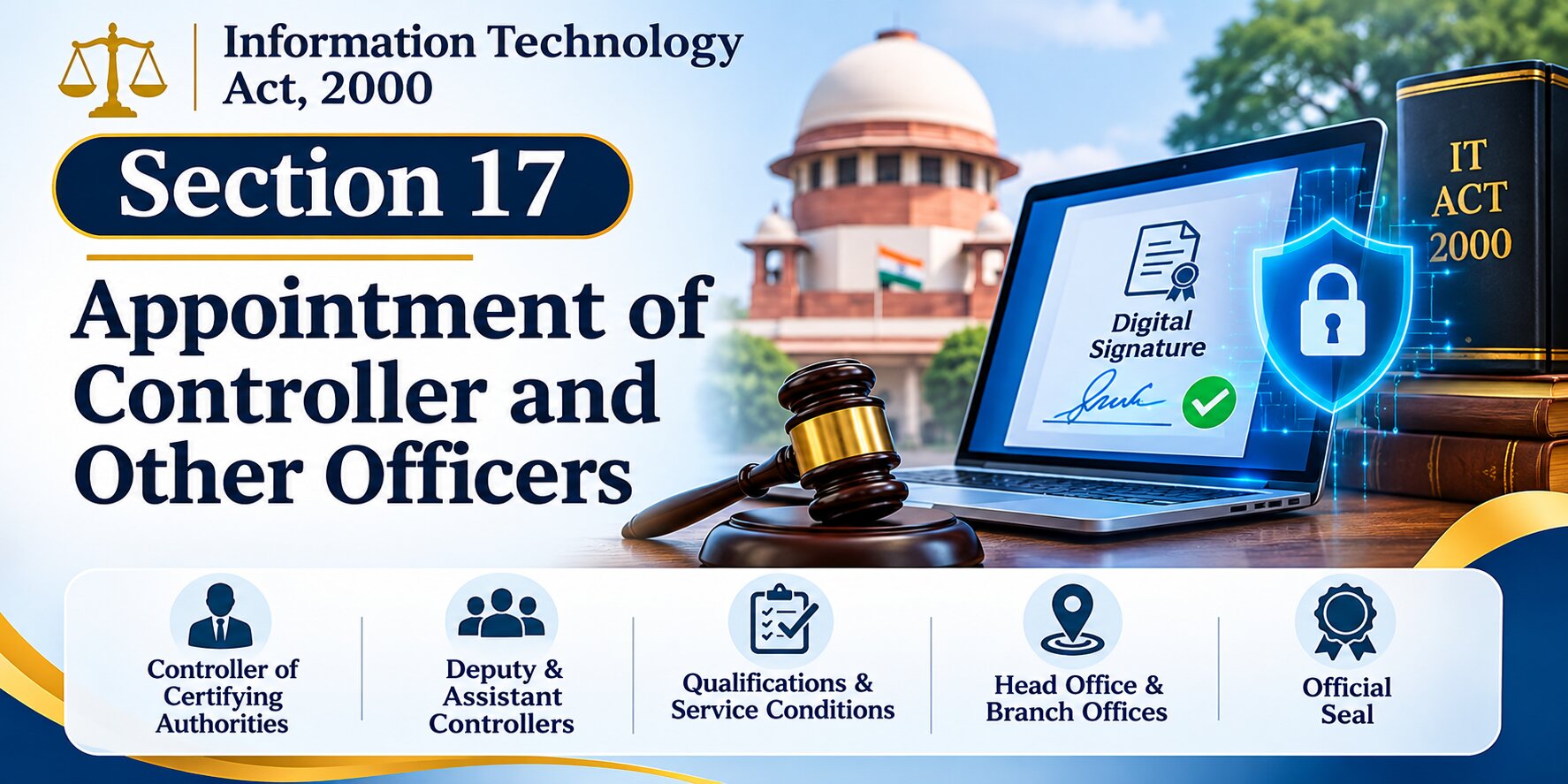
- Section 17 of IT Act 2000: Appointment of Controller and other officers
- Explained:
- Section 17(1): Appointment of Controller and Other Officers
- Section 17(2): Control and Directions of the Central Government
- Section 17(3): Functions of Deputy Controllers and Assistant Controllers
- Section 17(4): Qualifications, Experience and Conditions of Service
- Section 17(5): Head Office and Branch Offices
- Section 17(6): Official Seal of the Controller's Office
- Role and Importance of the Controller of Certifying Authorities
- Important Judgments
- Difference Between Section 17 and Section 18 of the Information Technology Act, 2000
- Other Important Sections to Read Along with Section 17
- Conclusion
Section 17 of IT Act 2000: Appointment of Controller and other officers
Section 17(1)
The Central Government may, by notification in the Official Gazette, appoint a Controller of Certifying Authorities for the purposes of this Act and may also by the same or subsequent notification appoint such number of Deputy Controllers, Assistant Controllers, other officers and employees as it deems fit.
Section 17(2)
The Controller shall discharge his functions under this Act subject to the general control and directions of the Central Government.
Section 17(3)
The Deputy Controllers and Assistant Controllers shall perform the functions assigned to them by the Controller under the general superintendence and control of the Controller.
Section 17(4)
The qualifications, experience and terms and conditions of service of Controller, Deputy Controllers and Assistant Controllers shall be such as may be prescribed by the Central Government.
Section 17(5)
The Head Office and Branch Office of the office of the Controller shall be at such places as the Central Government may specify, and these may be established at such places as the Central Government may think fit.
Section 17(6)
There shall be a seal of the office of the Controller.
Explained:
Section 17 of the Information Technology Act, 2000, is an important provision dealing with the appointment of the Controller of Certifying Authorities and other officers responsible for implementing the regulatory framework governing electronic signatures in India.
With the increasing use of digital signatures, electronic certificates and online transactions, it is necessary to have a regulatory authority that supervises the organisations issuing electronic signature certificates. The Controller of Certifying Authorities (CCA) plays an important role in maintaining confidence in India’s electronic authentication system.
Section 17 provides the legal foundation for establishing the office of the Controller, appointing supporting officers and determining their administrative structure. It also establishes the relationship between the Controller and the Central Government.
This provision falls under Chapter VI – Regulation of Certifying Authorities of the Information Technology Act, 2000. It should be read along with Sections 18, 19, 21 and 24, which deal with the functions, recognition and licensing framework of Certifying Authorities.
Section 17 contains six subsections. Each subsection establishes an important aspect of the administrative and regulatory structure of the Controller of Certifying Authorities.
Section 17(1): Appointment of Controller and Other Officers
This subsection empowers the Central Government to appoint a Controller of Certifying Authorities through a notification published in the Official Gazette.
The Central Government can also appoint Deputy Controllers, Assistant Controllers, other officers and employees through the same notification or a subsequent notification.
The main objective is to establish an appropriate administrative structure for regulating Certifying Authorities under the Information Technology Act.
For example, when electronic signature services expand and regulatory responsibilities increase, the government can appoint additional officers to support the Controller in carrying out statutory functions.
Section 17(2): Control and Directions of the Central Government
Under this subsection, the Controller performs statutory functions subject to the general control and directions of the Central Government.
This means that the Controller is not an entirely independent authority operating without governmental supervision. The Central Government exercises general administrative control and provides directions within the framework of the Act.
This arrangement helps maintain coordination between the regulatory authority and the government department responsible for electronic governance and information technology.
Section 17(3): Functions of Deputy Controllers and Assistant Controllers
This subsection explains the administrative relationship between the Controller and subordinate officers.
Deputy Controllers and Assistant Controllers perform the functions assigned to them by the Controller. They work under the general superintendence and control of the Controller.
Their responsibilities may include assisting in regulatory administration, supervising relevant activities, examining compliance matters and carrying out duties assigned under the Act.
The provision helps distribute administrative responsibilities and ensures that the Controller can perform regulatory functions effectively.
Section 17(4): Qualifications, Experience and Conditions of Service
This subsection authorises the Central Government to prescribe the qualifications, experience and service conditions of the Controller, Deputy Controllers, Assistant Controllers and other officers and employees.
It ensures that appointments and service arrangements are governed by prescribed standards rather than being left entirely to individual discretion.
The prescribed framework may address educational qualifications, professional experience, recruitment procedures, remuneration and other conditions of service.
Section 17(5): Head Office and Branch Offices
This subsection deals with the location and establishment of the office of the Controller.
The Central Government may specify the location of the Head Office and establish branch offices at places it considers appropriate.
The purpose is to provide an administrative structure capable of carrying out regulatory responsibilities and facilitating the implementation of the Act.
Section 17(6): Official Seal of the Controller’s Office
This subsection provides that there shall be a seal of the Office of the Controller.
An official seal serves as an institutional authentication mechanism for documents and official acts where its use is required or authorised.
It helps distinguish official communications and documents issued by the office from ordinary private correspondence.
Role and Importance of the Controller of Certifying Authorities
The Controller of Certifying Authorities is an important regulatory authority under the Information Technology Act, 2000. The Central Government appointed the Controller under Section 17 to regulate and supervise the functioning of Certifying Authorities.
The Office of the Controller of Certifying Authorities came into existence on 1 November 2000 and functions under the Ministry of Electronics and Information Technology.
Its regulatory framework supports the use of electronic signatures and digital certificates in India. The Controller also operates the Root Certifying Authority of India (RCAI), which forms the foundation of the country’s public key infrastructure. CCA+1
Important Judgments
There are limited reported judicial decisions directly interpreting Section 17. However, the following Supreme Court judgments provide important legal context regarding electronic records, digital transactions and technology in judicial proceedings.
1. State of Maharashtra v. Dr. Praful B. Desai (2003)
The Supreme Court considered whether evidence could be recorded through video conferencing under the criminal procedure framework.
Relevance: The judgment recognised the use of modern technology in judicial proceedings. It demonstrates how legal procedures can adapt to technological developments, although it does not directly interpret Section 17.
2. Trimex International FZE Ltd. v. Vedanta Aluminium Ltd. (2010)
The Supreme Court examined a commercial agreement formed through email communications and considered whether the electronic exchanges established a binding contract.
Relevance: The decision demonstrates the growing importance of electronic communications in commercial transactions. It provides broader context for understanding the regulatory framework governing electronic authentication under the Information Technology Act.
3. Anvar P.V. v. P.K. Basheer (2014)
The Supreme Court examined the admissibility of electronic records under Section 65B of the Indian Evidence Act, 1872.
Relevance: The judgment established important principles concerning the proof of electronic records in court proceedings. It highlights why reliable electronic authentication and proper record management are important in the digital environment.
4. Arjun Panditrao Khotkar v. Kailash Kushanrao Gorantyal (2020)
The Supreme Court clarified the requirements relating to certificates for electronic evidence under Section 65B of the Indian Evidence Act, 1872.
Relevance: The decision provides guidance on the evidentiary requirements applicable to electronic records. It is relevant to the wider legal framework governing digital documentation, although it is not a direct ruling on the appointment or administrative powers of the Controller under Section 17.
Note: The above decisions are relevant to the broader development of electronic transactions and digital evidence. They should not be cited as direct judicial interpretations of Section 17.
Difference Between Section 17 and Section 18 of the Information Technology Act, 2000
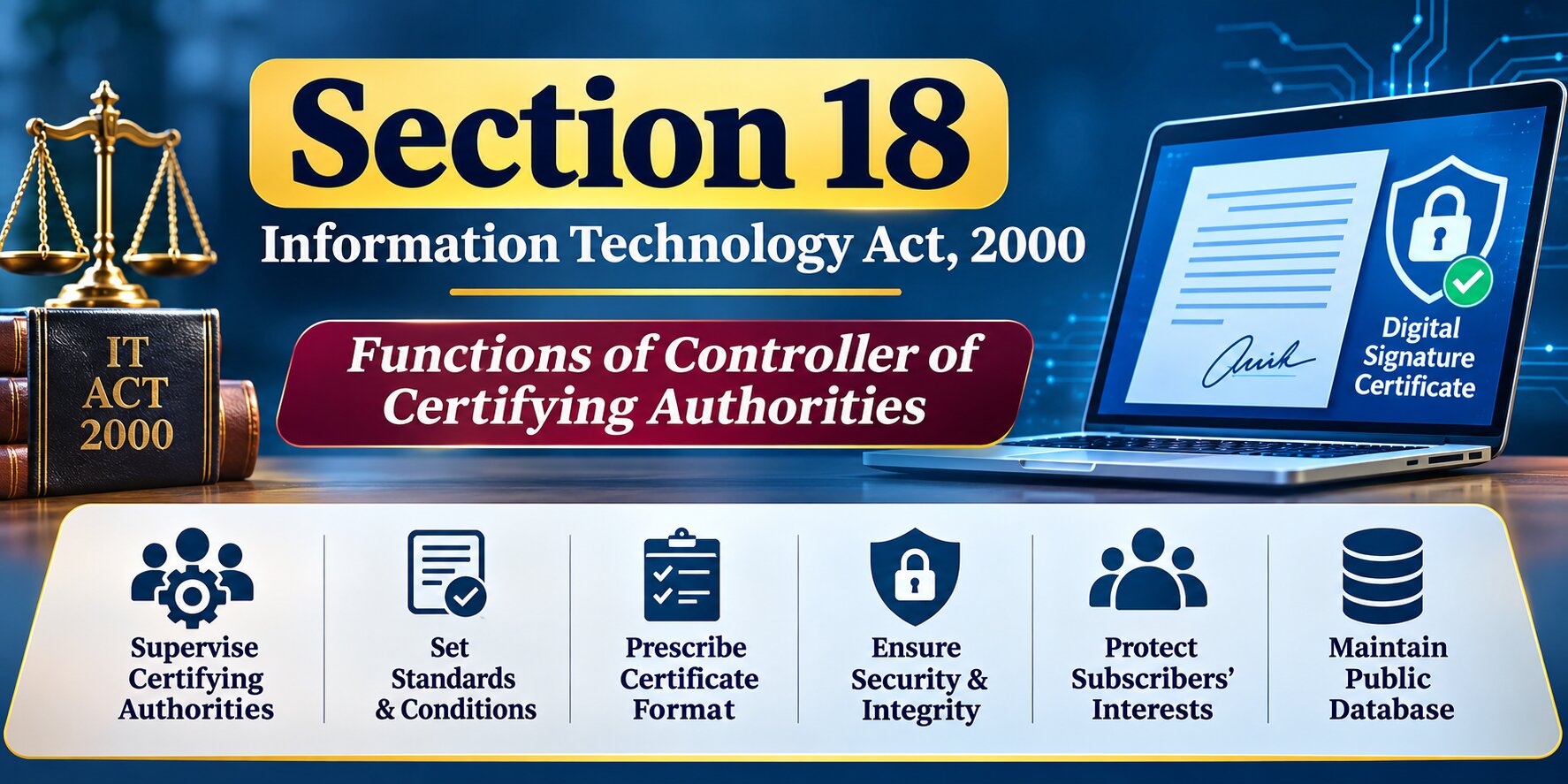
Sections 17 and 18 deal with different aspects of the Controller of Certifying Authorities.
| Section | Subject | Main purpose |
|---|---|---|
| Section 17 | Appointment of Controller and other officers | Establishes the office and administrative structure. |
| Section 18 | Functions of Controller | Specifies the regulatory functions and responsibilities of the Controller. |
Section 17 provides the institutional foundation, whereas Section 18 explains the powers and responsibilities exercised by the Controller.
Other Important Sections to Read Along with Section 17
For a better understanding of the regulation of Certifying Authorities, the following provisions are important:
- Section 18: Functions of Controller.
- Section 19: Recognition of foreign Certifying Authorities.
- Section 21: Licence to issue Electronic Signature Certificates.
- Section 24: Procedure for granting or rejecting a licence.
- Section 30: Certifying Authority to follow certain procedures.
- Section 35: Certifying Authority to issue Electronic Signature Certificate.
These provisions collectively establish the regulatory framework for electronic signature certification in India.
Conclusion
Section 17 of the Information Technology Act, 2000, provides the statutory foundation for appointing the Controller of Certifying Authorities and other supporting officers. Its six subsections establish the appointment procedure, administrative supervision, responsibilities of subordinate officers, service conditions, office locations and official seal.
The provision plays an important role in ensuring that India’s electronic signature certification system operates through an organised regulatory structure. By establishing the office of the Controller, the Act supports the supervision and regulation of Certifying Authorities and strengthens confidence in electronic authentication.
Leave a Reply