
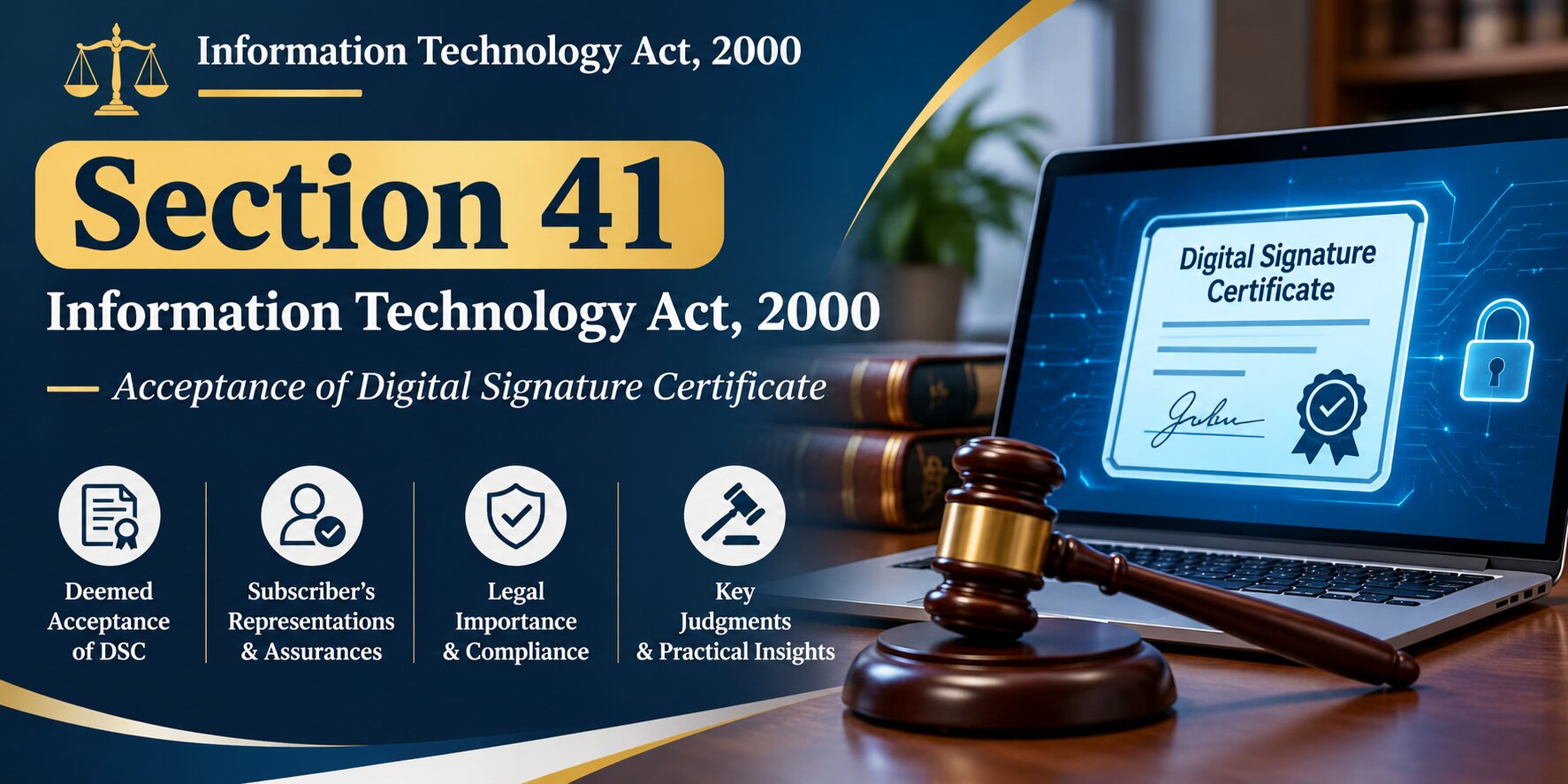
Section 41 of IT Act 2000: Acceptance of Digital Signature Certificate.
Section 41(1)
A subscriber shall be deemed to have accepted a Digital Signature Certificate if he publishes or authorises the publication of a Digital Signature Certificate—
(a) to one or more persons;
(b) in a repository; or
otherwise demonstrates his approval of the Digital Signature Certificate in any manner.
Section 41(2)
By accepting a Digital Signature Certificate the subscriber certifies to all who reasonably rely on the information contained in the Digital Signature Certificate that—
(a) the subscriber holds the private key corresponding to the public key listed in the Digital Signature Certificate and is entitled to hold the same;
(b) all representations made by the subscriber to the Certifying Authority and all material relevant to the information contained in the Digital Signature Certificate are true;
(c) all information in the Digital Signature Certificate that is within the knowledge of the subscriber is true.
Explained:
Section 41 contains two main subsections. Subsection (1) explains the circumstances in which a subscriber is legally considered to have accepted a Digital Signature Certificate. Subsection (2) describes the assurances given by the subscriber to persons who reasonably rely upon the information contained in that certificate.
1. Section 41(1) – Deemed Acceptance of Digital Signature Certificate
Section 41(1) provides that a subscriber is deemed to have accepted a Digital Signature Certificate when the subscriber publishes or authorises its publication or otherwise demonstrates approval of the certificate.
The provision identifies different ways through which acceptance may be established.
Section 41(1)(a) – Publication to one or more persons
This clause states that acceptance takes place when the subscriber publishes or authorises publication of the Digital Signature Certificate to one or more persons.
For example, when an individual provides their Digital Signature Certificate to a business organisation, government department or another authorised person for verification, such publication may demonstrate acceptance of the certificate.
The purpose is to establish that the subscriber has approved the certificate for use and that others may reasonably rely on its contents.
Section 41(1)(b) – Publication in a repository
A repository is an electronic system or database where Digital Signature Certificates and related information can be stored and made available for verification.
When a subscriber publishes or authorises publication of a certificate in a repository, the law treats this conduct as acceptance.
This mechanism helps interested persons verify digital credentials and obtain information about the certificate through an appropriate electronic source.
Other forms of demonstrating approval
Section 41(1) also covers situations where the subscriber demonstrates approval of the Digital Signature Certificate in any other manner.
This makes the provision flexible enough to cover different methods of communicating acceptance. The important consideration is whether the subscriber’s conduct demonstrates approval of the certificate.
2. Section 41(2) – Representations Made by the Subscriber
Subsection (2) explains the legal assurances given by a subscriber after accepting a Digital Signature Certificate. These assurances are important because third parties may rely on the information contained in the certificate while conducting electronic transactions.
The provision identifies three specific responsibilities.
Section 41(2)(a) – Ownership and control of the private key
The subscriber certifies that they hold the private key corresponding to the public key mentioned in the Digital Signature Certificate and are entitled to hold that key.
In digital signature technology, a public key and private key work together through cryptographic processes. The public key is included in the certificate, while the corresponding private key is used by the subscriber to create a digital signature.
This clause establishes the subscriber’s representation regarding the corresponding private key and their entitlement to possess it.
Section 41(2)(b) – Truthfulness of representations made to the Certifying Authority
This clause requires the subscriber to confirm that all representations made to the Certifying Authority and all material information relevant to the Digital Signature Certificate are true.
A Certifying Authority is an entity licensed under the Information Technology Act to issue electronic or digital signature certificates in accordance with the applicable legal requirements.
For example, when applying for a certificate, an applicant may provide identity details and other supporting information. The subscriber’s acceptance of the certificate carries an assurance regarding the truthfulness of those representations.
Section 41(2)(c) – Accuracy of information contained in the certificate
Under this clause, the subscriber certifies that all information contained in the Digital Signature Certificate, which is within the subscriber’s knowledge, is true.
This requirement promotes trust in electronic authentication systems. Individuals, companies and organisations relying on a certificate should be able to depend on the accuracy of information that the subscriber knows and has certified.
Legal Importance of Section 41
Section 41 plays an important role in maintaining trust in digital authentication systems. Its importance can be understood through the following points:
- Establishes acceptance: It clarifies the circumstances in which a subscriber is legally considered to have accepted a Digital Signature Certificate.
- Promotes authenticity: It requires the subscriber to make important representations concerning the private key and certificate information.
- Protects third parties: Persons who reasonably rely on the information in a certificate receive statutory assurances from the subscriber.
- Supports digital transactions: It provides confidence in the use of digital certificates for electronic business and administrative activities.
- Encourages accountability: It places responsibility on subscribers to ensure that the information supplied to the Certifying Authority is accurate.
Important Judgments Relating to Digital Signatures and Electronic Transactions
There are judicial decisions dealing with electronic contracts, digital records and electronic evidence that provide useful legal context for understanding Section 41. The following cases are relevant to the broader subject, although they should not be presented as direct interpretations of Section 41.
1. Trimex International FZE Ltd. v. Vedanta Aluminium Ltd. (2010)
The Supreme Court of India examined whether contractual agreements reached through email communications could create a legally binding contract.
The Court recognised that a binding agreement can arise through electronic communications when the essential requirements of contract formation are satisfied.
Relevance to Section 41: The judgment demonstrates the growing legal importance of electronic communications in commercial transactions. It supports the broader legal environment in which digital authentication and electronic documentation operate.
2. P.R. Transport Agency v. Union of India (2006)
The Allahabad High Court considered the legal significance of electronic communications in connection with a contractual dispute involving an email communication.
The decision is relevant to the recognition of electronic communications and their role in establishing legal relationships.
Relevance to Section 41: It illustrates how electronic communications can have legal consequences and why reliability and authenticity are important in digital transactions.
3. Anvar P.V. v. P.K. Basheer (2014)
The Supreme Court examined the admissibility of electronic records as evidence under Section 65B of the Indian Evidence Act, 1872.
The judgment clarified the importance of complying with statutory requirements when electronic records are produced as evidence before a court.
Relevance to Section 41: Acceptance of a Digital Signature Certificate and admissibility of an electronic record are separate legal issues. A certificate may establish important information about digital authentication, but the applicable rules of evidence must still be followed when electronic records are produced in court.
4. Arjun Panditrao Khotkar v. Kailash Kushanrao Gorantyal (2020)
The Supreme Court further clarified the requirements relating to the admissibility of electronic evidence and the certificate contemplated under Section 65B of the Indian Evidence Act.
Relevance to Section 41: This judgment highlights the importance of authenticity, reliability and proper legal procedures when electronic records are relied upon in judicial proceedings.
Judicial clarification: The above decisions concern related aspects of electronic transactions and evidence. They are not direct rulings on the interpretation of Section 41 itself.
Relationship Between Section 41 and Other Provisions of the IT Act
Section 41 should be understood along with other provisions dealing with Digital Signature Certificates and subscriber responsibilities.
| Section | Subject |
|---|---|
| Section 35 | Certifying Authority to issue Electronic Signature Certificate |
| Section 36 | Representations upon issuance of Digital Signature Certificate |
| Section 40 | Generating key pair |
| Section 40A | Duties of subscriber of Electronic Signature Certificate |
| Section 41 | Acceptance of Digital Signature Certificate |
| Section 42 | Control of private key |
Section 40 deals with the generation of a key pair, whereas Section 41 deals with acceptance of the certificate and the assurances made by the subscriber. Section 42 places an additional responsibility on subscribers to exercise reasonable care in retaining control of their private keys and preventing unauthorised disclosure.
These provisions collectively establish the legal responsibilities associated with digital authentication under the Information Technology Act, 2000.
Practical Examples of Section 41
Consider a company that obtains a Digital Signature Certificate for its authorised representative to conduct online business transactions. When the subscriber publishes or authorises publication of the certificate, the subscriber is deemed to have accepted it under Section 41(1).
Similarly, if an individual obtains a certificate by submitting identity documents and other relevant information to a Certifying Authority, acceptance of the certificate involves the assurances specified under Section 41(2).
If another person reasonably relies on the information contained in that certificate, the subscriber’s statutory representations become relevant to determining the reliability of the digital authentication.
Conclusion
Section 41 of the Information Technology Act, 2000, is an important provision governing the acceptance of Digital Signature Certificates in India. It explains how acceptance can be established through publication, authorisation or other forms of approval. It also requires subscribers to provide important assurances concerning their private keys, representations made to Certifying Authorities and the accuracy of information contained in their certificates.
By establishing these responsibilities, Section 41 strengthens confidence in electronic authentication and supports the development of secure digital transactions. Reading this provision alongside Sections 35, 36, 40, 40A and 42 provides a comprehensive understanding of the duties of subscribers under the Information Technology Act, 2000.

Leave a Reply