
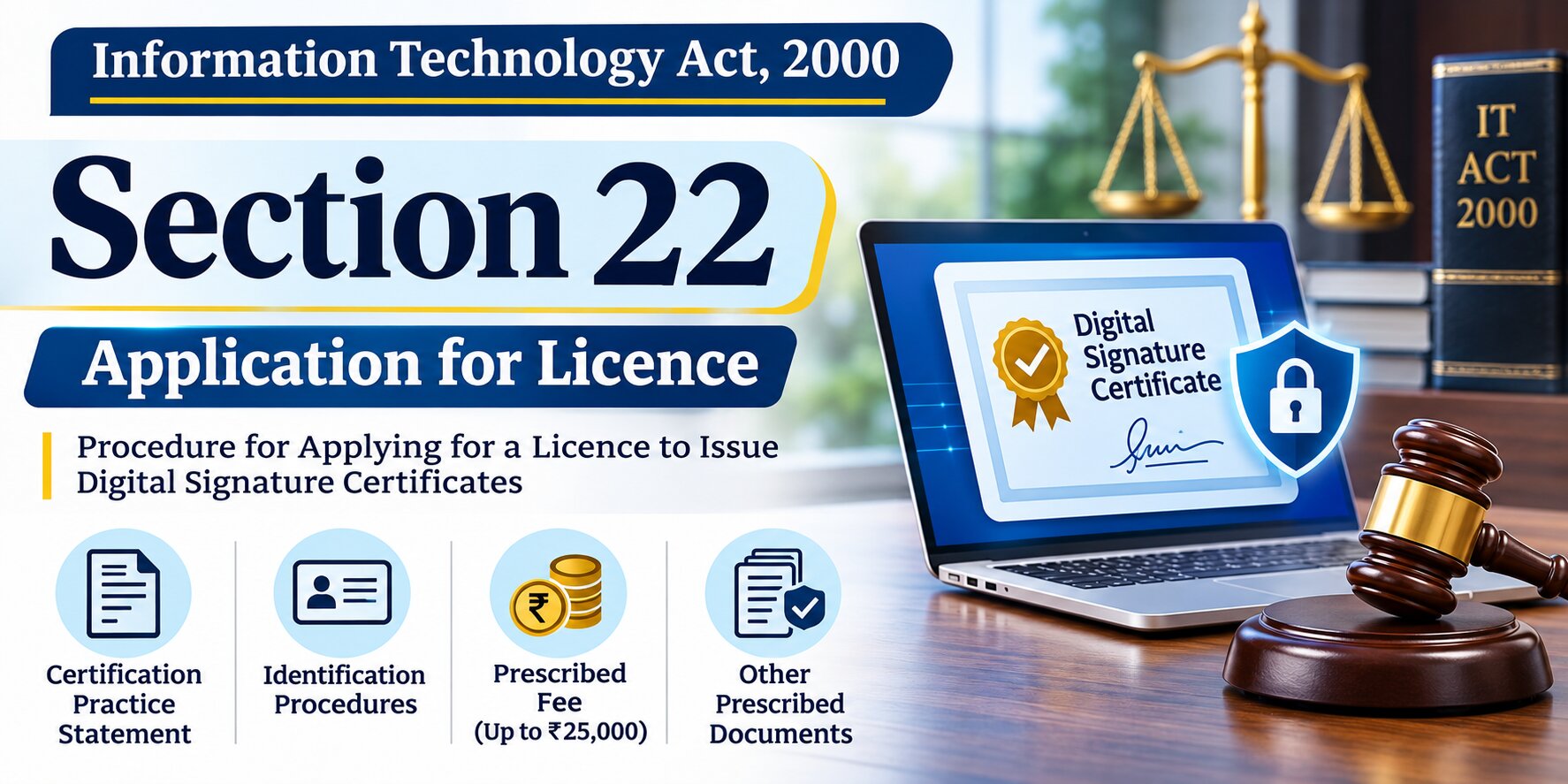
Section 22 of IT Act 2000: Application for license
Section 22(1)
Every application for issue of a licence shall be in such form as may be prescribed by the Central Government.
Section 22(2)
Every application for issue of a licence shall be accompanied by—
(a) a certification practice statement;
(b) a statement including the procedures with respect to identification of the applicant;
(c) payment of such fees, not exceeding twenty-five thousand rupees as may be prescribed by the Central Government;
(d) such other documents, as may be prescribed by the Central Government.
Explained:
Section 22 contains two subsections, with four important requirements under subsection (2). Each requirement ensures that an applicant provides the necessary information before seeking authorisation to issue electronic signature certificates.
Section 22(1): Application in the prescribed form
Subsection (1) provides that every application for the issue of a licence must be submitted in the form prescribed by the Central Government.
This means that an applicant cannot submit an informal request or an application containing incomplete information. The prescribed application format must be followed.
The purpose of this requirement is to maintain uniformity in the licensing process and ensure that the Controller of Certifying Authorities receives information in an organised manner.
For example, an organisation intending to establish a Certifying Authority must prepare its application according to the applicable prescribed form and provide the required organisational and technical particulars.
Section 22(2): Documents and requirements accompanying the application
Subsection (2) specifies the documents and payment that must accompany an application for a licence. It contains four clauses.
(a) Certification Practice Statement
A Certification Practice Statement (CPS) is a document explaining the practices and procedures followed by a Certifying Authority when issuing and managing Electronic Signature Certificates.
It generally describes the organisation’s certificate issuance procedures, authentication methods, security practices, certificate management and responsibilities.
This document is important because it enables the licensing authority to understand how the applicant intends to operate its certification services and maintain the reliability of electronic authentication.
(b) Statement containing identification procedures
The applicant must provide a statement explaining the procedures followed for identifying the applicant.
Identification is an essential part of digital authentication. Before issuing an electronic signature certificate, appropriate procedures must be followed to establish the identity of the person concerned.
These procedures help reduce impersonation, fraudulent applications and unauthorised use of electronic signature facilities.
(c) Payment of prescribed fees
Clause (c) requires the application to be accompanied by the prescribed fee.
The Act specifies that the fee must not exceed ₹25,000, and the actual amount is to be prescribed by the Central Government.
This provision establishes a statutory ceiling rather than automatically fixing every application fee at ₹25,000. Applicants must therefore check the applicable rules and fee requirements before submitting their applications.
(d) Other documents prescribed by the Central Government
Clause (d) provides flexibility to require additional documents as prescribed by the Central Government.
This is important because licensing a Certifying Authority involves technical, financial, organisational and security considerations. Additional documentation may be necessary to assess whether an applicant has the infrastructure and capability to provide reliable certification services.
The applicant must therefore comply with the applicable documentation requirements rather than relying only on the documents expressly mentioned in clauses (a), (b) and (c).
Relationship Between Section 22 and Other Provisions of the IT Act
Section 22 does not operate independently. Several other provisions establish the licensing, supervision and compliance framework for Certifying Authorities.
| Section | Subject |
|---|---|
| Section 17 | Appointment of Controller and other officers |
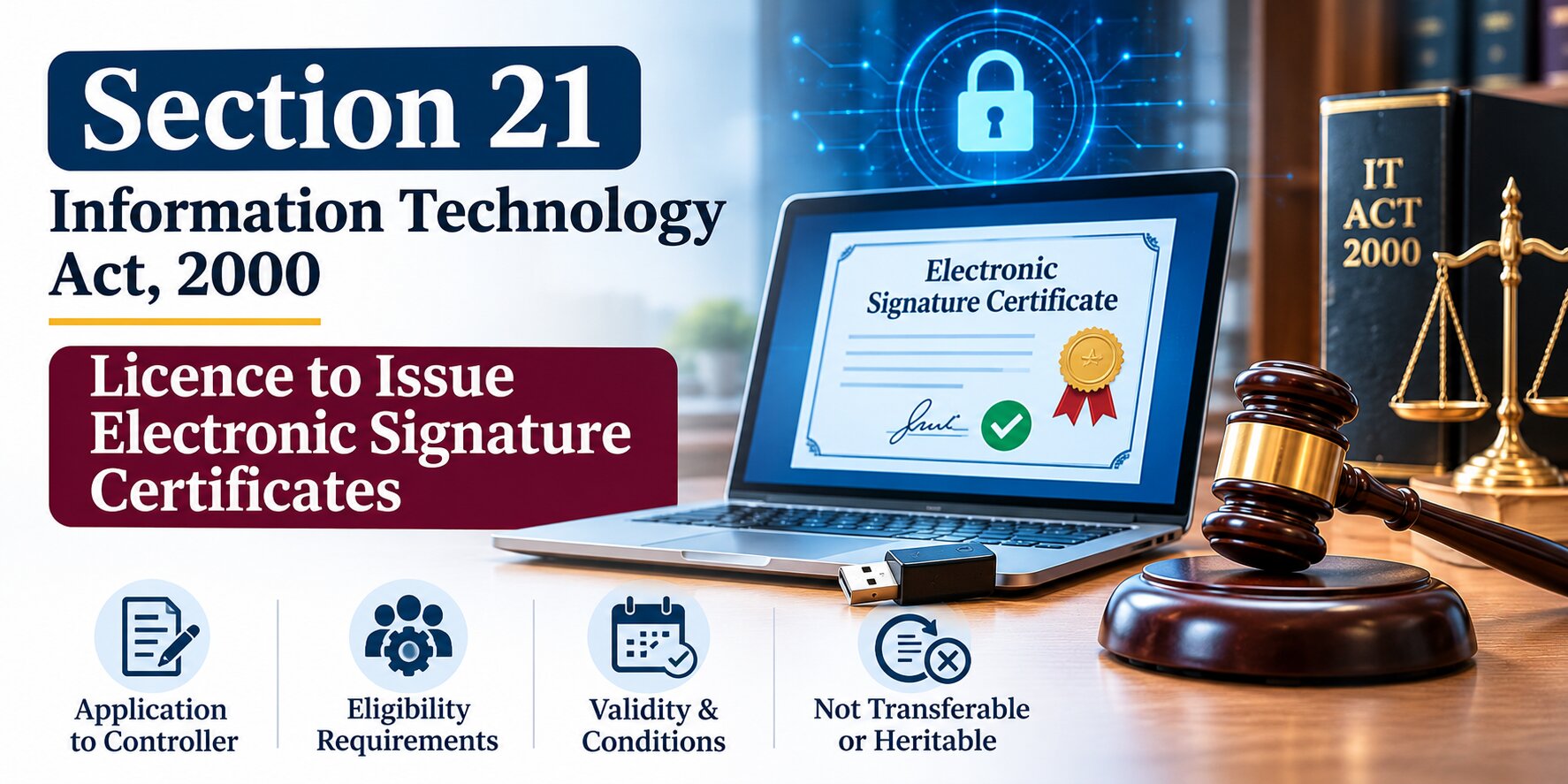
| Section 21 | Licence to issue Electronic Signature Certificates |
| Section 22 | Application for licence |
| Section 23 | Renewal of licence |
| Section 24 | Procedure for grant or rejection of licence |
| Section 25 | Suspension of licence |
| Section 26 | Notice of suspension or revocation |
| Section 30 | Procedures to be followed by Certifying Authorities |
Section 21 establishes who may apply and the eligibility requirements. Section 22 explains the application procedure. Section 24 deals with the Controller’s decision to grant or reject an application and provides an opportunity to present the applicant’s case before rejection. Section 25 addresses suspension and revocation of licences in specified circumstances. Indian Kanoon+1
Important Judgments
There is limited reported judicial interpretation directly addressing the individual clauses of Section 22. However, the following decisions provide useful legal principles concerning electronic transactions, documentary evidence and administrative decision-making.
1. State of Orissa v. Dr. (Miss) Binapani Dei (1967)
The Supreme Court emphasised that an administrative order involving civil consequences must comply with the principles of natural justice.
Relevance: This principle is important when considering licensing decisions under Section 24. An applicant whose licence application is proposed to be rejected must receive the reasonable opportunity contemplated by the statutory provision.
2. A.K. Kraipak v. Union of India (1969)
The Supreme Court explained the importance of fairness in administrative decision-making and the application of natural justice principles.
Relevance: The judgment provides broader guidance on fair administrative procedures. It is relevant to understanding why licensing authorities should exercise their statutory powers fairly and without arbitrariness.
3. Trimex International FZE Ltd. v. Vedanta Aluminium Ltd. (2010)
The Supreme Court considered whether contractual negotiations conducted through email communications could result in a binding commercial agreement.
Relevance: The decision demonstrates the legal importance of electronic transactions and communications. It provides commercial context for the regulatory framework governing electronic authentication, although it does not directly interpret Section 22.
4. Anvar P.V. v. P.K. Basheer (2014)
The Supreme Court examined the admissibility of electronic records under Section 65B of the Indian Evidence Act, 1872.
Relevance: The judgment highlights the importance of authenticity and proper handling of electronic records. It is relevant to the broader legal environment in which Certifying Authorities provide authentication services, but it is not a direct ruling on licensing applications under Section 22.
These decisions should be understood as supporting legal authorities on related principles, not as judgments establishing specific documentary requirements under Section 22.
Practical Importance of Section 22
Section 22 is important because it ensures that organisations seeking to issue electronic signature certificates follow a structured licensing process.
Its practical benefits include:
- Regulatory supervision: Licensing helps ensure that certification services operate within the statutory framework.
- Identity verification: Documented identification procedures help establish the identity of applicants and support trustworthy authentication.
- Transparency: A Certification Practice Statement explains how an applicant intends to issue and manage certificates.
- Security and reliability: Additional documentation enables the licensing authority to assess relevant technical and organisational arrangements.
- Legal accountability: The application process creates a formal record of the applicant’s representations and compliance obligations.
The Information Technology (Certifying Authorities) Rules, 2000, also provide supporting regulatory requirements concerning the operation and supervision of Certifying Authorities. MeitY+1
Difference Between Section 21 and Section 22
Section 21 and Section 22 are closely connected but serve different purposes.
Section 21 establishes the legal eligibility and requirements for obtaining a licence to issue Electronic Signature Certificates. Section 22 specifies the application form, supporting documents and prescribed fee that must accompany the application.
In simple terms, Section 21 explains the licensing entitlement and eligibility, whereas Section 22 explains how the application must be submitted.
Conclusion
Section 22 of the Information Technology Act, 2000, establishes the essential application requirements for obtaining a licence to operate as a Certifying Authority in India. By requiring a prescribed application form, Certification Practice Statement, identification procedures, payment of fees and other prescribed documents, the provision supports a structured and accountable licensing system.
The section plays an important role in maintaining confidence in electronic authentication and digital transactions. It also works alongside Sections 21, 23, 24 and 25 to ensure that Certifying Authorities remain subject to regulatory supervision.
Leave a Reply