
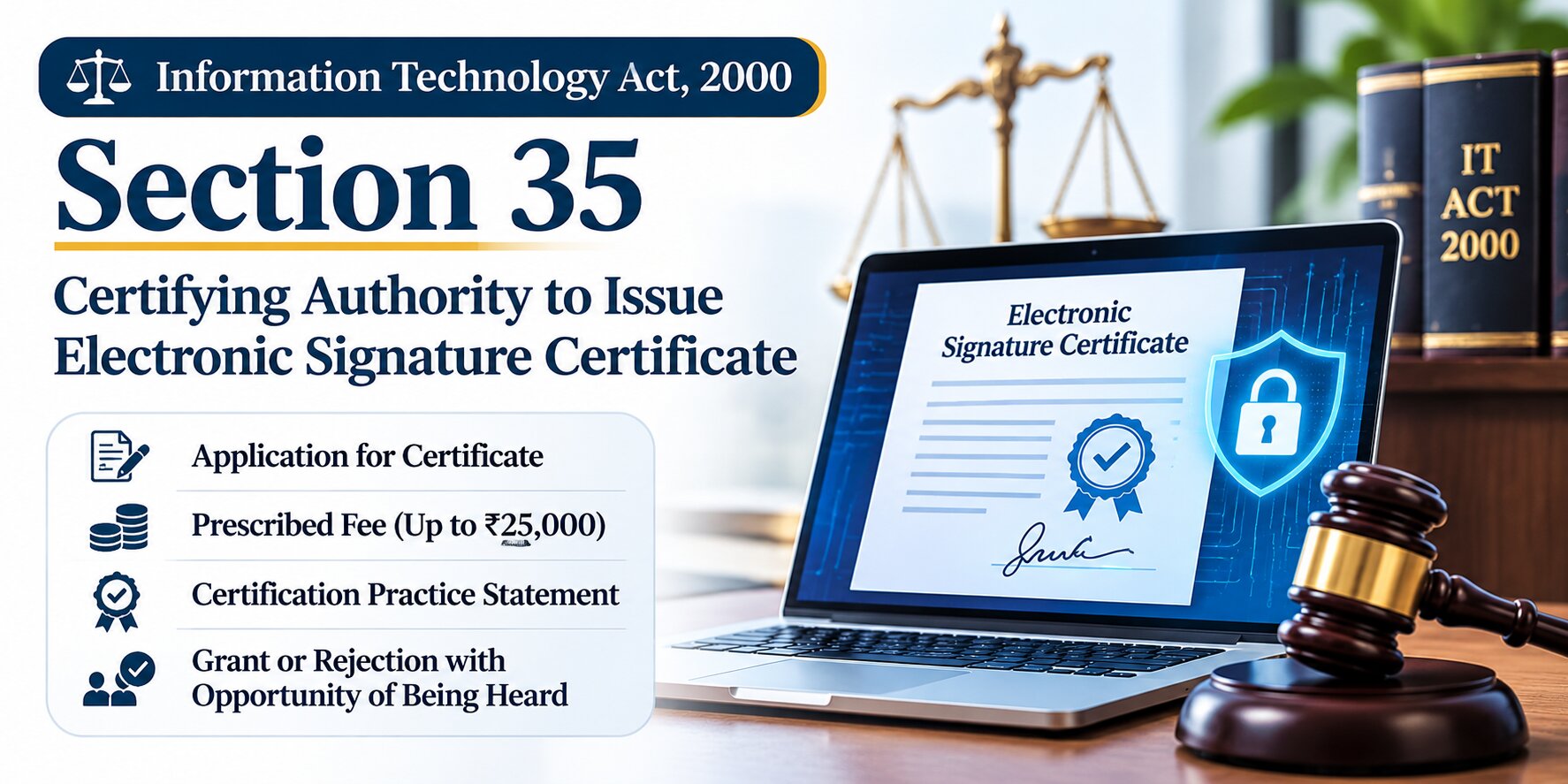
Section 35 of IT Act 2000: Certifying authority to issue [electronic signature] Certificate
Section 35(1)
Any person may make an application to the Certifying Authority for the issue of a [electronic signature] Certificate in such form as may be prescribed by the Central Government.
Section 35(2)
Every such application shall be accompanied by such fee not exceeding twenty-five thousand rupees as may be prescribed by the Central Government, to be paid to the Certifying Authority:
Provided that while prescribing fees under sub-section (2) different fees may be prescribed for different classes of applicants.
Section 35(3)
Every such application shall be accompanied by a certification practice statement or where there is no such statement, a statement containing such particulars, as may be specified by regulations.
Section 35(4)
On receipt of an application under sub-section (1), the Certifying Authority may, after consideration of the certification practice statement or the other statement under sub-section (3) and after making such enquiries as it may deem fit, grant the [electronic signature] Certificate or for reasons to be recorded in writing, reject the application:
Provided that no application shall be rejected unless the applicant has been given a reasonable opportunity of showing cause against the proposed rejection.
Explained:
Section 35(1): Application for Electronic Signature Certificate
Sub-section (1) provides that any person may apply to a Certifying Authority for obtaining an Electronic Signature Certificate.
The application must be submitted in the prescribed form and according to the procedure established by the Central Government.
For example, an individual who wants to use an electronic signature for business agreements, income tax filings or authorised government transactions may apply through an appropriate Certifying Authority.
This provision makes electronic signature certification accessible to individuals and other eligible applicants who require authenticated electronic transactions.
Section 35(2): Application Fee
Sub-section (2) requires the applicant to pay the prescribed fee along with the application.
The Act specifies that the fee must not exceed ₹25,000. The actual applicable fee is determined under the prescribed framework and should not be confused with this statutory maximum.
The proviso further allows the Central Government to prescribe different fees for different classes of applicants.
For example, the prescribed charges may differ depending on the applicant category or the type of certificate being requested.
Section 35(3): Certification Practice Statement
Sub-section (3) requires every application to be accompanied by a Certification Practice Statement.
A Certification Practice Statement describes the practices, procedures and standards followed by a Certifying Authority while issuing and managing electronic signature certificates.
It provides information about the certification process, authentication procedures, security measures and other relevant operational requirements.
Where no Certification Practice Statement exists, the applicant must provide another statement containing the particulars specified by regulations.
This requirement promotes transparency and helps the Certifying Authority assess whether the proposed certification arrangements comply with the applicable regulatory framework.
Section 35(4): Grant or Rejection of Application
Sub-section (4) explains how a Certifying Authority must deal with an application after receiving it.
The authority may examine the Certification Practice Statement or alternative statement and conduct any additional enquiries it considers necessary.
After completing its examination, the Certifying Authority may:
- Grant the Electronic Signature Certificate if the application satisfies the applicable requirements.
- Reject the application if sufficient legal or technical grounds justify rejection.
- Record reasons in writing when rejecting an application.
The requirement to record reasons promotes accountability and helps the applicant understand why the application has not been accepted.
Proviso to Section 35(4): Reasonable Opportunity of Being Heard
The proviso provides an important procedural safeguard. A Certifying Authority cannot reject an application without first giving the applicant a reasonable opportunity to show cause against the proposed rejection.
This means the applicant must be given an opportunity to explain the circumstances, clarify deficiencies or respond to concerns raised by the authority.
The provision reflects the principle of natural justice, particularly the right to be heard before an adverse decision is taken.
Importance of Section 35 in Digital Transactions
Section 35 plays an important role in establishing trust in India’s electronic authentication system. Its practical significance can be understood through the following examples.
1. Online government services: Electronic Signature Certificates are useful for authorised government portals where individuals and businesses are required to authenticate applications, declarations and official documents.
2. Income Tax and GST filings: Electronic authentication is widely used in tax-related online compliance. Eligible taxpayers and professionals may use permitted electronic signature methods to authenticate filings.
3. Corporate documentation: Companies can use electronic signatures for permitted corporate documents, business approvals and regulatory submissions, subject to the applicable requirements.
4. Electronic agreements: Electronic Signature Certificates help authenticate documents exchanged between parties and support the reliability of electronic business transactions.
5. Secure digital communication: Certificate-based authentication helps establish the identity of the certificate holder and supports confidence in electronic communications.
Important Judgments
There are limited reported judicial decisions directly interpreting the individual requirements of Section 35. However, the following Supreme Court judgments provide useful legal context regarding electronic transactions, electronic documents and their evidentiary treatment.
1. Trimex International FZE Ltd. v. Vedanta Aluminium Ltd. (2010)
The Supreme Court considered whether contractual negotiations conducted through email communications could result in a legally binding agreement.
The Court recognised that an agreement may be concluded through electronic communications when the essential requirements of a valid contract are satisfied.
Relevance to Section 35: The judgment demonstrates the growing legal importance of electronic transactions and communications. Although it does not directly interpret Section 35, it provides useful context for understanding the role of electronic authentication in commercial dealings.
2. Anvar P.V. v. P.K. Basheer (2014)
The Supreme Court examined the admissibility of electronic records under Section 65B of the Indian Evidence Act, 1872.
The judgment clarified that electronic records must satisfy the applicable statutory requirements before being admitted as evidence.
Relevance to Section 35: An Electronic Signature Certificate may assist in establishing the authenticity of an electronic document. However, the existence of such a certificate does not automatically establish that every electronic record is admissible in court. Authentication and evidentiary admissibility are separate legal questions.
3. Arjun Panditrao Khotkar v. Kailash Kushanrao Gorantyal (2020)
The Supreme Court further clarified the requirements for producing electronic evidence under Section 65B of the Indian Evidence Act, 1872, including the importance of the prescribed certificate.
Relevance to Section 35: This decision highlights the importance of maintaining reliable electronic records and following the applicable legal requirements when electronic documents are presented in judicial proceedings.
For proceedings governed by the current evidence framework, the Bharatiya Sakshya Adhiniyam, 2023, must also be considered.
4. State of Maharashtra v. Dr. Praful B. Desai (2003)
The Supreme Court recognised the use of video conferencing for recording evidence in judicial proceedings.
Relevance to Section 35: The decision illustrates the judiciary’s acceptance of technology in legal and administrative processes. It provides broader context for the development of digital procedures, although it does not directly decide the requirements for issuing Electronic Signature Certificates.
These decisions should be treated as related authorities on electronic transactions and evidence, not as judgments specifically deciding the interpretation of Section 35.
Difference Between Sections 35, 36, 37 and 38
The provisions in Chapter VII perform different functions in the lifecycle of an Electronic Signature Certificate.
| Section | Subject matter |
|---|---|
| Section 35 | Application for and issuance of an Electronic Signature Certificate |
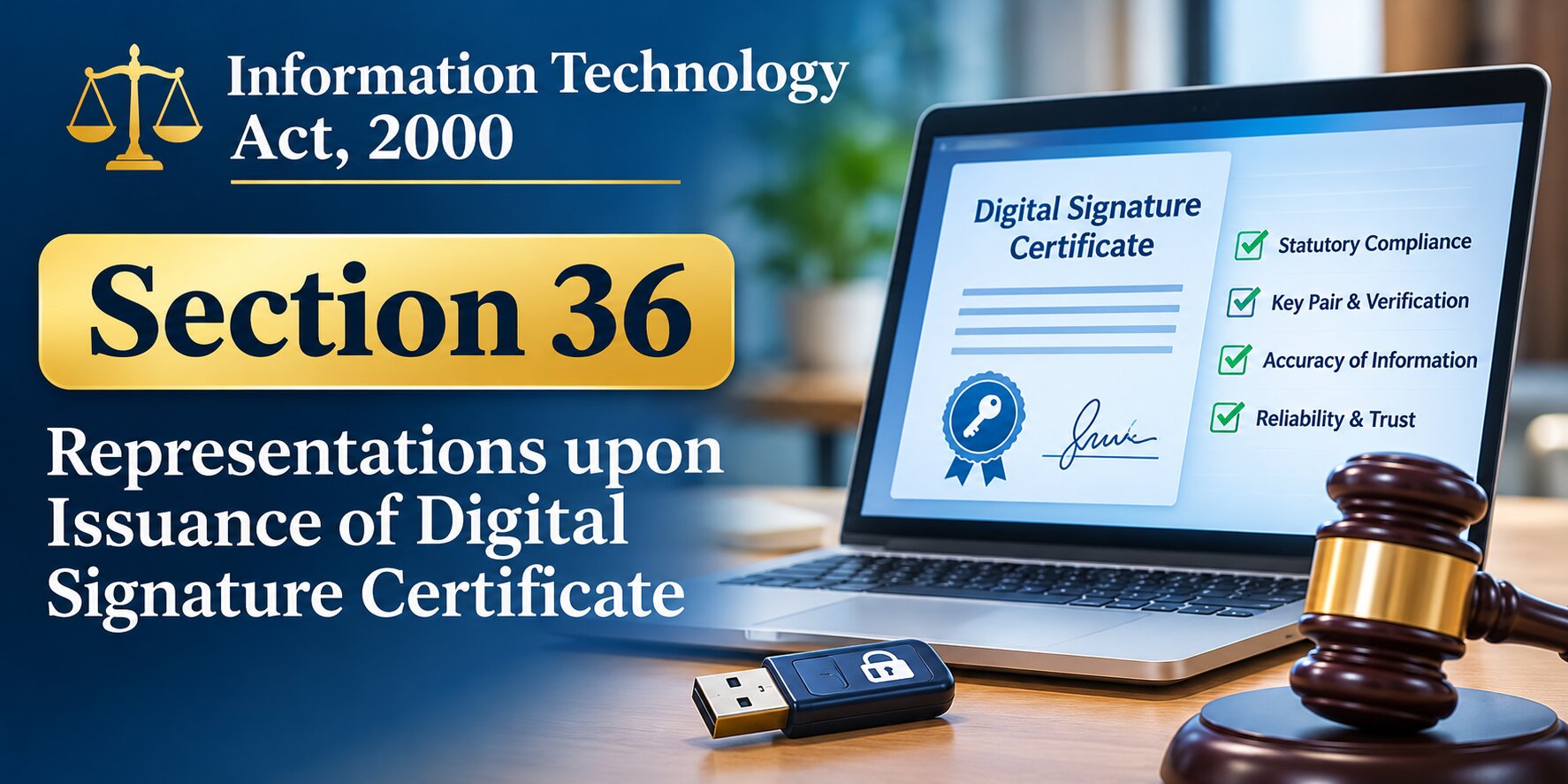
| Section 36 | Representations made by the Certifying Authority upon issuance |
| Section 37 | Suspension of an Electronic Signature Certificate |
| Section 38 | Revocation of an Electronic Signature Certificate |
Section 35 deals with obtaining the certificate, whereas the subsequent provisions regulate the representations made upon issuance and circumstances affecting the certificate’s continued validity.
Conclusion
Section 35 of the Information Technology Act, 2000, provides the legal foundation for obtaining Electronic Signature Certificates in India. It establishes the application procedure, prescribed fee requirements, submission of certification-related information and the authority’s responsibility to examine applications before making a decision.
The provision also protects applicants against arbitrary rejection by requiring the Certifying Authority to provide a reasonable opportunity to show cause before rejecting an application.
For individuals, businesses, companies and professionals involved in electronic transactions, understanding Section 35 is important for ensuring proper electronic authentication and compliance with the applicable legal framework.
When read together with Sections 30, 34, 36, 37 and 38, this provision forms part of the broader statutory framework governing Certifying Authorities and Electronic Signature Certificates in India.

Leave a Reply