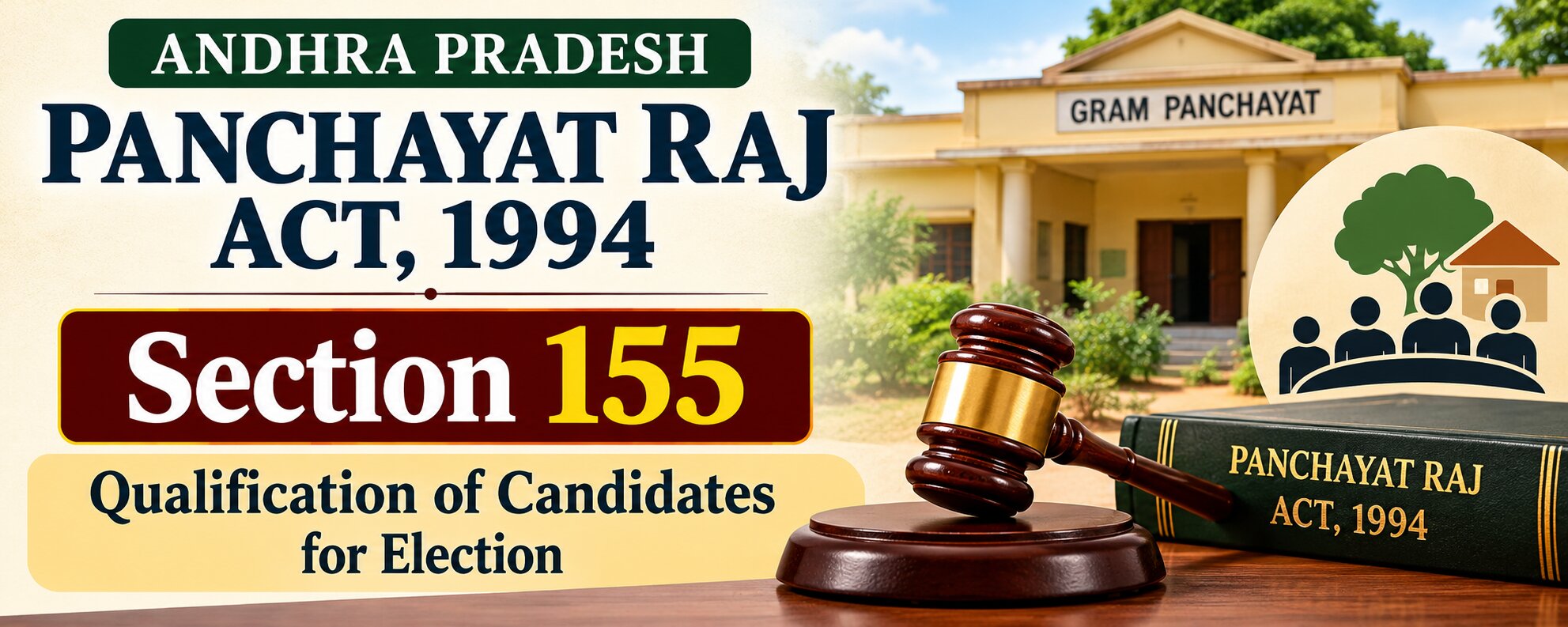
Section 155: Qualification of candidates for election
No person shall be eligible for election as member of a Mandal Praja Parishad unless his name appears in the electoral roll of the Mandal Praja Parishads concerned and he has completed the age of twenty-one years.
Explained:
Section 155 contains a single substantive provision rather than multiple numbered sub-sections. Its requirements should therefore be understood by examining the two eligibility conditions separately.
1. Name Must Appear in the Electoral Roll
The first requirement is that the candidate’s name must appear in the electoral roll of the concerned Mandal Praja Parishad.
An electoral roll is the official list of registered voters maintained under the applicable election laws. It establishes the person’s registration as an elector in the relevant electoral jurisdiction.
This requirement ensures that a candidate seeking membership satisfies the prescribed electoral registration condition. A person who is otherwise well known in the village or has considerable public support cannot disregard this statutory requirement.
For example, if a person wishes to contest an election as a member of a Mandal Praja Parishad, the relevant electoral roll must contain that person’s name as required by Section 155. Merely owning property in the area, residing nearby, or having relatives who are registered voters does not automatically satisfy the condition.
The electoral roll requirement must be considered in conjunction with the applicable election rules and the provisions governing the relevant constituency. Whether a particular electoral registration satisfies the requirement should be determined from the current statutory text and official election records.
2. Minimum Age of Twenty-One Years
The second condition under Section 155 is that the candidate must have completed 21 years of age.
The word “completed” is important. It means that a person who is still 20 years old does not satisfy the age requirement merely because they will turn 21 shortly after the relevant date.
The applicable rules governing the election must be consulted to establish the legally relevant date for determining age and eligibility.
This requirement provides a uniform minimum age for membership of the Mandal Praja Parishad. It also distinguishes the eligibility conditions for this local government office from those applicable to other elected offices, which may have different minimum age requirements.
For instance, a candidate who has completed 21 years of age and satisfies the electoral roll requirement meets the two express qualifications specified in Section 155. However, this does not automatically establish complete eligibility if another provision of the Act imposes a disqualification or an additional applicable requirement.
Important Judgments Relating to Section 155
Sarihaddu Ramya v. Gudivada Rural Mandal Parishad and Others (2005)
In Sarihaddu Ramya v. Gudivada Rural Mandal Parishad and Others, W.P. No. 20587 of 2004, decided on 24 January 2005, the Andhra Pradesh High Court considered issues connected with the eligibility of an elected representative under Section 155.
The case discussed the minimum age requirement and the statutory process for challenging an election. The judgment recognised that failure to meet the prescribed age qualification can constitute a valid ground for questioning the election of a returned candidate. It also addressed the significance of Section 233, which provides for challenging elections through an election petition under the prescribed procedure.
The practical lesson is that an allegation of ineligibility must be pursued through the legally appropriate procedure. A person who believes that an elected candidate was below the prescribed age should collect relevant evidence and consider the applicable election petition requirements.
Chirala Goverdhanareddy v. Election Tribunal, Bapatla and Others (1967)
In Chirala Goverdhanareddy v. Election Tribunal, Bapatla and Others, decided on 27 December 1967, the Andhra Pradesh High Court considered whether an election tribunal could examine a candidate’s age to determine eligibility on the date of nomination.
Although this case arose under earlier election legislation, it provides historical judicial context for disputes concerning age qualifications and election tribunals. It should not be treated as a direct interpretation of Section 155 of the 1994 Act. The governing statutory provisions and subsequent judicial developments must be examined when applying its principles to a present-day dispute.
Application of Section 155
Consider a situation in which a candidate contests an MPTC election despite not having completed 21 years of age on the legally relevant date. If reliable records establish the shortfall, the candidate’s eligibility may be challenged under the applicable election law.
Similarly, a person whose name does not satisfy the electoral roll requirement cannot assume that other personal qualifications will compensate for that deficiency.
Anyone considering an election challenge should verify the candidate’s date of birth, relevant electoral records, nomination documents and the applicable procedural deadlines. The proper forum and available remedies depend on the facts and the legislation governing the election.
Conclusion
Section 155 of the Andhra Pradesh Panchayat Raj Act, 1994 establishes two essential qualifications for election as a member of a Mandal Praja Parishad: inclusion of the candidate’s name in the concerned electoral roll and completion of 21 years of age. These conditions provide a clear statutory standard for determining basic eligibility.
The provision must be read alongside the Act’s election and disqualification provisions. Judicial decisions, including Sarihaddu Ramya, illustrate why age eligibility and the prescribed election petition procedure can be important in local government disputes.
Leave a Reply