
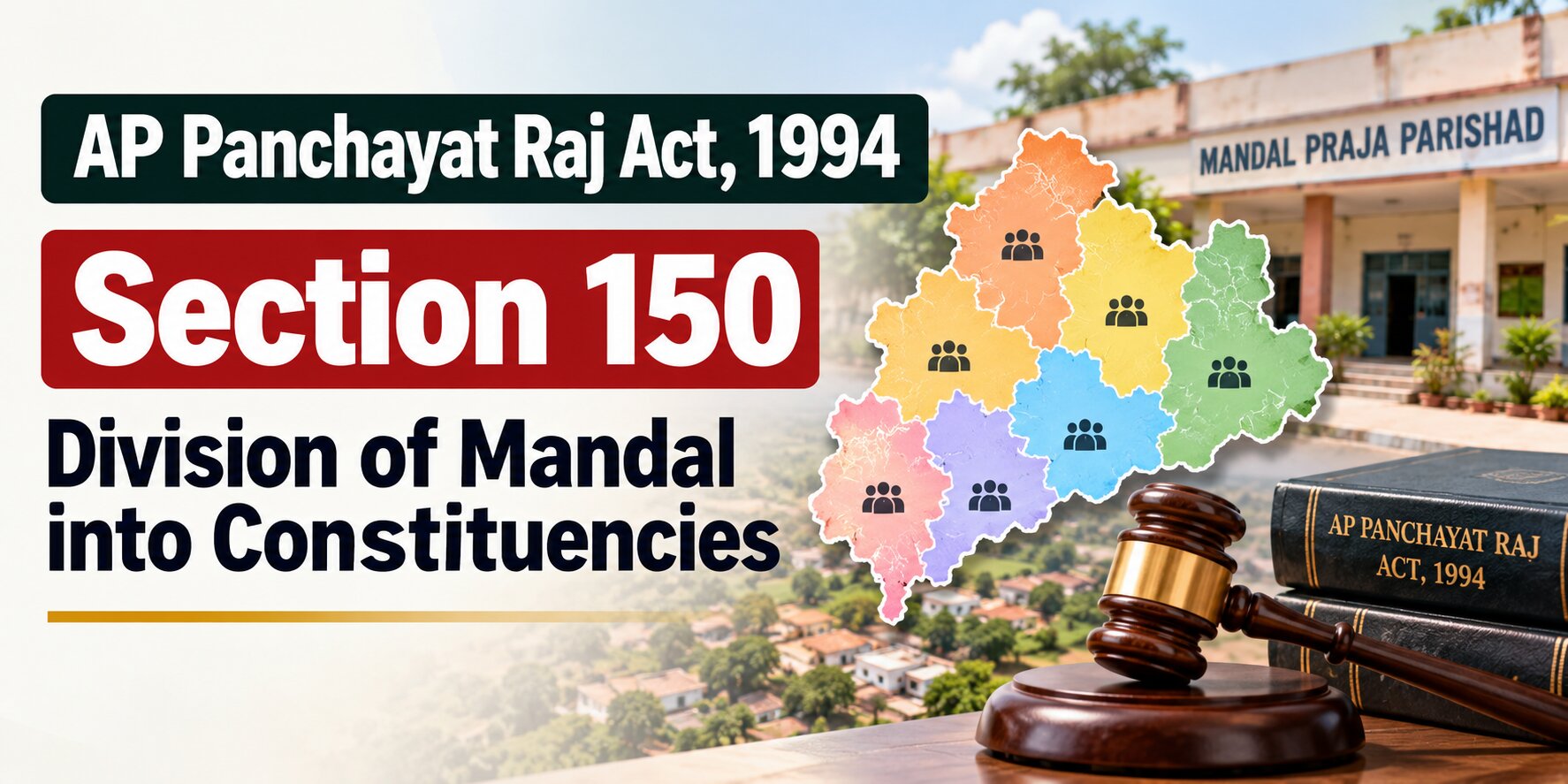
Section 150: Division of Mandal into constituencies:
For the purpose of electing the members specified in clause (i) of sub-section (1) of section 149, the Commissioner shall, subject to such rules as may be made in this behalf, divide each Mandal Parishad area into as many territorial constituencies as he may, by notification specify; in such manner that, as far as practicable, shall consist of a population ranging between three thousand and four thousand; and that the ratio between the population of each constituency and the number of seats allotted to it shall, as far as practicable, be the same throughout the Mandal Parishad area:
Provided that the ratio between the population of the territorial area of a Mandal Parishad and the number of seats in such Parishad to be filled by election shall, as far as practicable, be the same throughout the State.
Explained:
1. Authority to divide Mandal areas into constituencies
Section 150 empowers the Commissioner to divide each Mandal Praja Parishad area into territorial constituencies. This division is necessary to establish the geographical units from which elected members will represent local communities.
The Commissioner must act according to the rules prescribed under the Act and specify the constituencies through an official notification. Therefore, delimitation is a statutory process rather than an informal administrative arrangement.
2. Population range of 3,000 to 4,000
The section provides that each territorial constituency should, as far as practicable, have a population ranging between 3,000 and 4,000. This guideline seeks to prevent significant differences in population among constituencies.
For example, if one constituency has a substantially larger population than another, residents of the larger constituency may have comparatively less representation per person. Maintaining a reasonable population balance helps promote fair electoral representation.
However, the expression “as far as practicable” recognises that achieving an exact population range may not always be possible in every situation.
3. Equal population-to-seat ratio
Section 150 also requires the population-to-seat ratio to remain, as far as practicable, uniform throughout the Mandal Praja Parishad area. This principle aims to ensure that each elected member represents a reasonably comparable number of people.
4. Statewide uniformity under the proviso
The proviso extends the principle of proportional representation across Andhra Pradesh. As far as practicable, the relationship between a Mandal Praja Parishad’s population and its elected seats should be consistent throughout the State.
This provision seeks to promote fairness not only within individual Mandals but also between different Mandal-level local bodies.
Relationship with Other Sections
- Section 149: Explains the composition of the Mandal Praja Parishad and identifies the elected members covered by Section 150.
- Section 151: Provides for the election of one member from each territorial constituency through secret ballot.
- Section 152: Deals with reservation of seats for members of the Mandal Praja Parishad.
Read together, these provisions establish the framework for constituency formation, election and representation.
Important Court Judgments
1. Narina Venkata Satyanarayana v. State of Andhra Pradesh (2020)
In this Andhra Pradesh High Court matter, the petitioner challenged aspects of the number of Mandal Parishad Territorial Constituencies (MPTCs) following changes in the population of Elamanchili Mandal after certain Gram Panchayats were merged into Palakol Municipality.
The judgment discussed the relevance of Section 150, Section 268 and G.O.Ms.No.877 dated 3 December 1994 in determining the number of territorial constituencies with reference to population. The case illustrates why changes in territorial boundaries and population figures can become important in constituency delimitation disputes.
2. Kishorchandra Chhanganlal Rathod v. Union of India (2024)
In this Supreme Court decision, reported as 2024 INSC 579, the Court considered whether the exercise of statutory powers in constituency delimitation was entirely beyond judicial review under Article 226 of the Constitution.
The Court explained that constitutional restrictions on judicial scrutiny of delimitation do not automatically exclude review of every action taken during the process. The judgment concerns delimitation under the Delimitation Act and the constitutional framework for legislative constituencies, rather than a direct interpretation of Section 150 of the Andhra Pradesh Panchayat Raj Act. Its broader discussion may nevertheless be relevant when examining questions about administrative legality and judicial review.
Conclusion
Section 150 of the Andhra Pradesh Panchayat Raj Act, 1994, provides an important legal foundation for dividing Mandal Praja Parishad areas into territorial constituencies. Its principal objectives are to maintain reasonable population distribution, promote equality in electoral representation and establish a clear statutory basis for electing Mandal-level representatives.
For citizens, candidates and legal practitioners, understanding this provision is useful when examining constituency boundaries, population calculations, the number of MPTCs and the legality of delimitation notifications. Any specific dispute should be assessed against the applicable statutory amendments, prescribed rules, official notifications and relevant judicial decisions.


Leave a Reply