
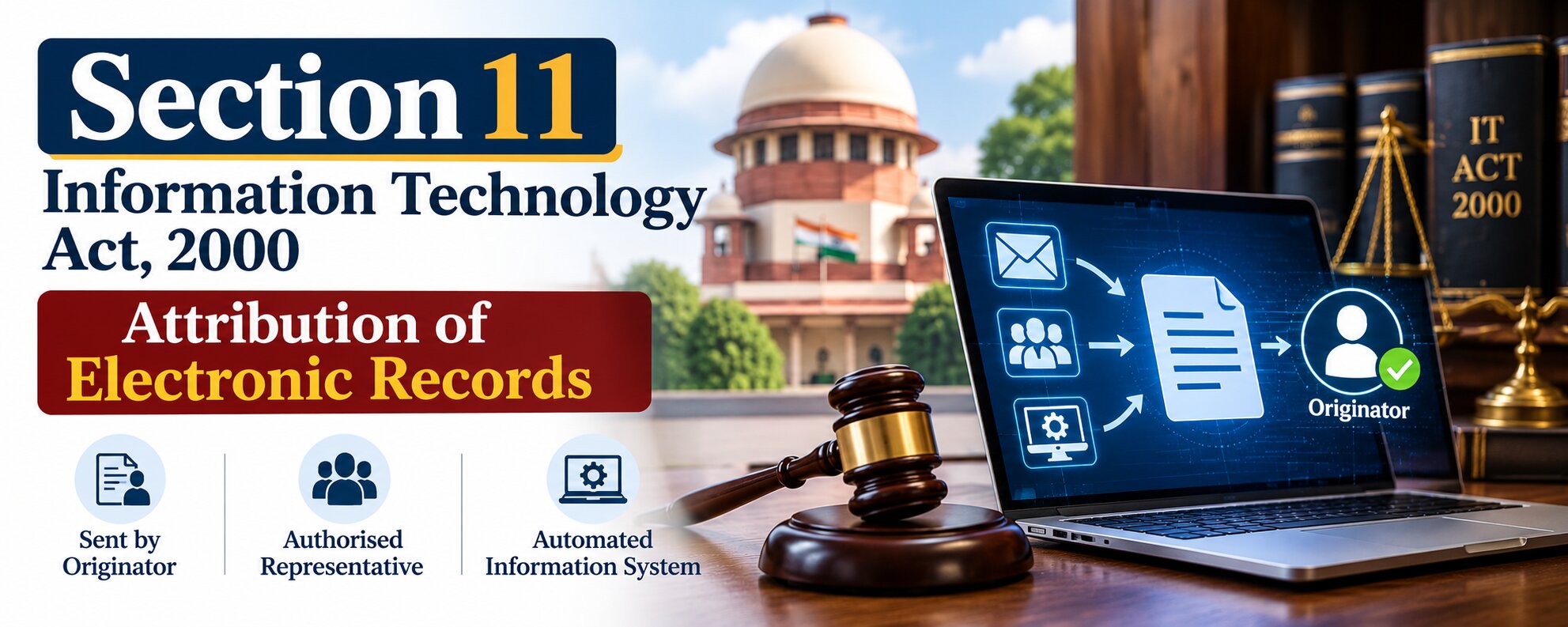
Section 11 of IT Act 2000: Attribution of Electronic Records
An electronic record shall be attributed to the originator—
(a) if it was sent by the originator himself;
(b) by a person who had the authority to act on behalf of the originator in respect of that electronic record; or
(c) by an information system programmed by or on behalf of the originator to operate automatically.
Explained:
The primary objective of Section 11 is to establish the legal connection between an electronic record and the person from whom it is considered to have originated.
Under the Information Technology Act, 2000, the term “originator” refers broadly to a person who sends, generates, stores or transmits an electronic message, or causes an electronic message to be sent, generated, stored or transmitted to another person. An intermediary is excluded from this definition.
The provision recognises three important situations.
Clause (a): Electronic record sent by the originator himself
Clause (a) states that an electronic record shall be attributed to the originator if it was sent by the originator himself.
This is the simplest situation covered by Section 11. Where an individual personally sends an email, submits an electronic application or transmits a business communication, the electronic record may be attributed to that individual.
For example, if a business owner sends an electronic purchase order to a supplier using an authorised business account, the communication may be attributed to the business owner, subject to the facts and supporting evidence.
However, the mere appearance of a person’s name or email address does not conclusively establish that the person actually sent the communication. Questions concerning account access, identity theft, unauthorised use and authenticity may still require examination.
Clause (b): Electronic record sent by an authorised person
Clause (b) covers situations where an electronic record is sent by a person who has authority to act on behalf of the originator in relation to that particular record.
In modern organisations, directors, employees, representatives and authorised agents regularly communicate with customers, suppliers and government departments on behalf of their organisations.
For example, a company’s authorised employee may submit an electronic tax-related document or send a contractual communication on behalf of the company. Where the employee has the necessary authority, the electronic record may be attributed to the company.
The important consideration is the existence and scope of authority. A person cannot automatically bind another individual or organisation merely because they have access to an email account or computer system.
Clause (c): Electronic record generated by an automated information system
Clause (c) deals with electronic records generated or transmitted by an information system programmed by or on behalf of the originator to operate automatically.
This clause is especially relevant in modern digital commerce because many transactions take place without direct human involvement at the moment the electronic record is generated.
Examples include:
- Automated email confirmations after online purchases.
- Computer-generated invoices and payment receipts.
- Automatic order confirmations from e-commerce platforms.
- Banking transaction alerts.
- Automated booking confirmations.
- Electronic notifications generated by business software.
For example, when a customer purchases a product through an online platform, the system may automatically generate an order confirmation. Under the appropriate circumstances, that electronic record can be attributed to the person or organisation on whose behalf the system was programmed to operate.
This provision recognises the legal importance of automated electronic communications in commercial activities.
Importance of Section 11 in Electronic Transactions
Section 11 has practical importance because electronic communications are now widely used in commercial, administrative and personal activities.
1. Electronic contracts: When parties negotiate and exchange contractual documents through email or other electronic systems, Section 11 helps determine the origin of the relevant communications.
2. Online banking: Automated transaction notifications, payment confirmations and other electronic communications may be attributed to the relevant financial institution or system operator, depending on the circumstances.
3. E-commerce transactions: Online shopping platforms generate invoices, order confirmations and delivery notifications automatically. Clause (c) provides an important legal basis for understanding such automated communications.
4. Corporate communications: Employees and authorised representatives regularly send electronic documents on behalf of companies. Clause (b) helps determine when those communications can be attributed to the organisation.
5. Cybercrime investigations: Where an electronic communication is disputed, questions of authorship, account access, authority and system operation become important. Section 11 provides a framework for examining attribution, although it does not by itself establish criminal liability.
Important Judgments
The following judicial decisions are useful for understanding electronic records, attribution and the legal treatment of digital communications. Some directly refer to Section 11, while others explain related principles.
1. M/s Axiom Gen Nxt India Private Limited v. Commercial State Tax Officer (Madras High Court, 2025)
This case concerned service of notices under the GST framework through the common electronic portal and the legal implications of making communications available electronically.
Relevance: The dispute illustrates the importance of identifying the electronic system through which official communications are issued and determining the legal consequences of electronic service. It is relevant to the broader subject of electronic communication and attribution, although the precise statutory issue arose under the GST legislation. Information Technology Act, 2000
2. Prashant Prakash Nilawar v. [Revenue Authorities] (Income Tax Appellate Tribunal, Mumbai, 2025)
In an order concerning ITA Nos. 5689 and 5073/MUM/2024, the Tribunal discussed Section 11 while examining electronic images and sheets recovered from mobile phones belonging to concerned persons or third parties.
The Tribunal considered whether electronic records could automatically be attributed to the assessee without sufficient supporting material.
Relevance: The decision highlights an important principle: the mere discovery or possession of an electronic record does not automatically establish that a particular person originated or transmitted it. Attribution must be examined in light of the statutory conditions and the available evidence. Income Tax Appellate Tribunal
3. Trimex International FZE Ltd. v. Vedanta Aluminium Ltd. (2010)
The Supreme Court considered whether contractual negotiations conducted through email communications could result in a binding agreement.
The Court recognised that a contract can be concluded through electronic communications when the essential elements of a valid agreement are established.
Relevance: This judgment demonstrates the importance of electronic communications in commercial transactions. Although it is not a direct interpretation of Section 11, it provides useful context for understanding the legal significance of electronic correspondence.
Legal Importance and Limitations of Section 11
Although Section 11 provides rules for attributing electronic records, attribution should not be confused with conclusive proof of authenticity or liability.
For example, an email sent through an employee’s account may require further examination to establish whether the employee was authorised to send it. Similarly, an automated message may need to be connected with the organisation or person responsible for programming the system.
The following factors may be relevant when examining attribution:
- Identity of the person who sent or generated the electronic record.
- Authority granted to an employee, agent or representative.
- Ownership and control of the relevant electronic account.
- System logs, timestamps and transmission records.
- Evidence of unauthorised access or identity misuse.
- Reliability and authenticity of the electronic record.
The admissibility of electronic records in court is a separate issue governed by the applicable evidence legislation. For proceedings governed by the Bharatiya Sakshya Adhiniyam, 2023, its provisions concerning electronic and digital records must also be considered.
Conclusion
Section 11 of the Information Technology Act, 2000, plays an important role in establishing the legal origin of electronic records in India. It recognises three situations in which an electronic record can be attributed to its originator: when the originator sends it personally, when an authorised representative sends it, or when an automated information system programmed by or on behalf of the originator generates or transmits it.
The provision is particularly relevant to online transactions, electronic contracts, banking communications, corporate correspondence and automated digital services.
As technology continues to develop, electronic communications are becoming increasingly important in commercial and legal activities. Understanding Section 11 helps individuals, businesses and legal professionals identify responsibility for electronic communications and assess disputes involving digital records.
Leave a Reply