
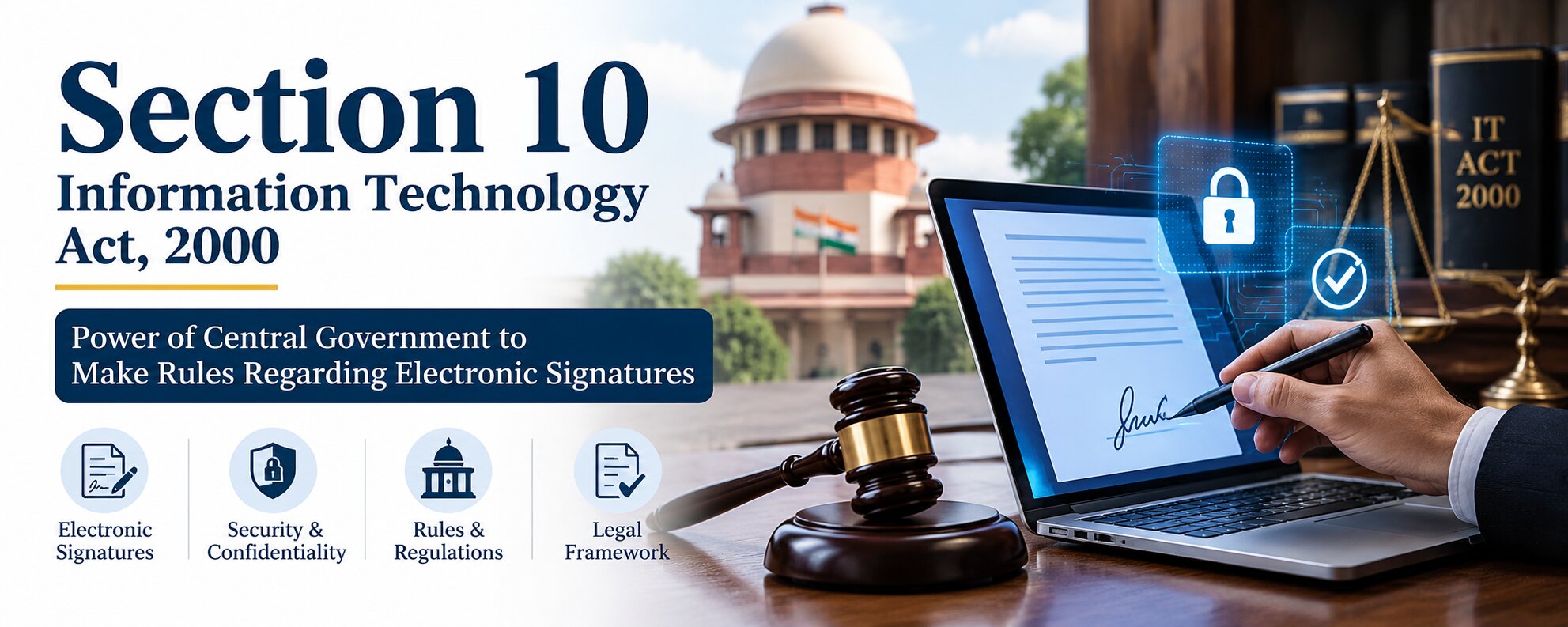
Section 10 of IT Act 2000: Power of Central Government to Make Rules Regarding Electronic Signatures
The Central Government may, for the purposes of this Act, by rules, prescribe—
(a) the type of electronic signature;
(b) the manner and format in which the electronic signature shall be affixed;
(c) the manner or procedure which facilitates identification of the person affixing the electronic signature;
(d) control processes and procedures to ensure adequate integrity, security and confidentiality of electronic records or payments; and
(e) any other matter which is necessary to give legal effect to electronic signatures.
Explained:
Section 10 does not itself establish a separate signature method for every transaction. Instead, it authorises the Central Government to prescribe rules governing electronic signatures and related safeguards. Each clause addresses a particular aspect of that framework.
Clause (a): Types of electronic signatures
Clause (a) empowers the Central Government to prescribe the types of electronic signatures recognised under the applicable legal framework.
An electronic signature is used to authenticate electronic information or indicate a person’s association with a document. The relevant method must satisfy the applicable statutory and regulatory requirements.
Section 3 addresses digital signatures, while Section 3A provides a broader framework for electronic signatures and electronic authentication techniques meeting prescribed reliability conditions.
Clause (b): Manner and format of affixing an electronic signature
Clause (b) authorises rules prescribing how an electronic signature must be applied and the format in which it is to appear.
This is important because electronic signing involves more than inserting a person’s name into a document. Depending on the applicable method, the process may involve authentication credentials, cryptographic mechanisms, certificates or a prescribed electronic platform.
For example, a business using an authorised digital-signature system for electronic filings must follow the requirements applicable to that system and transaction.
Clause (c): Identification of the person signing
Clause (c) focuses on identifying the person who affixes the electronic signature.
Reliable identification helps prevent impersonation, unauthorised signing and disputes concerning who approved a document. The applicable procedure may require verification through credentials, certificates or other permitted authentication mechanisms.
For businesses, maintaining appropriate access controls and protecting signing credentials can help establish accountability and reduce the risk of fraudulent transactions.
Clause (d): Integrity, security and confidentiality
Clause (d) empowers the Central Government to prescribe control processes and procedures to protect the integrity, security and confidentiality of electronic records or payments.
- Integrity: Helps protect records against unauthorised alteration.
- Security: Supports safeguards against misuse, unauthorised access and fraudulent activity.
- Confidentiality: Helps prevent unauthorised disclosure of protected information.
These objectives are particularly important for electronic contracts, financial transactions, government records and confidential business documents.
Clause (e): Other matters necessary to give legal effect to electronic signatures
Clause (e) provides flexibility to address additional matters necessary to give legal effect to electronic signatures.
Technology changes rapidly, and new authentication methods may emerge over time. This clause enables the rule-making framework to address relevant implementation requirements without limiting the provision to only the specific matters listed in the preceding clauses.
The power remains subject to the Act and the limits governing delegated legislation.
Importance of Section 10 in Digital Transactions
Section 10 supports the legal and technical framework needed for trustworthy electronic authentication. Its practical importance can be seen in several areas.
Electronic contracts and business agreements: Electronic signatures can facilitate the signing of commercial agreements, subject to the applicable law and the requirements governing the particular contract.
Government e-filing: Electronic signatures may be used in authorised online filing systems for applications, declarations and other official documents.
Banking and financial services: Authentication safeguards help protect electronic payment processes and financial records against unauthorised use.
Corporate documentation: Companies can use qualifying electronic signatures for permitted business documents, approvals and filings, improving efficiency and reducing paperwork.
Prevention of electronic fraud: Procedures for identifying signatories and protecting electronic records help reduce disputes involving impersonation, tampering and unauthorised signing.
Section 10 provides the rule-making foundation for these safeguards, while the detailed legal requirements depend on the relevant provisions, rules and applicable technical standards.
Important Judgments
There is an important distinction between judgments directly interpreting Section 10 and decisions that explain the broader legal framework for electronic transactions and evidence. The following cases are relevant to the subject, but should not be described as direct rulings on every clause of Section 10.
1. Trimex International FZE Ltd. v. Vedanta Aluminium Ltd. (2010)
The Supreme Court considered a commercial dispute involving contractual negotiations conducted through email communications. The decision recognised that a binding contract may be formed through electronic exchanges when the essential elements of a valid agreement are established.
Relevance: The case illustrates the legal importance of electronic communications in commercial transactions. However, the enforceability of an electronically formed contract is distinct from the technical and regulatory requirements governing electronic signatures under Section 10.
2. Anvar P.V. v. P.K. Basheer (2014)
The Supreme Court examined the admissibility of electronic records under Section 65B of the Indian Evidence Act, 1872.
Relevance: The judgment demonstrates that electronic information may need to satisfy specific evidentiary requirements before it can be relied upon in court. Although Section 10 addresses rule-making concerning electronic signatures, the admissibility of electronic records is a separate legal question.
3. Arjun Panditrao Khotkar v. Kailash Kushanrao Gorantyal (2020)
The Supreme Court clarified the requirements governing certificates for electronic evidence under Section 65B of the Indian Evidence Act, 1872.
Relevance: This decision is useful when electronically stored documents or computer-generated records are presented in legal proceedings. It reinforces the importance of proper electronic-record handling and proof, although it is not a direct interpretation of Section 10.
The applicable evidence law must be checked for the relevant proceeding, including the Bharatiya Sakshya Adhiniyam, 2023, which came into force on 1 July 2024.
4. State of Maharashtra v. Dr. Praful B. Desai (2003)
The Supreme Court considered the use of video conferencing in judicial proceedings and interpreted the expression “presence” in the context of recording evidence.
Relevance: The judgment illustrates the broader judicial recognition of technology in legal processes. It is relevant to the development of technology-enabled legal procedures, but it does not directly decide the scope of the Central Government’s rule-making powers under Section 10.
Conclusion
Section 10 of the Information Technology Act, 2000, is an important provision supporting the regulation of electronic signatures in India. By empowering the Central Government to prescribe signature methods, application procedures, identification requirements and security safeguards, it helps establish a framework for reliable electronic authentication.
Its five clauses address the type of signature, the manner of application, identification of the signatory, protection of electronic records and other matters necessary to give electronic signatures legal effect.
Leave a Reply