
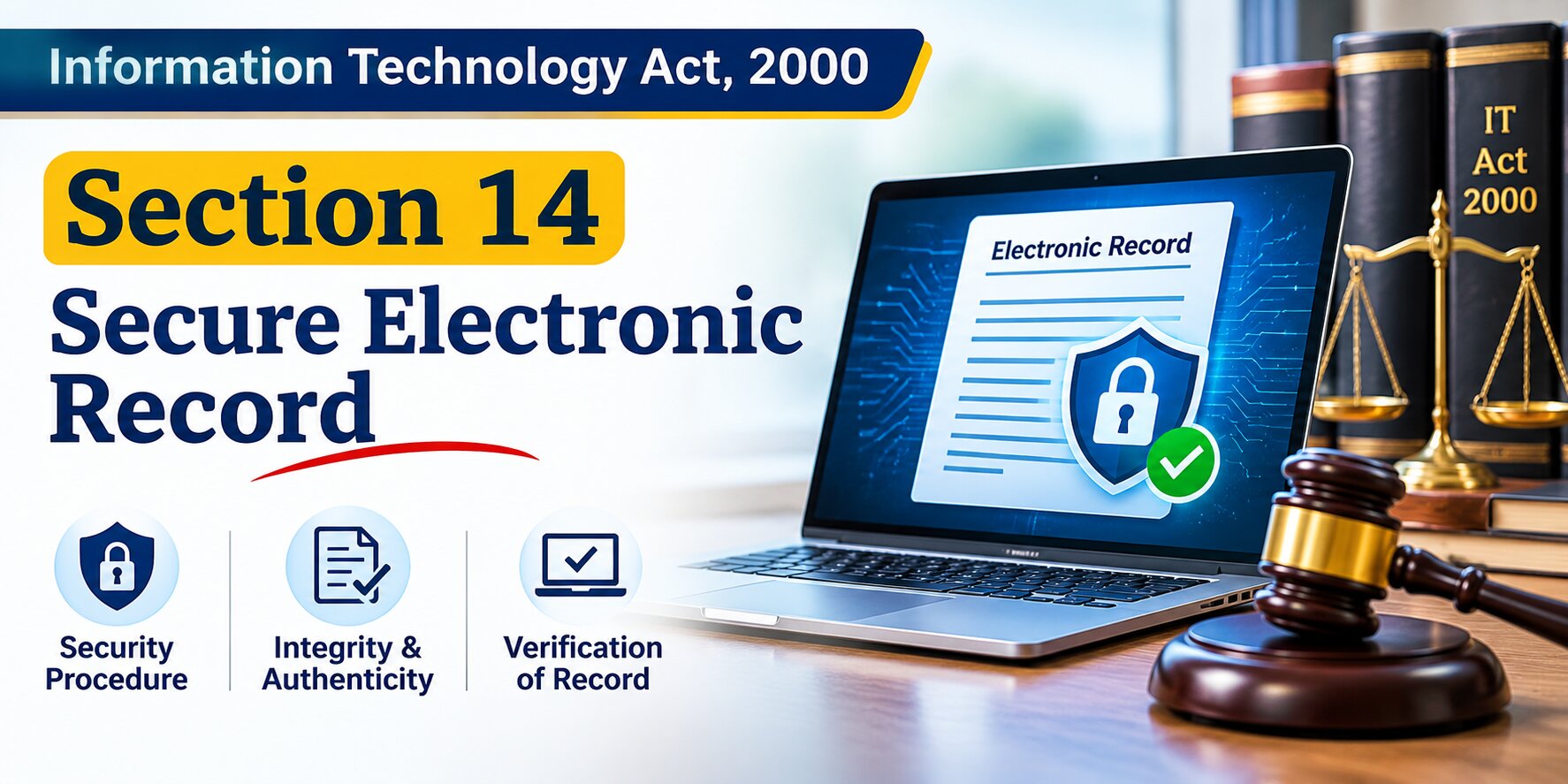
Section 14 of IT Act 2000: Secure Electronic Records
Where any security procedure has been applied to an electronic record at a specific point of time, then such record shall be deemed to be a secure electronic record from such point of time to the time of verification.
Explained:
Section 14 of the Information Technology Act, 2000, deals with the recognition of secure electronic records in India. It is an important provision of Indian cyber law because it establishes when an electronic record can be treated as a secure electronic record after the prescribed security procedure has been applied.
With the increasing use of electronic contracts, online transactions, digital documentation and government e-services, protecting electronic information from unauthorised alteration has become essential. Section 14 provides legal recognition to electronic records that satisfy the statutory requirements for security.
The provision is particularly relevant to businesses, government departments, financial institutions and individuals who create, store or exchange important electronic documents. It should be read along with Sections 3, 3A, 15 and 16 of the Information Technology Act, 2000.
1. Application of a security procedure
The first requirement under Section 14 is that a security procedure must be applied to an electronic record.
A security procedure refers to a prescribed or recognised method used to protect an electronic record against unauthorised changes. Such procedures may involve cryptographic techniques, authentication mechanisms and other appropriate safeguards.
For example, an organisation may apply a recognised digital authentication process to an electronic agreement to help establish its integrity and authenticity.
2. Electronic record at a specific point of time
The section specifically refers to the application of a security procedure at a particular point of time.
This is important because the security status of an electronic record is connected to the time when the procedure was applied. Establishing this point helps determine whether the record has remained protected during the relevant period.
3. Deemed to be a secure electronic record
Once the required security procedure has been applied, the electronic record is deemed to be a secure electronic record under Section 14.
This statutory recognition is significant because it provides a legal basis for treating appropriately protected electronic documents differently from ordinary electronic records.
4. From the time of application until verification
The final part of Section 14 explains the period during which the electronic record receives this recognition.
The record is treated as secure from the time the security procedure is applied until the time of verification. Verification helps establish whether the security procedure and the record satisfy the relevant requirements.
This provision is important when electronic documents are exchanged between businesses, submitted to authorities or relied upon in legal proceedings.
Importance of Section 14 in Digital Transactions
Section 14 has practical importance in situations where the authenticity and integrity of electronic records are disputed.
- Electronic agreements: Helps establish the security status of electronically authenticated agreements.
- Banking transactions: Supports the protection and verification of electronic financial records.
- Government records: Provides a statutory framework for recognising records protected through prescribed security procedures.
- Business documentation: Helps organisations maintain reliable electronic invoices, orders and contractual records.
- Cybercrime investigations: Security verification can assist in examining whether electronic information has been altered or compromised.
Important Judgments
There is limited reported higher-court interpretation directly explaining Section 14. The following judgments are relevant to the broader principles of electronic-record authentication and verification.
1. Anvar P.V. v. P.K. Basheer (2014)
The Supreme Court examined the admissibility of electronic records under Section 65B of the Indian Evidence Act, 1872.
Relevance: The judgment highlights the importance of establishing the authenticity and evidentiary reliability of electronic records. It is relevant to understanding the distinction between a secure electronic record under Section 14 and the admissibility of electronic evidence in court.
2. Arjun Panditrao Khotkar v. Kailash Kushanrao Gorantyal (2020)
The Supreme Court clarified the requirements for proving electronic records under Section 65B of the Indian Evidence Act, 1872.
Relevance: The decision explains the importance of proper certification and proof when electronic records are produced in judicial proceedings. It provides useful guidance when electronic documents are relied upon in litigation, although it does not directly interpret Section 14.
3. Ms Deep Motors Gallery v. RBL Bank Limited (2022)
This matter was before the Debt Recovery Tribunal and is indexed in legal databases under Section 14 of the Information Technology Act, 2000.
Relevance: It provides a case reference for further research into disputes involving electronic records and banking transactions. Its precise legal findings should be examined from the complete tribunal order before relying on it as an authority on Section 14.
Important clarification: The above decisions should not be presented as Supreme Court rulings directly establishing the interpretation of Section 14. They assist in understanding related principles of electronic-record authenticity and evidence. Information Technology Act, 2000+2
Difference Between Sections 14, 15 and 16
| Section | Subject | Purpose |
|---|---|---|
| Section 14 | Secure electronic record | Recognises an electronic record as secure after application of the prescribed security procedure. |
| Section 15 | Secure electronic signature | Establishes conditions for treating an electronic signature as secure. |
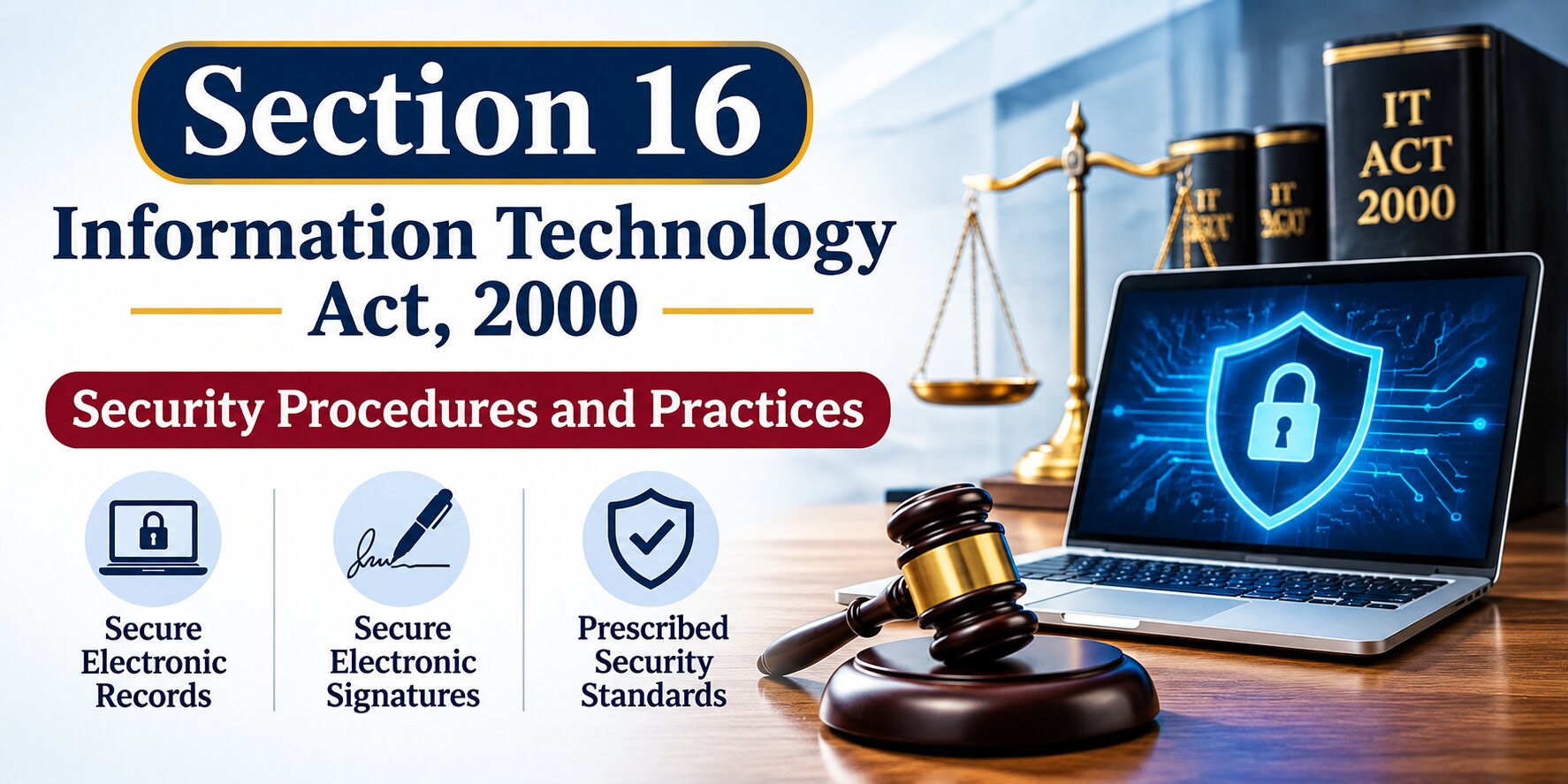
| Section 16 | Security procedures and practices | Empowers the Central Government to prescribe security procedures and practices for Sections 14 and 15. |
Section 16 is particularly important because the expression “security procedure” under Section 2(1)(zf) refers to the procedure prescribed by the Central Government. Further, Section 2(1)(zh) explains verification in relation to a digital signature, electronic record or public key. India Code+1
Conclusion
Section 14 of the Information Technology Act, 2000, plays an important role in protecting the legal reliability of electronic records in India. It provides that an electronic record to which the prescribed security procedure has been applied is deemed to be a secure electronic record from that point until verification.
The provision is especially relevant in digital banking, electronic contracts, online business transactions and government documentation. Reading Sections 14, 15 and 16 together provides a better understanding of how Indian cyber law addresses the security and verification of electronic information.
Leave a Reply