
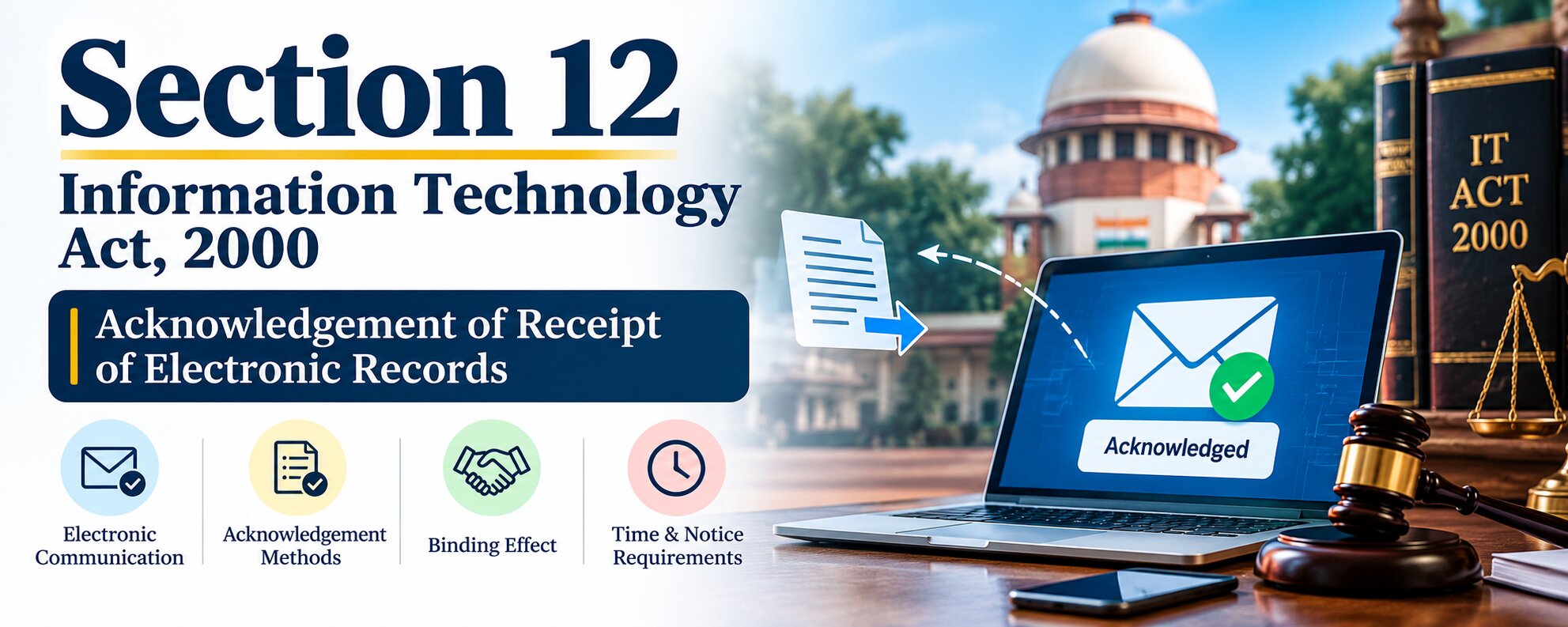
Section 12 of IT Act 2000: Acknowledgement of receipt
Section 12(1)
Where the originator has not agreed with the addressee that the acknowledgement of receipt of electronic record be given in a particular form or by a particular method, an acknowledgement may be given by—
(a) any communication by the addressee, automated or otherwise; or
(b) any conduct of the addressee, sufficient to indicate to the originator that the electronic record has been received.
Section 12(2)
Where the originator has stipulated that the electronic record shall be binding only on receipt of an acknowledgement of such electronic record by him, then unless acknowledgement has been so received, the electronic record shall be deemed to have never been sent by the originator.
Section 12(3)
Where the originator has not stipulated that the electronic record shall be binding only on receipt of such acknowledgement, and the acknowledgement has not been received by the originator within the time specified or agreed or, if no time has been specified or agreed to within a reasonable time, then the originator may give notice to the addressee stating that no acknowledgement has been received by him and specifying a reasonable time by which the acknowledgement must be received by him and if no acknowledgement is received within the aforesaid time limit he may after giving notice to the addressee, treat the electronic record as though it has never been sent.
Explained:
Section 12(1): Methods of acknowledgement of receipt
Subsection (1) explains how an acknowledgement of an electronic record can be communicated when the originator has not stipulated a particular form or method.
It recognises two methods:
Clause (a): Communication by the addressee
An acknowledgement may be provided through any communication made by the recipient, whether automated or otherwise.
Examples include:
- An automatic email delivery confirmation.
- An electronic message confirming receipt.
- An automated acknowledgement generated by a government portal.
- A written electronic response from the recipient.
Clause (b): Conduct of the addressee
An acknowledgement need not always be given through a separate written message. The recipient’s conduct may also be sufficient if it clearly indicates to the sender that the electronic record has been received.
For example, where a recipient responds to an electronic application by referring to its contents, that response may indicate receipt of the original communication.
The important requirement is that the conduct must be sufficient to indicate receipt to the originator. Mere silence should not automatically be treated as acknowledgement.
Section 12(2): Electronic record made binding only upon acknowledgement
Subsection (2) deals with situations where the sender specifically stipulates that an electronic record will become binding only when an acknowledgement is received.
If the required acknowledgement is not received, the electronic record is deemed never to have been sent by the originator.
For example, suppose a company sends an electronic offer stating that it will be binding only after the recipient acknowledges receipt. If the required acknowledgement never reaches the company, the legal consequence under this subsection applies.
This provision is important in commercial transactions where confirmation of receipt is an essential condition of communication.
Section 12(3): Failure to receive acknowledgement
Subsection (3) deals with situations where the sender has not made acknowledgement a condition for the electronic record becoming binding.
If acknowledgement is not received within the agreed or specified period, the sender may take further action.
The subsection provides the following procedure:
- The originator must consider the time specified or agreed for receiving acknowledgement.
- If no time has been fixed, a reasonable period must be allowed.
- If acknowledgement is not received, the originator may issue a notice to the addressee.
- The notice must state that acknowledgement has not been received and specify a reasonable time within which it must be received.
- If acknowledgement is still not received within that period, the originator may, after giving notice, treat the electronic record as though it had never been sent.
This provision protects the sender from uncertainty when electronic communications do not receive confirmation.
Important Judgments
There is a distinction between judgments directly interpreting Section 12 and decisions dealing with the broader legal validity of electronic communications. No Supreme Court decision directly interpreting all three subsections of Section 12 has been identified in the sources reviewed. The following cases are nevertheless useful for understanding electronic communications and their legal consequences.
1. Trimex International FZE Ltd. v. Vedanta Aluminium Ltd. (2010)
The Supreme Court examined whether contractual negotiations conducted through email communications could result in a legally binding agreement.
The Court recognised that a contract may be concluded through electronic correspondence when the essential elements of a valid contract are established.
Relevance to Section 12: The judgment demonstrates the importance of electronic communications in commercial transactions. It also highlights why parties should clearly specify whether receipt or acknowledgement is necessary before an electronic communication becomes binding.
2. Shakti Bhog Foods Ltd. v. Kola Shipping Ltd. (2009)
The Supreme Court considered contractual relationships and documentary communications in a commercial dispute.
Relevance to Section 12: The decision provides broader context for understanding how communications and documentary records may establish contractual dealings. It is not a direct interpretation of the acknowledgement requirements under Section 12.
3. Anvar P.V. v. P.K. Basheer (2014)
The Supreme Court examined the admissibility of electronic records under Section 65B of the Indian Evidence Act, 1872.
Relevance to Section 12: The judgment is important because acknowledgement of receipt and admissibility of electronic evidence are separate legal questions. Even where receipt is established, the party relying on an electronic record in court must satisfy the applicable evidentiary requirements.
4. Arjun Panditrao Khotkar v. Kailash Kushanrao Gorantyal (2020)
The Supreme Court clarified the requirements for producing electronic evidence under Section 65B of the Indian Evidence Act, 1872.
Relevance to Section 12: This decision helps explain the importance of preserving electronic records and maintaining appropriate supporting documentation when electronic communications become relevant to litigation.
The last two judgments concern electronic evidence rather than the direct interpretation of Section 12. For proceedings after 1 July 2024, the Bharatiya Sakshya Adhiniyam, 2023, should also be considered.
Importance of Section 12 in Modern Business and Legal Transactions
Section 12 is particularly relevant in situations where parties exchange important documents electronically.
- Business communication: Helps establish whether electronic business correspondence has been acknowledged.
- Online contracts: Allows parties to make acknowledgement a condition for an electronic record becoming binding.
- Government applications: Provides a framework for acknowledgement through automated electronic systems.
- Banking transactions: Supports the use of electronic confirmations and communication records.
- Legal disputes: Helps determine whether a sender received confirmation of an electronic communication.
Businesses should retain acknowledgement emails, automated confirmation messages, server records and other relevant electronic evidence wherever appropriate.
Conclusion
Section 12 of the Information Technology Act, 2000, provides an important legal framework for acknowledgement of receipt of electronic records in India. It recognises that acknowledgement may be communicated through an automated message, direct communication or conduct indicating receipt.
Subsection (2) protects the originator where acknowledgement has expressly been made a condition for the electronic record becoming binding. Subsection (3) provides a notice-based procedure where acknowledgement has not been received within the specified or reasonable period.
Understanding Section 12 alongside Sections 11 and 13 is essential for businesses, legal professionals and individuals dealing with electronic contracts, online communications and digital transactions. It helps reduce uncertainty and provides a statutory framework for handling disputes concerning the receipt of electronic records.
Leave a Reply