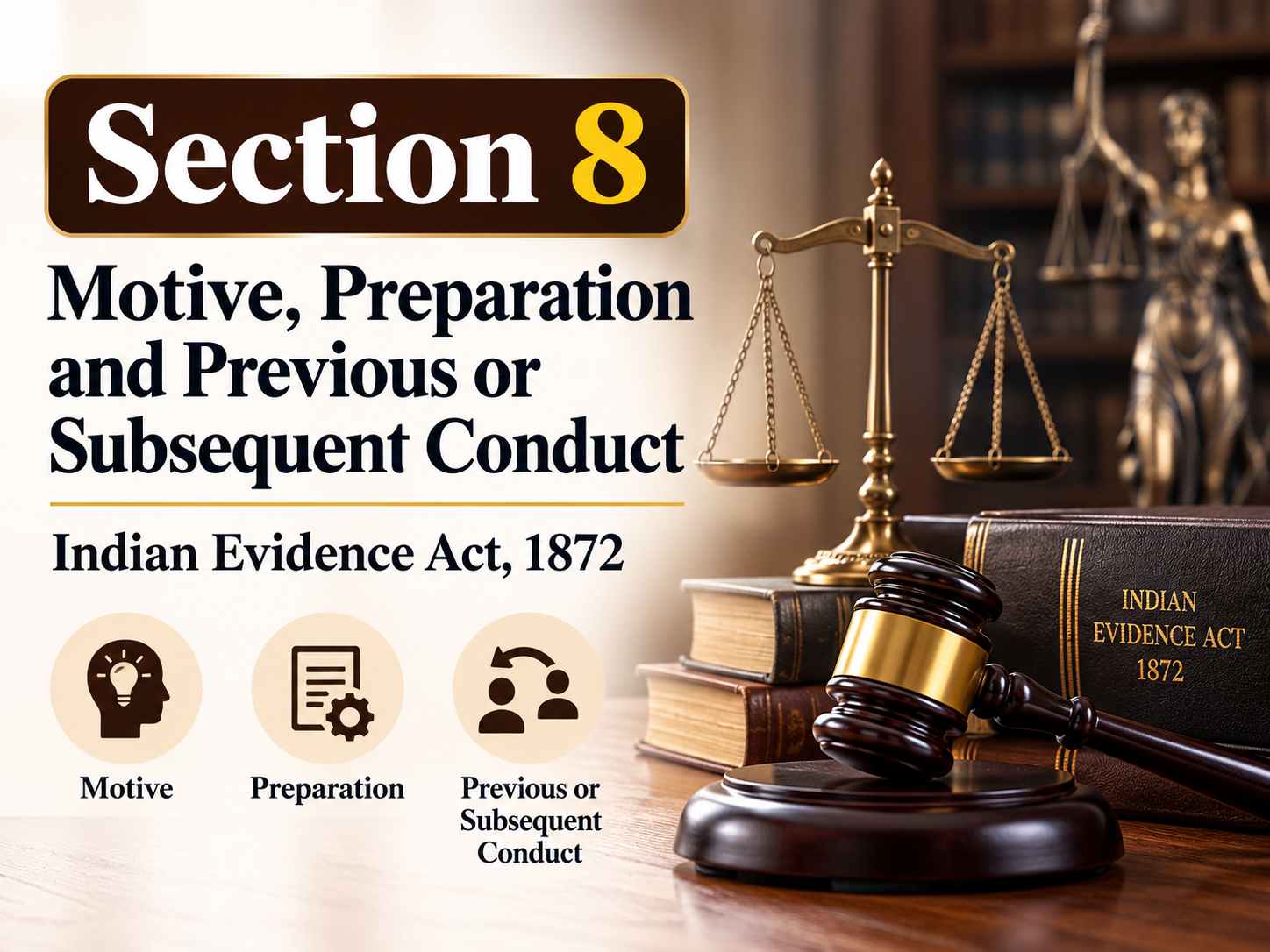
Section 8 of the Indian Evidence Act, 1872 deals with the relevancy of facts relating to motive, preparation, and the previous or subsequent conduct of a person. These facts can assist the court in understanding the circumstances surrounding a fact in issue or relevant fact. The provision is particularly important in criminal cases where the prosecution relies on circumstantial evidence.
Motive and Preparation
Motive refers to the reason or purpose that may lead a person to commit an act. For example, a financial dispute may provide a possible motive for an alleged offence. Preparation refers to steps taken before an act, such as obtaining an instrument or making arrangements to commit the alleged offence. However, proof of motive alone does not establish guilt.
In Atley v. State of Uttar Pradesh, AIR 1955 SC 807, the Supreme Court observed that clear proof of motive can provide additional support to a case based on circumstantial evidence, but failure to establish motive does not necessarily mean that the prosecution case must fail.
Previous or Subsequent Conduct
Section 8 also makes relevant the conduct of a person when that conduct is influenced by, or influences, a fact in issue or relevant fact. Such conduct may occur before or after the alleged incident.
In A.N. Venkatesh v. State of Karnataka, (2005) 7 SCC 714, the Supreme Court recognised that the conduct of an accused in pointing out the place where a body was found could be relevant under Section 8, independently of the question of admissibility under Section 27. This principle has subsequently been reiterated by the Supreme Court.
The Supreme Court in Sharad Birdhichand Sarda v. State of Maharashtra, (1984) 4 SCC 116 also emphasised that circumstances relied upon in a case based on circumstantial evidence must form a complete chain pointing towards the guilt of the accused.
Section 8 therefore helps courts evaluate surrounding circumstances, but the relevance of motive or conduct must be assessed along with the entire evidence and cannot, by itself, replace proof of the offence.
Note: The Indian Evidence Act, 1872 was repealed with effect from 1 July 2024 and replaced by the Bharatiya Sakshya Adhiniyam, 2023. The older provision remains relevant to proceedings governed by the repealed Act.
Leave a Reply