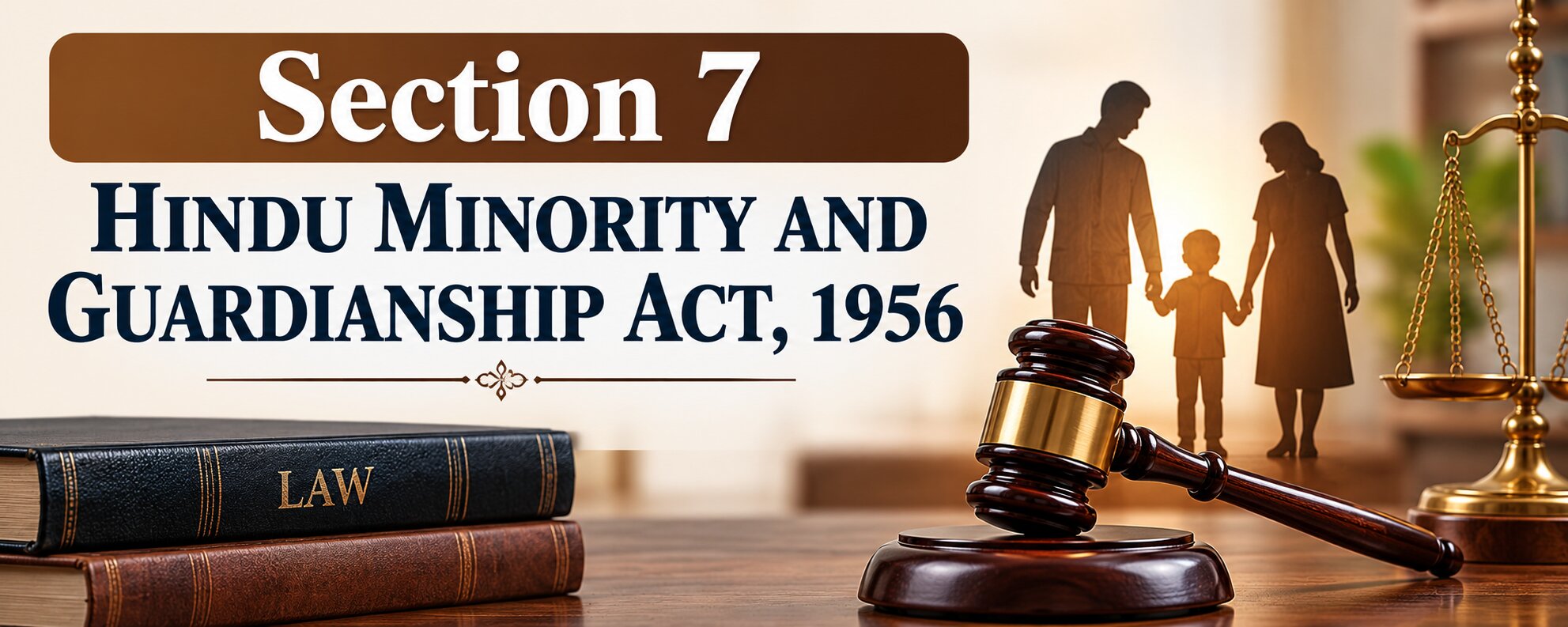
Section 7 of the Hindu Minority and Guardianship Act, 1956, deals with the natural guardianship of an adopted son who has not attained the age of majority. The provision clarifies who becomes legally responsible for the guardianship of a minor following adoption. It forms an important part of Hindu personal law governing the relationship between adoption, parental responsibility and the protection of minors.
For anyone studying Hindu law, family law or guardianship proceedings, understanding Section 7 is essential because it explains how natural guardianship passes to adoptive parents under the statutory framework.
Section 7 – Natural guardianship of adopted son
“The natural guardianship of an adopted son who is a minor passes, on adoption, to the adoptive father and after him to the adoptive mother.”
This is the complete text of Section 7 of the Hindu Minority and Guardianship Act, 1956.
Explained:
1. Natural guardianship of an adopted son
The first part of the provision concerns an adopted son who remains a minor. Under the Act, a minor is a person who has not completed eighteen years of age.
Natural guardianship involves legal responsibility for the minor’s person and, where applicable, property. It includes responsibilities connected with the child’s protection, upbringing and welfare, subject to the applicable legal provisions.
Section 7 specifically addresses the transfer of natural guardianship upon adoption. It recognises the adoptive parents within the legal framework governing the adopted child’s care and protection.
2. Guardianship passes upon adoption
The words “passes, on adoption” indicate that the statutory change in guardianship takes place when the adoption becomes legally effective. A valid adoption must satisfy the applicable requirements of the Hindu Adoptions and Maintenance Act, 1956.
Adoption is not merely an informal arrangement for caring for a child. Its legal consequences depend upon compliance with the governing law. Consequently, questions concerning the validity of adoption may become important when a dispute arises over guardianship, family status or property rights.
3. Role of the adoptive father
Section 7 states that natural guardianship passes to the adoptive father upon adoption. The provision places the adoptive father within the statutory arrangement for the guardianship of a minor adopted son.
However, guardianship must be understood alongside the other provisions of the Act and the wider legal principles protecting minors. The existence of guardianship does not permit a parent to disregard the child’s welfare or exercise powers beyond those authorised by law.
4. Role of the adoptive mother
The section further provides that guardianship passes to the adoptive mother after the adoptive father. This recognises the adoptive mother’s role in the legal protection and care of the adopted child.
The wording of Section 7 reflects the original statutory framework. Because the Hindu Adoptions and Maintenance Act, 1956, recognises the adoption of daughters as well as sons, the gender-specific wording of Section 7 has attracted discussion concerning equal treatment of adopted children. The provision should therefore be read alongside the relevant adoption law and applicable judicial principles.
Important Judgments
1. Githa Hariharan v. Reserve Bank of India (1999)
The Supreme Court examined natural guardianship under Section 6 of the Hindu Minority and Guardianship Act, 1956. It interpreted the expression “after him” in a manner that did not require the father to be completely absent before the mother could act as natural guardian.
The judgment is important for understanding parental guardianship and the need to interpret guardianship provisions consistently with constitutional principles of equality. Although it concerned Section 6 rather than Section 7 directly, it provides useful context for understanding the Act.
2. Ghisalal v. Dhapubai (Dead) by LRs and Others (2011)
In this case, the Supreme Court considered the legal requirements governing a valid adoption under the Hindu Adoptions and Maintenance Act, 1956. The Court examined the statutory conditions relevant to adoption, including the consent requirements applicable in the circumstances.
The decision is relevant to Section 7 because the transfer of guardianship contemplated by that provision depends upon a legally effective adoption. It is not a direct ruling interpreting Section 7 itself.
Conclusion
Section 7 of the Hindu Minority and Guardianship Act, 1956, establishes the statutory rule governing the natural guardianship of a minor adopted son. It identifies the adoptive father and subsequently the adoptive mother within the prescribed order of guardianship.
For legal interpretation, Section 7 should be read alongside the Hindu Adoptions and Maintenance Act, 1956, and relevant judicial decisions. Ultimately, guardianship law must operate within the wider framework of lawful parental responsibility and the protection of minors.
Disclaimer: This article is intended for legal information and educational purposes. Specific adoption and guardianship disputes require examination of the relevant facts and applicable law.


Leave a Reply