
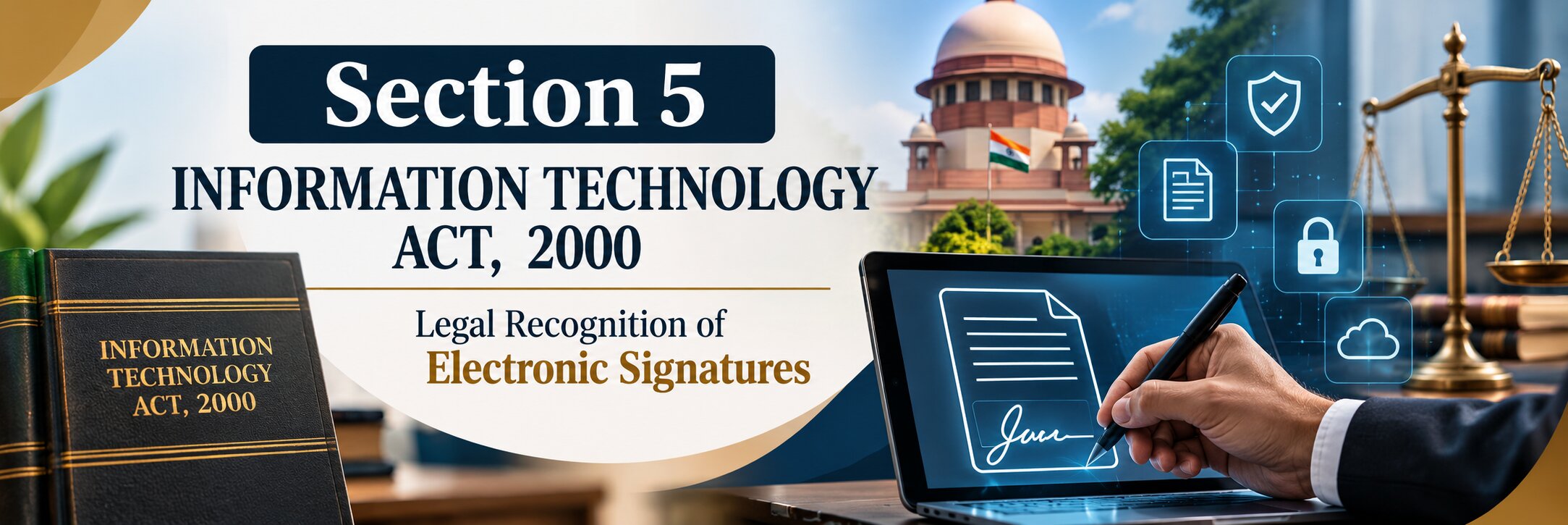
Section 5 of IT Act 2000: Legal recognition of electronic signatures
Where any law provides that information or any other matter shall be authenticated by affixing the signature or any document shall be signed or bear the signature of any person, then, notwithstanding anything contained in such law, such requirement shall be deemed to have been satisfied, if such information or matter is authenticated by means of electronic signature affixed in such manner as may be prescribed by the Central Government.
Explanation.— For the purposes of this section, “signed”, with its grammatical variations and cognate expressions, shall, with reference to a person, mean affixing of his hand written signature or any mark on any document and the expression “signature” shall be construed accordingly.
Explained:
ection 5 does not contain separate numbered subsections. Instead, it establishes a general legal rule followed by an explanation clarifying the meaning of signing.
1. Where the law requires a signature
The opening words apply when an existing law requires information to be authenticated by a signature or a document to be signed by a particular person.
For example, a company may need to submit a document through an authorised electronic filing system. Where electronic signing is legally permitted, Section 5 can support the use of a qualifying electronic signature to meet the relevant signature requirement.
2. Meaning of “notwithstanding anything contained in such law”
This expression gives Section 5 overriding effect concerning the applicable signature requirement. It allows a legally recognised electronic signature to satisfy that requirement even where the relevant law would otherwise call for a signature.
However, this does not mean every document can be executed electronically without restriction. Other applicable requirements, including registration, stamping, prescribed formalities and statutory exclusions, must still be considered.
3. Authentication through an electronic signature
The section requires the information or document to be authenticated using an electronic signature applied in the prescribed manner. A typed name, scanned signature or image pasted into a document does not automatically qualify as a legally recognised electronic signature under Section 5.
Section 3 addresses digital signatures, while Section 3A provides for electronic signatures and electronic authentication techniques that satisfy the applicable statutory requirements. Reading these provisions together helps explain the legal framework for electronic authentication. Indian Kanoon+1
4. Signature in the manner prescribed by the Central Government
The prescribed procedure is an essential part of Section 5. The electronic signature must comply with the relevant rules and technical requirements applicable to the method used.
For individuals and businesses, this means checking whether the selected signing method is legally accepted for the particular document or transaction rather than assuming that every electronic signing service has the same legal status.
5. Explanation of the word “signed”
The explanation clarifies the conventional meaning of “signed” and related expressions by referring to a handwritten signature or mark. Section 5 extends legal recognition to qualifying electronic signatures, allowing electronic authentication to fulfil applicable signature requirements.
Importance of Section 5 in Digital Transactions
Section 5 supports the development of paperless transactions and electronic governance in India. Its practical importance can be seen in several areas:
- Business agreements: Qualifying electronic signatures can be used for permitted commercial agreements and business documentation.
- Government filings: Electronic signatures can facilitate online submissions and approvals where the relevant department accepts them.
- Corporate documentation: Organisations can reduce the need to print, physically sign and circulate documents.
- Professional services: Lawyers, accountants and other professionals can use authorised electronic signing methods for eligible documents.
- Electronic records: A properly authenticated signature may help establish the identity of the signatory and the integrity of a document, depending on the method used and the evidence available.
Section 5 supports electronic authentication, but it does not independently determine whether every agreement is legally enforceable or whether every electronically signed record is admissible as evidence.
Important Judgments
The following judgments provide useful context on electronic communications, contracts and electronic evidence. They should not be described as direct interpretations of Section 5 unless the particular judgment expressly decides an issue under that provision.
1. Trimex International FZE Ltd. v. Vedanta Aluminium Ltd. (2010)
The Supreme Court examined whether contractual negotiations conducted through email communications resulted in a binding commercial agreement. The case illustrates that contractual obligations may arise through electronic communications when the essential elements of a valid contract are established.
Relevance: It is useful for understanding electronic commercial transactions, although the case is not a direct ruling on the technical requirements for a valid electronic signature under Section 5.
2. Anvar P.V. v. P.K. Basheer (2014)
The Supreme Court considered the admissibility of electronic records under the Indian Evidence Act, 1872, particularly Section 65B.
Relevance: The decision distinguishes the legal recognition of electronic documents from the requirements for proving them in court. A signature’s recognition under Section 5 does not automatically settle every evidentiary question concerning the document.
3. Arjun Panditrao Khotkar v. Kailash Kushanrao Gorantyal (2020)
The Supreme Court clarified important requirements concerning the production of electronic evidence under Section 65B of the Indian Evidence Act, 1872.
Relevance: The judgment is useful when electronically signed documents or other electronic records are relied upon in litigation. Its principal focus is electronic evidence, not the direct interpretation of Section 5. For proceedings governed by the Bharatiya Sakshya Adhiniyam, 2023, the applicable evidentiary provisions must also be considered.
Limitations of Section 5
Despite its importance, Section 5 does not remove every legal formality associated with signing a document.
- Statutory exclusions: Section 1(4) and the First Schedule identify certain documents and transactions excluded from the Act’s application, subject to the applicable statutory framework.
- Document-specific requirements: Some transactions require additional formalities, such as registration or payment of stamp duty.
- Authentication disputes: A party may dispute the identity of the signatory, the validity of the signing method or whether the document was altered.
- Evidence requirements: The admissibility and proof of an electronic record depend on the applicable evidence law and the circumstances of the case.
Accordingly, the legal validity of an electronic signature should be assessed in the context of the document, the applicable statute and the prescribed authentication method.
Difference Between Section 4 and Section 5
Section 4 of the Information Technology Act, 2000, recognises qualifying electronic records where a law requires information to be in writing, typewritten or printed form. Section 5 recognises qualifying electronic signatures where a law requires a signature or authentication.
In simple terms, Section 4 deals with the written-form requirement, whereas Section 5 deals with the signature requirement.
Conclusion
Section 5 of the Information Technology Act, 2000, provides the statutory foundation for recognising electronic signatures in India. It enables qualifying electronic authentication to satisfy legal signature requirements and supports digital business, electronic governance and paperless documentation.
Nevertheless, electronic signatures must comply with the prescribed procedure, and other legal requirements may continue to apply. Understanding Section 5 alongside Sections 3, 3A and 4 helps businesses, professionals and individuals use electronic documents more confidently and lawfully.
Leave a Reply