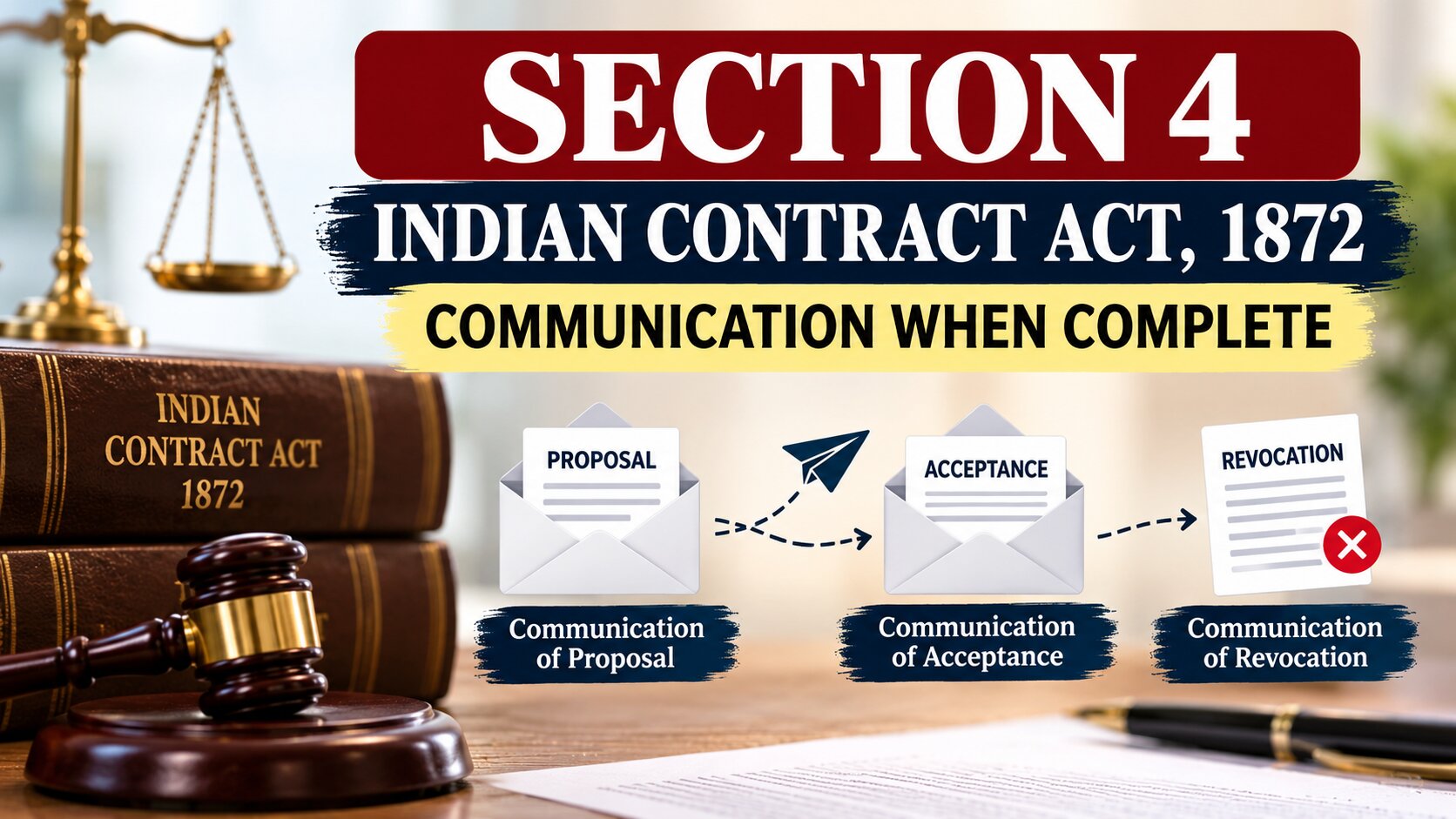
Section 4:
The communication of a proposal is complete when it comes to the knowledge of the person to whom it is made.
The communication of an acceptance is complete,—
as against the proposer, when it is put in a course of transmission to him so as to be out of the power of the acceptor;
as against the acceptor, when it comes to the knowledge of the proposer.
The communication of a revocation is complete,
—as against the person who makes it, when it is put into a course of transmission to the person to whom it is made, so as to be out of the power of the person who makes it;
as against the person to whom it is made, when it comes to his knowledge.
Illustrations
(a)A proposes, by letter, to sell a house to at a certain price. The communication of the proposal is complete when receives the letter.
(b)accepts A’s proposal by a letter sent by post.The communication of the acceptance is complete,as against A when the letter is posted;as against B, when the letter is received by A.
(c)A revokes his proposal by telegram.
The revocation is complete as against A when the telegram is despatched.
It is complete as against B when B receives it.
B revokes his acceptance by telegram. B’s revocation is complete as against B when the telegram is despatched, and as against A when it reaches him.
Explained
Section 4 of the Indian Contract Act, 1872 explains when the communication of a proposal, acceptance and revocation becomes complete. The provision is important because a contract can arise only when the parties effectively communicate their intention and acceptance.
Communication of Proposal
Under Section 4, communication of a proposal is complete when the proposal comes to the knowledge of the person to whom it is made. For example, if A sends a letter offering to sell a property to B, communication is complete when B receives and becomes aware of the offer.
Communication of Acceptance
The law creates two stages for communication of acceptance:
- Against the proposer: communication is complete when the acceptance is put into a course of transmission so that it is beyond the control of the acceptor.
- Against the acceptor: communication is complete when the acceptance comes to the knowledge of the proposer.
The Act traditionally illustrates this through acceptance sent by post. When B posts the acceptance letter, communication is complete against A; when A receives it, communication is complete against B.
Communication of Revocation
Revocation is complete against the person making it when it is put into transmission and is beyond that person’s control. Against the other party, it becomes complete when it comes to that person’s knowledge.
Important Judgment
In Bhagwandas Goverdhandas Kedia v. Girdharilal Parshottamdas & Co. (1965), the Supreme Court considered the operation of Section 4 in relation to instantaneous communication, including telephone communication. The Court explained that Section 4 establishes specific rules concerning the completion of communication and observed that the provision deals with completion of communication rather than simply determining the place where a contract is made.
Conclusion
Section 4 provides certainty about the point at which proposals, acceptances and revocations become legally communicated. Understanding these rules is particularly important in disputes involving postal communication, electronic communication and the timing of withdrawal or acceptance of contractual offers.





Leave a Reply