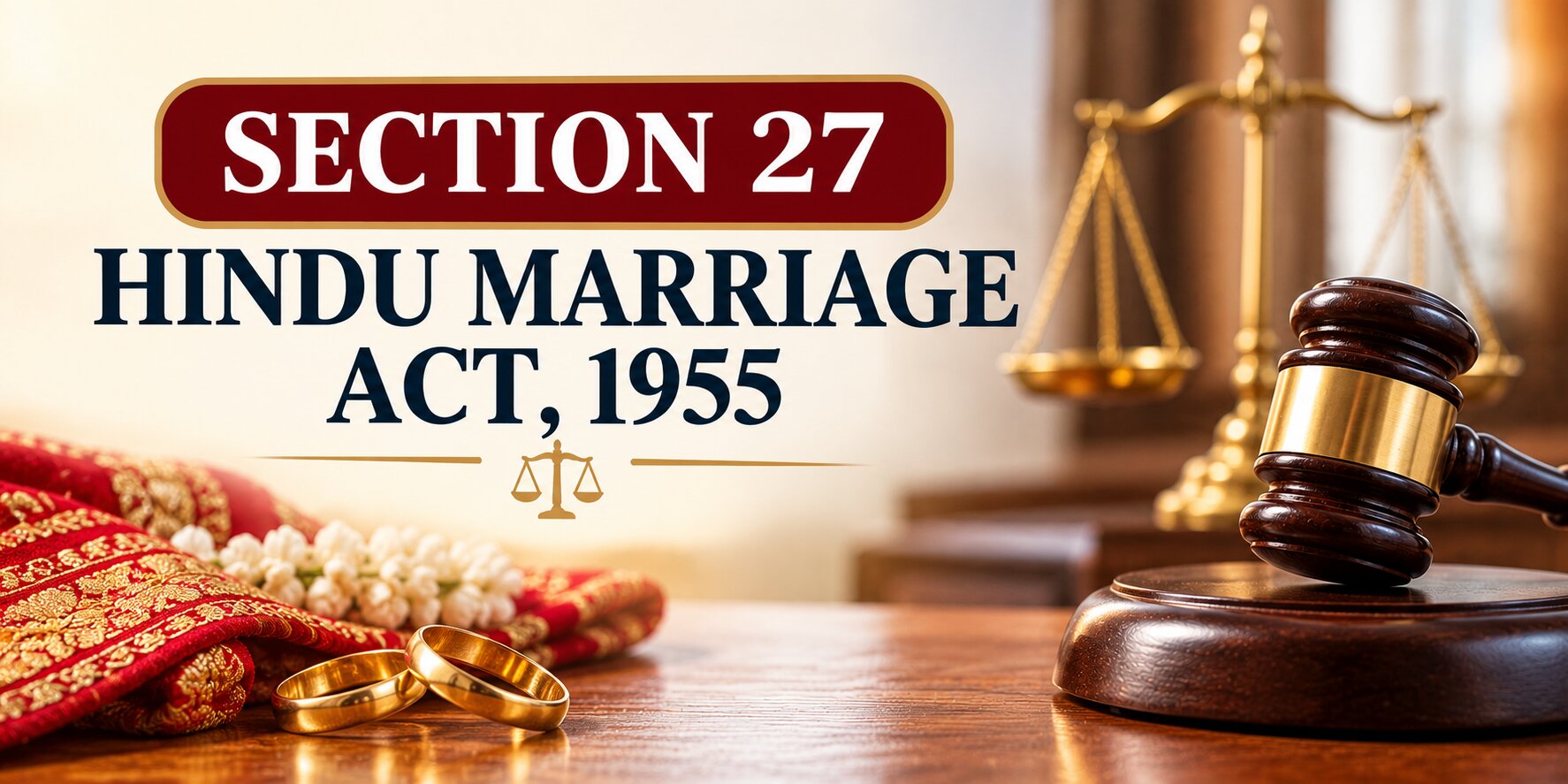
Section 27: Disposal of Property
In any proceeding under this Act, the court may make such provisions in the decree as it deems just and proper with respect to any property presented, at or about the time of marriage, which may belong jointly to both the husband and the wife.
Explained:
Section 27 of the Hindu Marriage Act, 1955 deals with the disposal of property presented at or around the time of marriage that belongs jointly to the husband and wife. It enables the matrimonial court to pass appropriate orders regarding such property while deciding proceedings under the Act.
Meaning and Scope of Section 27
Under Section 27, the court may include suitable directions in its decree concerning property presented at or about the time of marriage, provided that the property belongs jointly to both spouses. The objective is to provide a practical legal remedy for resolving disputes over matrimonial gifts and jointly owned marriage-related property.
For example, if a couple receives jewellery, household articles or other gifts jointly at the time of their marriage, and a dispute arises over their possession following separation or divorce, the court may examine whether the property falls within Section 27 and make an appropriate order.
However, Section 27 does not cover every asset acquired during marriage. Property purchased independently by either spouse using their own earnings does not automatically fall within this provision. The nature of the property, the circumstances in which it was given, its ownership and the available evidence are important considerations.
Important Judgments on Section 27
1. Balkrishna Ramchandra Kadam v. Sangeeta Balkrishna Kadam (1997)
The Supreme Court clarified that a matrimonial court has jurisdiction to deal with property covered by Section 27. The expression “at or about the time of marriage” can include property given before or after the wedding if it is sufficiently connected with the marriage. However, the claim must be established through evidence.
2. Pratibha Rani v. Suraj Kumar (1985)
The Supreme Court explained that a woman’s stridhan remains her absolute property. Section 27 does not extinguish her ownership rights or remove the possibility of criminal liability where dishonest misappropriation is established.
3. Urmila Rani v. Raj Kishan Gupta (1995)
The Supreme Court recognised that an application under Section 27 may be maintainable even when it is filed at a later stage of matrimonial proceedings, depending on the circumstances of the case.
Conclusion
Section 27 of the Hindu Marriage Act, 1955, provides an important remedy for disputes involving jointly owned marriage-related property. Understanding its scope helps spouses seek appropriate relief while ensuring that property claims are supported by evidence and applicable legal principles.
Leave a Reply