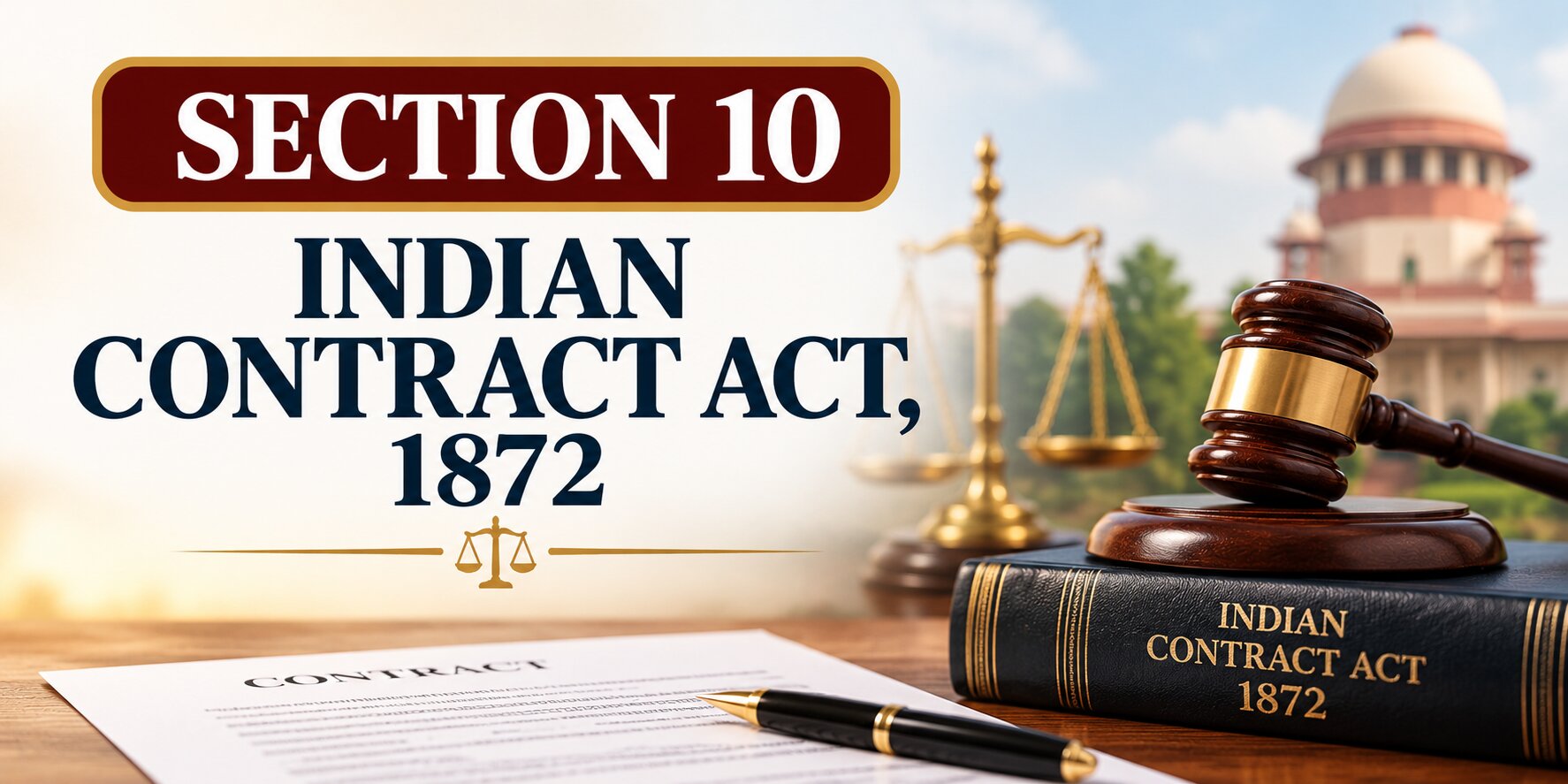
Section 10: What agreements are contracts.
All agreements are contracts if they are made by the free consent of parties competent to contract, for a lawful consideration and with a lawful object, and are not hereby expressly declared to be void.
Nothing herein contained shall affect any law in force in India, and not hereby expressly repealed, by which any contract is required to be made in writing, or in the presence of witnesses, or any law relating to the registration of documents.
Explained:
Section 10 of the Indian Contract Act, 1872 is one of the fundamental provisions governing the validity of contracts in India. It explains when an agreement becomes a legally enforceable contract. The provision requires free consent, competent parties, lawful consideration, a lawful object and the absence of any statutory provision declaring the agreement void.
Essentials of a Valid Contract
Under Section 10, an agreement generally becomes a contract when the following requirements are satisfied:
1. Free Consent: The parties must voluntarily agree to the terms. Consent affected by coercion, undue influence, fraud or misrepresentation may affect enforceability.
2. Competent Parties: The parties must have legal capacity to contract. Section 11 deals with competency, including majority, soundness of mind and absence of legal disqualification.
3. Lawful Consideration: The consideration exchanged between the parties must be legally permissible.
4. Lawful Object: The purpose of the agreement must not be unlawful, fraudulent, immoral or opposed to public policy.
5. Agreement Must Not Be Void: The agreement must not fall within provisions that expressly declare certain agreements void.
Section 10 also recognises that other laws may require particular contracts to be in writing, witnessed or registered. Such statutory formalities must still be complied with.
Important Judgments
Mohori Bibee v. Dharmodas Ghose (1903)
The Privy Council held that a minor is not competent to contract under Section 11. Therefore, an agreement entered into by a minor is void ab initio. The decision demonstrates the close relationship between Sections 10 and 11.
Trimex International FZE Ltd. v. Vedanta Aluminium Ltd. (2010)
The Supreme Court recognised that a concluded contract may arise through correspondence when the essential terms have been agreed and accepted. A formal signed document is not necessarily indispensable where the parties have otherwise concluded a binding agreement.
Gherulal Parakh v. Mahadeodas Maiya (1959)
The Supreme Court considered the effect of agreements involving wagering transactions and the statutory framework concerning lawful and unlawful agreements. The case remains an important authority in understanding agreements that may not receive contractual enforcement.
Conclusion
Section 10 therefore acts as the foundation for determining contractual validity. An agreement must satisfy the statutory requirements concerning consent, capacity, consideration and object before it can receive legal recognition as an enforceable contract.


Leave a Reply