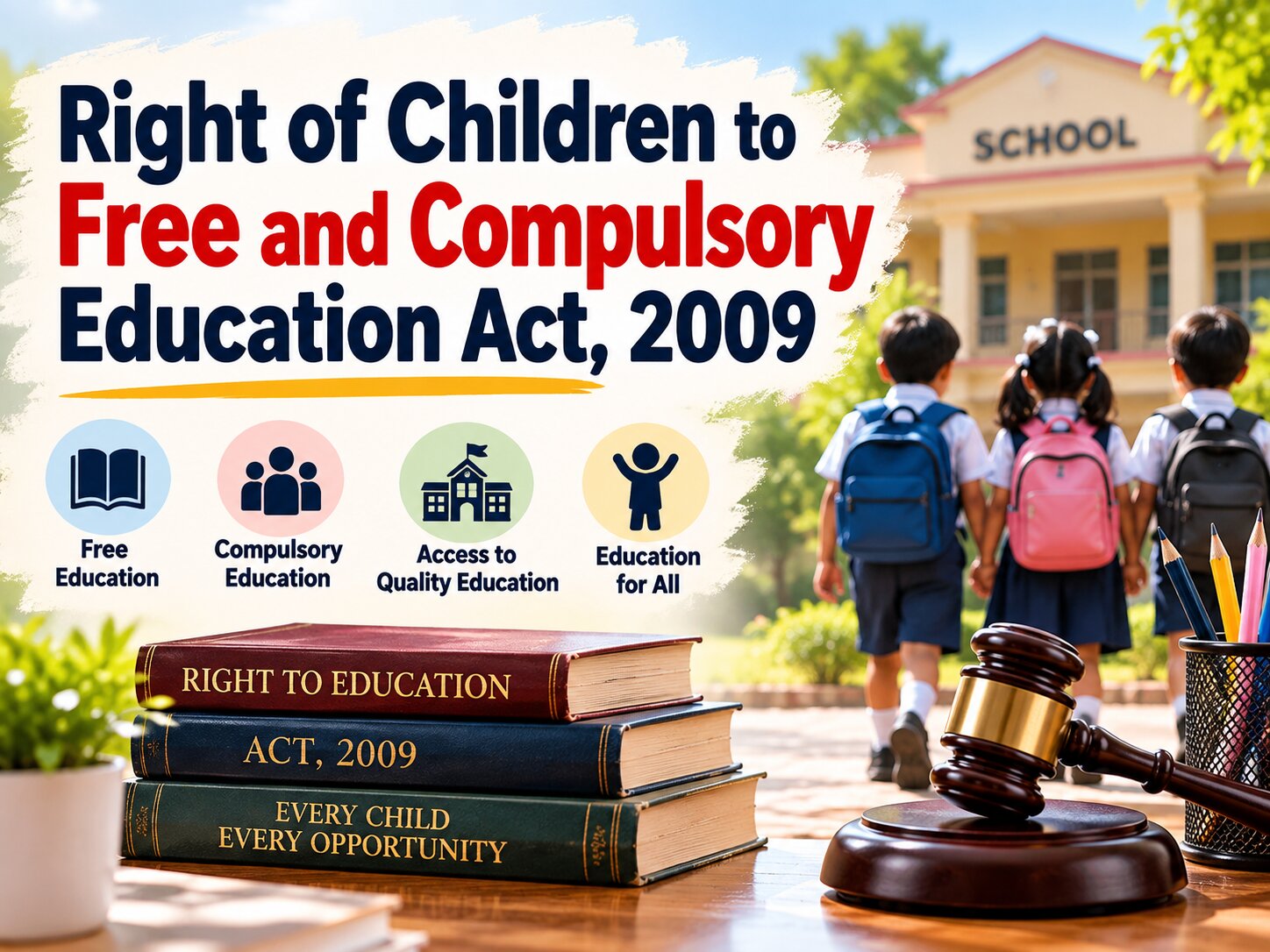
The Right of Children to Free and Compulsory Education Act, 2009 consists of 38 sections divided into 7 chapters outlining the legal framework for elementary education in India under Article 21A.
Chapter I: Preliminary (Sections 1–2)
- Section 1: Short title, extent, and commencement of the Act.
- Section 2: Definitions of terms like appropriate government, child, elementary education, and capitation fee.
Chapter II: Right to Free and Compulsory Education (Sections 3–5)
- Section 3: Right of children to free and compulsory education in a neighborhood school.
- Section 4: Special training provisions for age-appropriate admission of out-of-school children.
- Section 5: Right of a child to transfer to another school.
Chapter III: Duties of Appropriate Government, Local Authority and Parents (Sections 6–11)
- Section 6: Duty of the government and local authority to establish neighborhood schools.
- Section 7: Sharing of financial and other responsibilities between central and state governments.
- Section 8 & 9: Specific duties of the appropriate government and local authorities.
- Section 10: Duty of parents and guardians to ensure elementary education attendance.
- Section 11: Provision for pre-school education for children above three years.
Chapter IV: Responsibilities of Schools and Teachers (Sections 12–28)
- Section 12: Extent of school responsibility, including the 25% reservation for weaker sections in private/specified schools.
- Section 13: Prohibition of capitation fees and screening procedures for admission.
- Section 14 & 15: Proof of age and rules against denial of admission.
- Section 16: Prohibition of holding back and expelling students in elementary classes.
- Section 17: Prohibition of physical punishment and mental harassment.
- Section 18 & 19: Requirement of a certificate of recognition and compliance with school infrastructure norms and standards.
- Section 20: Power of the government to amend the schedule of norms.
- Section 21 & 22: Formation of School Management Committees (SMC) and School Development Plans.
- Section 23: Qualifications, terms, and service conditions of teachers.
- Section 24 & 25: Duties of teachers and maintenance of specified Pupil-Teacher Ratios (PTR).
- Section 26 & 27: Filling up teacher vacancies and restrictions on deploying teachers for non-educational work (except census, elections, and disaster relief).
- Section 28: Prohibition of private tuition by teachers.
Chapter V: Curriculum and Completion of Elementary Education (Sections 29–30)
- Section 29: Curriculum development aligned with constitutional values and all-round child development.
- Section 30: Exemption from holding mandatory board/completion examinations until the end of elementary education (as amended later by states).
Chapter VI: Protection of Right of Children (Sections 31–34)
- Section 31 & 32: Monitoring of the child’s right to education and grievance redressal mechanisms through National/State Commissions for Protection of Child Rights (NCPCR/SCPCR).
- Section 33 & 34: Constitution of a National Advisory Council to advise the central government.
Chapter VII: Miscellaneous (Sections 35–38)
- Section 35: Power of central/state governments and local authorities to issue guidelines and directions.
- Section 36: Prior sanction of the appropriate government required for prosecution of offenses.
- Section 37: Protection of action taken in good faith under the Act.
- Section 38: Power of appropriate governments to make rules for carrying out the provisions of the Act.
Leave a Reply