Section 26 of IT Act 2000:
Section 26(1)
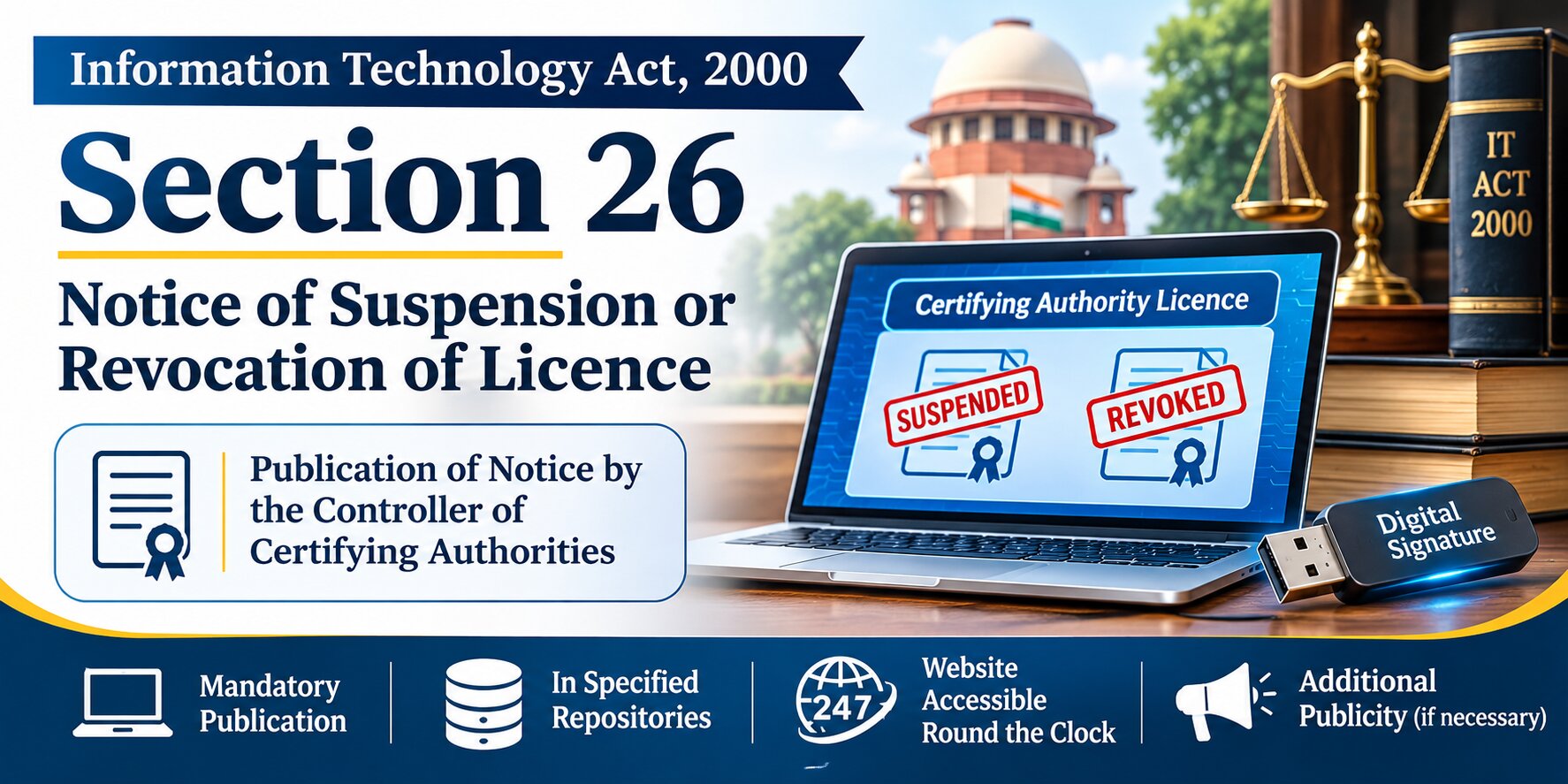
Where the licence of the Certifying Authority is suspended or revoked, the Controller shall publish notice of such suspension or revocation, as the case may be, in the data base maintained by him.
Section 26(2)
Where one or more repositories are specified, the Controller shall publish notices of such suspension or revocation, as the case may be, in all such repositories:
Provided that the data base containing the notice of such suspension or revocation, as the case may be, shall be made available through a web site which shall be accessible round the clock:
Provided further that the Controller may, if he considers necessary, publicise the contents of data base in such electronic or other media, as he may consider appropriate.
Explained:
Section 26 contains two subsections and two provisos. Each part establishes a specific responsibility relating to public notification of the suspension or revocation of a Certifying Authority’s licence.
Section 26(1): Publication of Notice in the Controller’s Database
Subsection (1) provides that whenever the licence of a Certifying Authority is suspended or revoked, the Controller must publish a notice of that action in the database maintained by the Controller.
The provision uses the word “shall”, making publication a mandatory responsibility rather than an optional administrative activity.
A Certifying Authority is an organisation licensed under the Information Technology Act, 2000, to issue Electronic Signature Certificates. These certificates help establish the identity of subscribers and support the authentication of electronic records.
If such an authority loses its licence or its licence is suspended, people relying on its certification services need to know about the change.
Example: Suppose a licensed Certifying Authority is found to have violated applicable regulatory requirements, and its licence is suspended by the competent authority. Under Section 26(1), the Controller must publish notice of that suspension in the database maintained by the Controller.
This helps users identify changes in the regulatory status of the concerned authority.
Section 26(2): Publication of Notices in Specified Repositories
Subsection (2) extends the publication requirement beyond the database maintained by the Controller.
Where one or more repositories are specified, the Controller must publish notices of suspension or revocation in all such repositories.
Repositories are important because they provide a source of information relating to electronic signature certificates and their status. Making relevant notices available through specified repositories helps users and organisations access information from the appropriate certification infrastructure.
The provision therefore strengthens transparency and improves the availability of information concerning the licensing status of Certifying Authorities.
First Proviso: Website Must Be Accessible Round the Clock
The first proviso to Section 26(2) requires the database containing the notice of suspension or revocation to be made available through a website accessible round the clock.
This requirement ensures that information concerning the licensing status of Certifying Authorities is not restricted to office hours.
Individuals, businesses, banks and government organisations may need to verify certification-related information at different times. Continuous website accessibility helps users obtain relevant information whenever required.
The objective is to improve transparency and provide convenient access to important regulatory information.
Second Proviso: Additional Publicity Through Electronic or Other Media
The second proviso gives the Controller discretion to publicise the contents of the database through electronic or other media whenever considered necessary.
The purpose is to ensure that important information reaches the relevant users and stakeholders.
Depending on the circumstances, publicity may be provided through suitable electronic platforms or other appropriate communication channels.
For example, if a Certifying Authority’s licence is revoked and the Controller considers wider publicity necessary, information may be disseminated through appropriate media in addition to the statutory database.
This provision provides flexibility to communicate important regulatory decisions effectively.
Importance of Section 26 in Digital Transactions
Section 26 is significant because electronic signatures are widely used in modern commercial and administrative activities.
1. Protection of electronic signature users: Publication of licensing changes helps users avoid relying on a Certifying Authority without checking its current regulatory status.
2. Transparency in certification services: Public availability of suspension and revocation notices promotes transparency in the digital certification system.
3. Regulatory accountability: The provision ensures that the Controller communicates important licensing decisions through the prescribed channels.
4. Confidence in digital transactions: Reliable information about Certifying Authorities supports confidence in electronic authentication and digital documentation.
5. Prevention of confusion and misuse: Timely publication can help reduce confusion about the authority of a Certifying Authority to provide certification services.
Important Judgments
Section 26 is a specific procedural provision dealing with publication of suspension or revocation notices. There are limited reported higher-court decisions directly examining its interpretation. The following decisions provide useful context on electronic records, digital transactions and the legal framework governing electronic information. They should not be treated as direct rulings on Section 26.
1. Anvar P.V. v. P.K. Basheer (2014)
The Supreme Court examined the admissibility of electronic records under Section 65B of the Indian Evidence Act, 1872.
Relevance: The judgment established important requirements for proving electronic records in court. It highlights the importance of authenticity and reliability in electronic documentation, which are also important considerations in the digital certification framework.
2. Arjun Panditrao Khotkar v. Kailash Kushanrao Gorantyal (2020)
The Supreme Court clarified the requirements relating to the admissibility of electronic evidence and the certificate prescribed under Section 65B of the Indian Evidence Act, 1872.
Relevance: The decision explains the importance of following legal requirements when electronic records are produced as evidence. Although it does not directly interpret Section 26, it provides useful guidance concerning the legal treatment of electronic information.
3. Trimex International FZE Ltd. v. Vedanta Aluminium Ltd. (2010)
The Supreme Court considered whether contractual negotiations conducted through email communications could result in a binding agreement.
Relevance: The decision demonstrates the legal importance of electronic communications in commercial transactions. It provides broader context for understanding the growing importance of trustworthy electronic documentation and authentication.
These decisions should be read as contextual authorities rather than judgments deciding the specific publication duties imposed by Section 26.
Difference Between Suspension and Revocation of Licence
Suspension and revocation are different regulatory actions.
| Suspension | Revocation |
|---|---|
| Temporarily suspends the licence or its operation. | Cancels the licence. |
| May be subject to specified conditions and duration. | Generally terminates the authority’s licence. |
| The authority may be permitted to resume operations if suspension is lifted. | A fresh legal authorisation may be required before the authority can operate again. |
Both actions trigger the publication obligations prescribed under Section 26.
Conclusion
Section 26 of the Information Technology Act, 2000, plays an important role in maintaining transparency and accountability in India’s electronic signature certification system. It requires the Controller to publish notices whenever the licence of a Certifying Authority is suspended or revoked.
The provision also requires publication in specified repositories, ensures round-the-clock website accessibility of the relevant database and permits wider publicity through electronic or other media when necessary.
For individuals, companies, government departments and organisations relying on digital signatures, Section 26 provides an important mechanism for obtaining information about the regulatory status of Certifying Authorities.
Understanding this provision along with Sections 17 to 25 of the Information Technology Act helps readers understand the regulatory framework governing Certifying Authorities in India.
Leave a Reply