
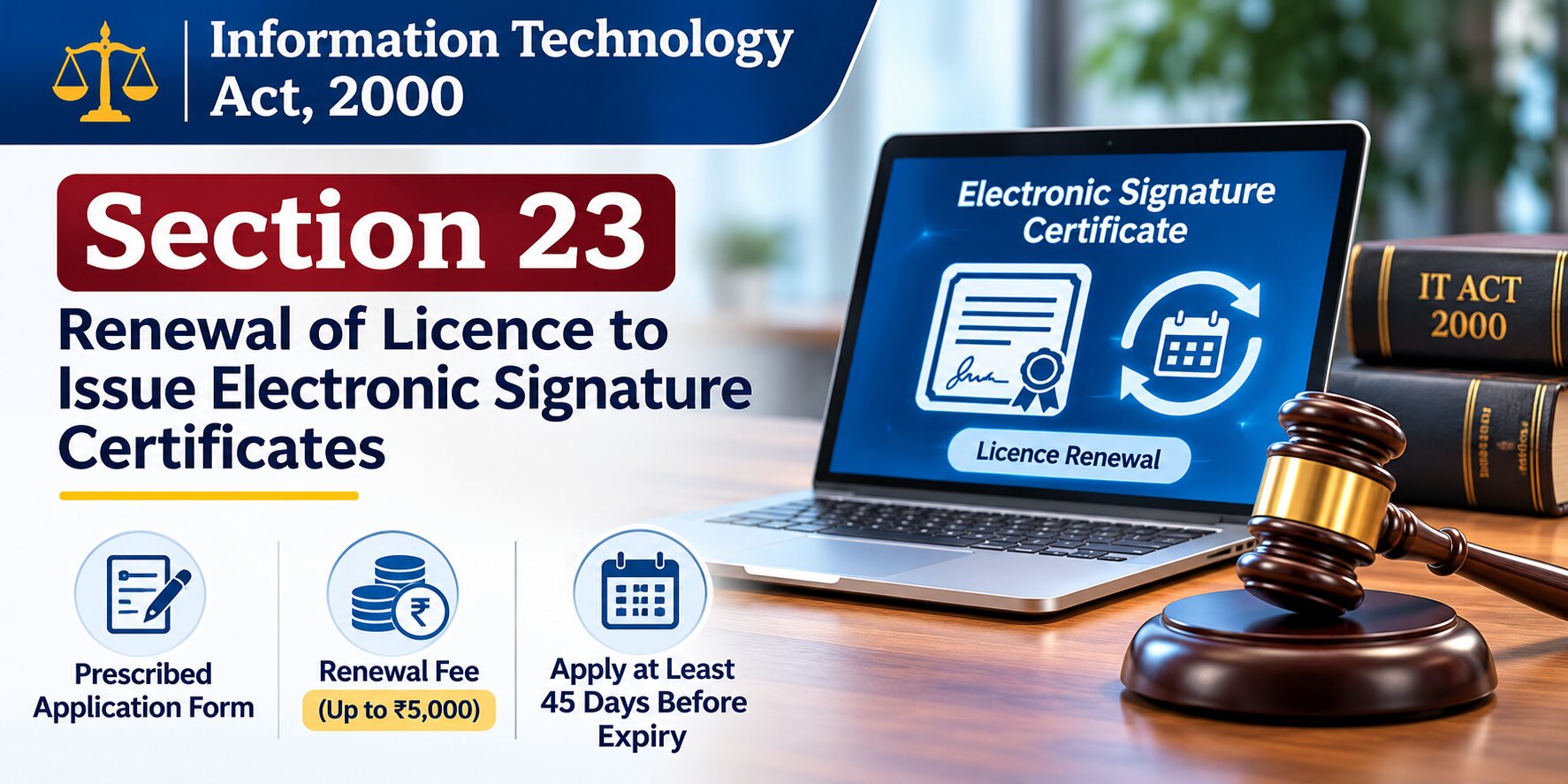
Section 23 of IT Act 2000:
An application for renewal of a licence shall be—
(a) in such form;
(b) accompanied by such fees, not exceeding five thousand rupees, as may be prescribed by the Central Government; and
(c) made not less than forty-five days before the date of expiry of the period of validity of the licence.
Explained:
Section 23 does not contain separately numbered subsections. It provides three requirements through which a Certifying Authority can apply for renewal of its licence.
Clause (a): Application in the prescribed form
The first requirement is that the application for renewal must be submitted in the form prescribed by the Central Government.
A Certifying Authority cannot simply request renewal through an informal letter or an unspecified communication. It must follow the prescribed application procedure and provide the information required by the applicable rules.
The purpose of this requirement is to maintain uniformity in the licensing process and enable the Controller to examine renewal applications properly.
Clause (b): Payment of prescribed renewal fees
The second requirement concerns payment of the renewal fee.
Section 23 provides that the renewal application must be accompanied by the prescribed fee, which cannot exceed ₹5,000 under the statutory wording.
The fee is intended to form part of the regulatory process governing the continuation of a Certifying Authority’s licence. The actual payable amount and payment procedure must be checked against the applicable rules.
Payment of the prescribed fee alone does not automatically guarantee renewal. The applicant must also comply with the relevant licensing conditions and regulatory requirements.
Clause (c): Application at least 45 days before expiry
The third important requirement relates to the time for submitting the renewal application.
Section 23 requires the application to be made not less than 45 days before the expiry of the licence.
This advance period allows the licensing authority sufficient time to examine the application and take an appropriate decision before the existing licence expires.
For example, if a Certifying Authority’s licence expires on 30 September, the renewal application should be submitted at least 45 days before that date.
Submitting an application within the prescribed period helps avoid unnecessary interruption in the authority’s licensing status. Organisations should therefore maintain a renewal calendar and begin preparing their documentation well in advance.
Who Is a Certifying Authority Under the IT Act?
A Certifying Authority is a person or organisation granted a licence under Section 24 of the Information Technology Act, 2000, to issue Electronic Signature Certificates.
These authorities perform an important role in the electronic authentication system. Their responsibilities include verifying relevant subscriber information, issuing certificates and maintaining appropriate security procedures.
For example, when an individual applies for an electronic signature certificate, the Certifying Authority follows the applicable verification process before issuing the certificate.
The licensing framework helps ensure that organisations providing electronic signature certification services meet prescribed standards of competence, security and reliability.
Important Judgments
There is a distinction between judgments directly interpreting Section 23 and decisions explaining the general principles governing administrative licensing decisions. The following Supreme Court judgments are relevant to understanding the legal principles that may arise when a licensing authority considers an application or takes an adverse administrative decision.
1. State of Orissa v. Dr. (Miss) Binapani Dei (1967)
Citation: AIR 1967 SC 1269.
The Supreme Court held that even an administrative order involving civil consequences must comply with the principles of natural justice. The affected person must receive a fair opportunity to understand and respond to the case against them.
Relevance to Section 23: If a renewal-related decision involves adverse administrative consequences, the principles of natural justice may become relevant, depending on the nature of the decision and the applicable statutory provisions. Indian Kanoon+1
2. Canara Bank v. Debasis Das (2003)
Citation: (2003) 4 SCC 557.
The Supreme Court examined the application of natural justice in administrative and disciplinary proceedings. It discussed the importance of providing a reasonable opportunity of hearing and considered whether procedural shortcomings had caused prejudice.
Relevance to Section 23: The judgment provides guidance on procedural fairness in administrative decision-making. It may be relevant when examining disputes concerning the treatment of applications or adverse decisions by regulatory authorities. Indian Kanoon+1
3. A.K. Kraipak v. Union of India (1969)
Citation: (1969) 2 SCC 262.
The Supreme Court examined the principles of natural justice in administrative selection processes. The judgment explained that the distinction between administrative and quasi-judicial functions cannot be used to justify unfair decision-making.
Relevance to Section 23: The decision provides broader guidance on fairness and impartiality in administrative processes, including regulatory decisions involving licences and statutory permissions.
Important: These judgments concern general administrative law principles. They should not be represented as direct judgments interpreting Section 23 of the Information Technology Act.
Responsibilities of Certifying Authorities During Licence Renewal
A Certifying Authority seeking renewal should take appropriate steps to ensure that its operations remain compliant with the Information Technology Act and applicable regulations.
Important responsibilities include:
- Maintaining the required technical infrastructure and security systems.
- Following the applicable procedures for issuing Electronic Signature Certificates.
- Protecting subscriber information and electronic signature credentials.
- Maintaining appropriate records and documentation.
- Complying with the conditions imposed by the licensing authority.
- Submitting the renewal application within the statutory period.
Section 30 also requires Certifying Authorities to follow prescribed security and operational procedures. Section 31 requires them to ensure compliance by their employees and other persons engaged by them. These provisions reinforce the regulatory obligations associated with operating as a licensed Certifying Authority. India Code
Difference Between Section 22 and Section 23
| Section 22 | Section 23 |
|---|---|
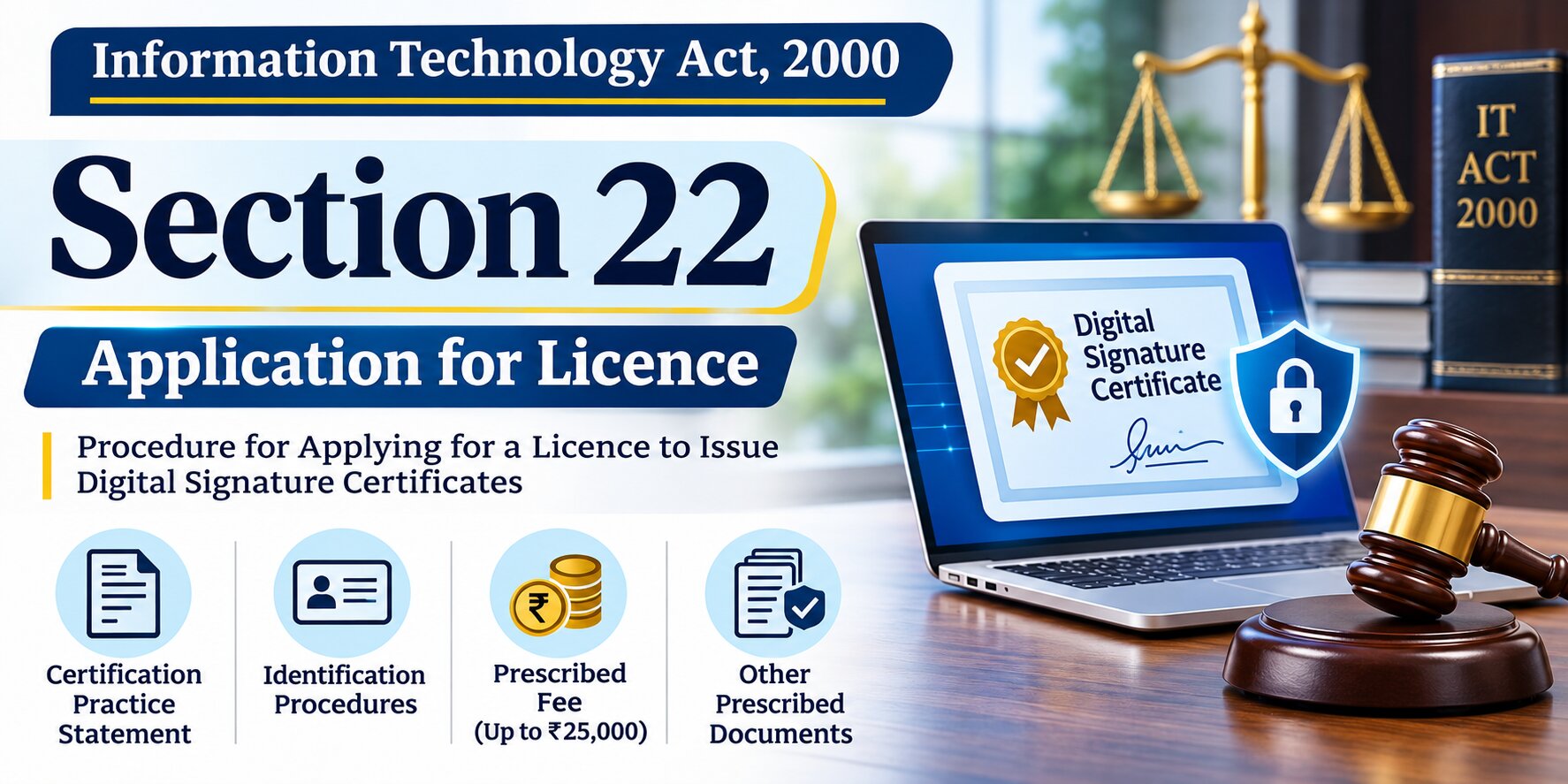
| Deals with the original application for a licence. | Deals with renewal of an existing licence. |
| Requires prescribed documents and application fees. | Requires the prescribed renewal form and fee. |
| Applies to persons seeking an initial licence. | Applies to existing licensed Certifying Authorities. |
| Forms part of the initial licensing process. | Ensures continuity through the renewal process. |
Conclusion
Section 23 of the Information Technology Act, 2000, plays an important role in regulating Certifying Authorities in India. It establishes the procedure for renewing licences and requires applicants to follow the prescribed application format, pay the applicable renewal fee and submit their applications at least 45 days before the expiry of their licences.
The provision helps maintain continuity in the electronic signature certification system and supports regulatory supervision of organisations authorised to issue Electronic Signature Certificates.


Leave a Reply