
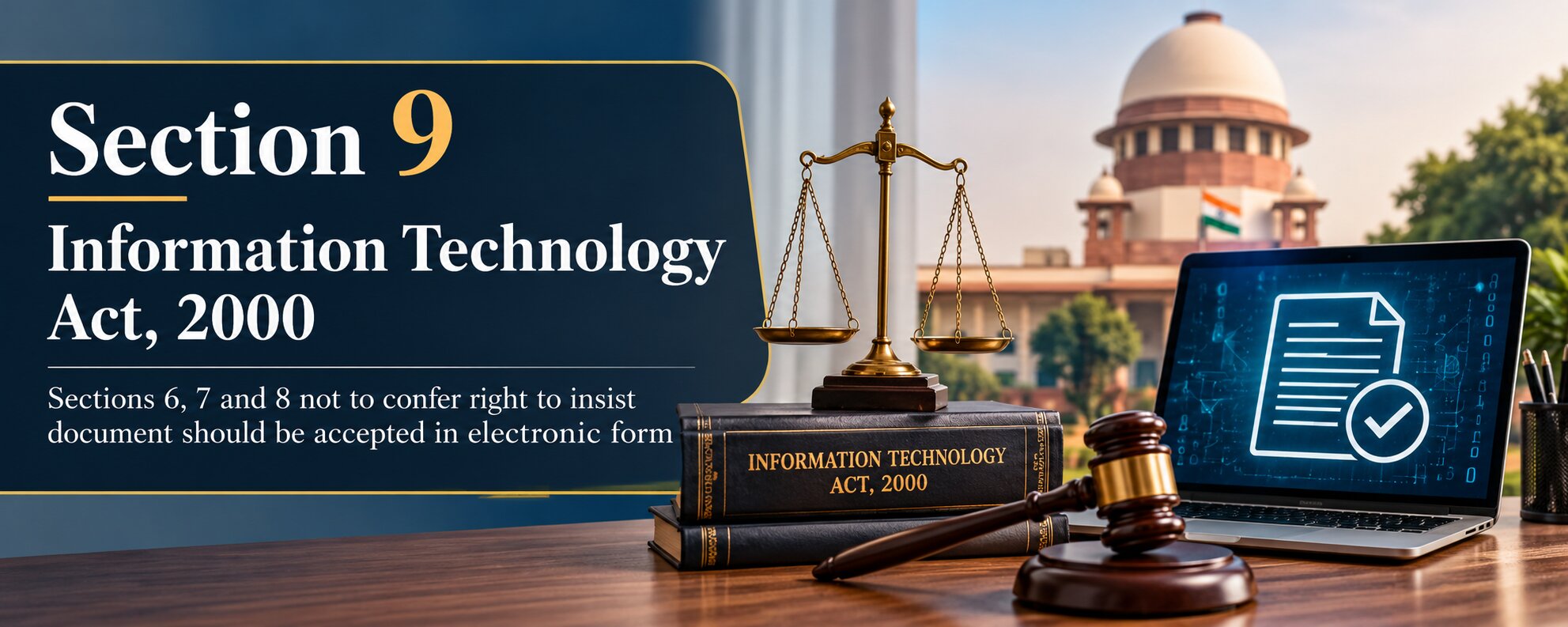
Section 9 of IT Act 2000:
Nothing contained in sections 6, 7 and 8 shall confer a right upon any person to insist that any Ministry or Department of the Central Government or the State Government or any authority or body established by or under any law or controlled or funded by the Central or State Government should accept, issue, create, retain and preserve any document in the form of electronic records or effect any monetary transaction in the electronic form.
Explained:
1. Meaning of “nothing contained in Sections 6, 7 and 8”
The opening words establish the relationship between Section 9 and the preceding provisions of the Act.
- Section 6: Addresses the use of electronic records and electronic signatures in government and its agencies.
- Section 7: Deals with the retention of electronic records where legal requirements for retaining documents apply.
- Section 8: Provides for publication of rules, regulations and similar matters in the Electronic Gazette.
Section 9 clarifies that these provisions do not automatically give an individual the right to insist that a public authority conduct every such activity electronically.
2. Government departments and public authorities
Section 9 applies to ministries and departments of the Central Government and State Governments, as well as authorities or bodies established by law or controlled or funded by the Central or State Governments.
For example, a citizen may prefer to submit an application through an online portal. However, Section 9 means that Sections 6, 7 and 8 alone do not establish a right to compel the department to accept the application electronically.
Whether electronic submission is available or legally required depends on the relevant legislation, government rules, notifications and applicable administrative procedures.
3. Acceptance of electronic records
The provision covers the acceptance of documents in electronic form. It prevents the general recognition of electronic records under the Act from being interpreted as a universal obligation on public authorities to accept every document electronically.
This does not mean that a government department can disregard a separate legal requirement to provide an electronic service. Where another applicable law or binding rule requires electronic acceptance, that obligation must be assessed independently.
4. Issuing, creating, retaining and preserving electronic documents
Section 9 also refers to the issuing, creation, retention and preservation of electronic records.
These terms cover different stages of document management. A department might issue a certificate electronically, create an electronic record during an administrative process, or preserve records in a digital archive.
Section 9 clarifies that Sections 6, 7 and 8 do not independently entitle a person to demand that every one of these activities be conducted electronically. The relevant legal framework and the authority’s applicable procedures remain important.
5. Electronic monetary transactions
The final part of Section 9 covers monetary transactions in electronic form.
For instance, an individual may prefer to pay a government fee through an online payment system. Section 9 does not, by itself, establish a right to compel a government authority to accept every payment electronically.
However, if a particular service is governed by rules requiring digital payment, the authority’s obligations must be examined under those rules rather than Section 9 alone.
Important Judgments
A key point for legal accuracy is that reported decisions directly interpreting Section 9 are limited. The following cases provide related context on electronic records and electronic governance, but they should not be presented as direct rulings on Section 9.
1. Union of India v. G.S. Chatha Rice Mills (2020)
The Supreme Court examined the legal significance of publication in the Official Gazette and Electronic Gazette in the context of the applicable customs notification.
Relevance: The judgment is relevant to understanding Section 8 and the legal role of electronic publication. It helps explain the statutory framework surrounding Section 9, although it is not a direct ruling on the scope of Section 9 itself. IndiaCode+1
2. Anvar P.V. v. P.K. Basheer (2014)
The Supreme Court considered the requirements for admitting electronic records as evidence under the Indian Evidence Act, 1872.
Relevance: This decision illustrates the importance of distinguishing the legal recognition of electronic records from the rules governing their use in court. It concerns electronic evidence rather than the direct interpretation of Section 9.
3. Arjun Panditrao Khotkar v. Kailash Kushanrao Gorantyal (2020)
The Supreme Court clarified the requirements for proving electronic evidence under Section 65B of the Indian Evidence Act, 1872.
Relevance: The judgment provides useful background on electronic records and legal compliance. It does not establish that Section 9 gives or removes a specific right to demand electronic services from government departments.
For proceedings governed by current evidence legislation, the Bharatiya Sakshya Adhiniyam, 2023, which came into force on 1 July 2024, should also be considered.
Importance of Section 9
Section 9 maintains a distinction between recognising electronic records and requiring public authorities to operate entirely electronically. It allows the applicable government framework to determine which services, documents and payment processes are available in digital form.
For citizens, the practical lesson is to check the relevant department’s rules, official notifications and application procedures before insisting on electronic submission. For businesses and legal professionals, the provision highlights the importance of identifying the specific statutory basis for any claimed right to digital service delivery.
Conclusion
Section 9 of the Information Technology Act, 2000, places a clear limitation on the effect of Sections 6, 7 and 8. It clarifies that those provisions do not, by themselves, confer a right to compel specified government departments and public authorities to accept, issue, create, retain or preserve documents electronically or conduct monetary transactions electronically.
The provision does not prohibit electronic governance. Instead, it distinguishes the legal recognition of electronic records from an enforceable right to demand that every public service be delivered digitally.
Leave a Reply