
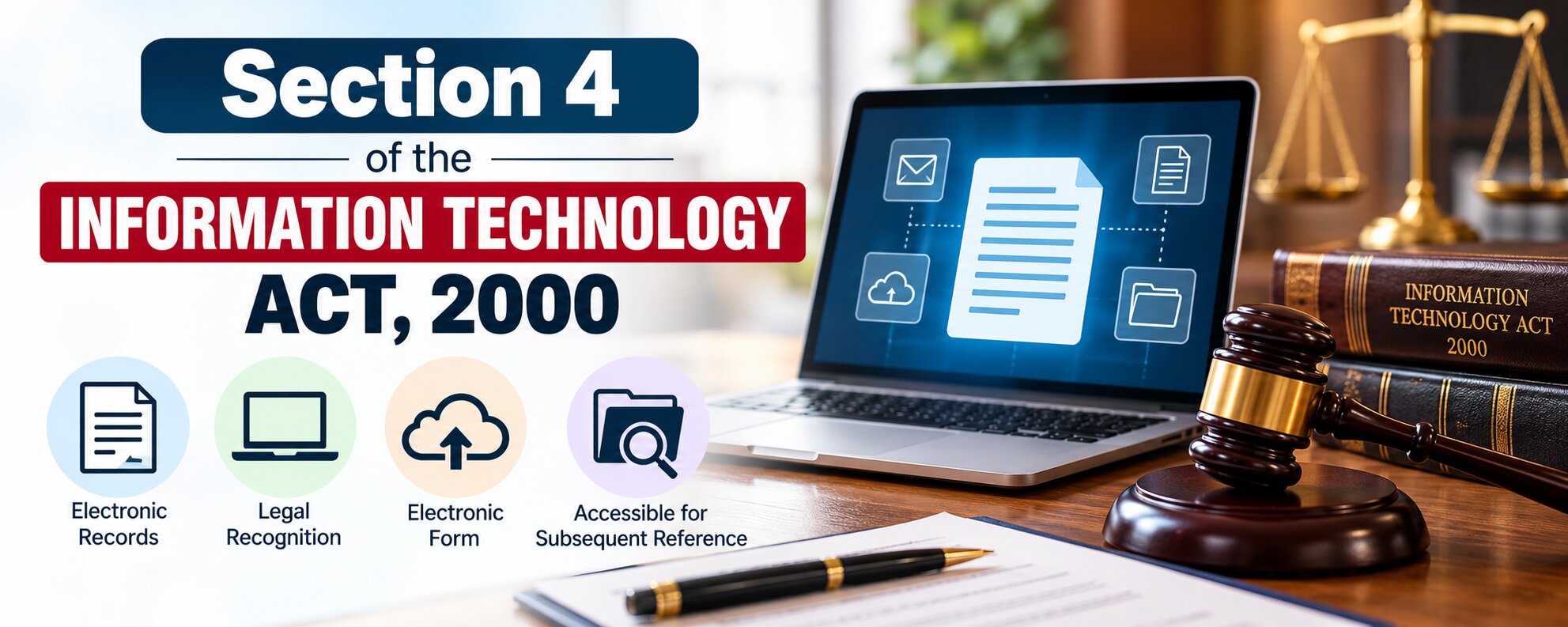
Section 4 of IT Act 2000: Legal recognition of electronic records.
Where any law provides that information or any other matter shall be in writing or in the typewritten or printed form, then, notwithstanding anything contained in such law, such requirement shall be deemed to have been satisfied if such information or matter is—
(a) rendered or made available in an electronic form; and
(b) accessible so as to be usable for a subsequent reference.
Explained:
Section 4 contains two essential conditions. Both must be considered when determining whether an electronic record satisfies a legal requirement for written or printed information.
1.Information rendered or made available in electronic form
The first requirement is that the relevant information must be rendered or made available electronically. Electronic records may include digital documents, electronic statements, computer-generated reports, emails and other forms of digitally stored information, depending on the circumstances.
For example, a business may maintain invoices electronically rather than printing every invoice on paper. Similarly, an organisation may store its internal records in a computer system.
The central idea is that information need not always exist as a physical paper document to satisfy a legal requirement for written information. Its electronic form may be recognised under Section 4 when the statutory conditions are fulfilled.
2.Accessibility for subsequent reference
The second requirement is that the electronic information must be accessible and usable for subsequent reference.
This means the record should be capable of being retrieved and consulted when required. Merely creating an electronic document may not be sufficient if the information cannot subsequently be accessed or used.
For instance, an electronic invoice stored in a properly maintained accounting system may be retrieved later for an audit, tax assessment or commercial dispute. By contrast, a temporary electronic message that cannot be recovered may raise questions about whether the requirement of subsequent accessibility has been met.
This condition highlights the importance of appropriate electronic recordkeeping, secure storage, backups and reliable retrieval procedures.
Applications of Section 4
Section 4 has practical importance in several areas of everyday life and commercial activity.
- Business transactions: Electronic invoices, accounting records and business correspondence can help satisfy applicable requirements for written information.
- Banking and finance: Electronic statements and transaction records support digital banking and financial recordkeeping.
- Government services: Electronic records facilitate online applications, registrations and administrative processes, subject to the relevant rules.
- Commercial disputes: Emails and electronic acknowledgements may help establish communications between parties, depending on their authenticity and the applicable law.
- Corporate recordkeeping: Digital storage allows organisations to retrieve documents for audits, compliance and future reference.
Nevertheless, Section 4 does not automatically validate every electronic document. Requirements concerning signatures, prescribed formats, service of notices and admissibility of evidence must be examined separately.
Important Judicial Decisions
Megha Enterprises v. Haldiram Snacks Pvt. Ltd. (2021)
In Megha Enterprises v. Haldiram Snacks Pvt. Ltd., decided by the Delhi High Court on 15 April 2021, the Court considered the legal significance of electronic communications in the context of an acknowledgement of debt and limitation under Section 18 of the Limitation Act, 1963.
The Court explained how Section 4 of the Information Technology Act supports the recognition of electronic information where the law requires written information. In the circumstances of the case, relevant emails were considered in determining whether an acknowledgement of debt could satisfy the requirements of Section 18.
Legal significance: The decision illustrates that electronic correspondence may have legal consequences when it satisfies the applicable statutory conditions. Indian Kanoon+1
Delhi Tourism Transportation Development Corporation Ltd. v. Barefoot Holidays India Pvt. Ltd. (2022)
In this case, decided by the Delhi High Court on 13 July 2022, the Court examined whether sending an order through email was sufficient to satisfy the statutory requirements governing service under the Public Premises (Eviction of Unauthorised Occupants) Act, 1971 and its associated rules.
The Court observed that Section 4, by itself, did not dispense with the specific requirements for service prescribed under the applicable legislation and rules.
Legal significance: Recognition of an electronic record does not necessarily mean that every statutory procedure can be completed through email. Where a law prescribes a particular method of service, that requirement must also be considered. Indian Kanoon+1
Arjun Panditrao Khotkar v. Kailash Kushanrao Gorantyal (2020)
The Supreme Court of India decided Arjun Panditrao Khotkar v. Kailash Kushanrao Gorantyal on 14 July 2020. The case dealt primarily with the admissibility of electronic evidence and the certificate requirement under Section 65B of the Indian Evidence Act, 1872.
The Supreme Court reaffirmed that the applicable certificate requirement under Section 65B(4) was a condition precedent for admitting the relevant secondary electronic evidence, subject to the legal principles explained in the judgment.
Legal significance: Section 4 establishes legal recognition of electronic records for written-form requirements, but recognition and admissibility as evidence are different questions. An electronic document may be recognised in law and still need to satisfy the applicable evidentiary requirements before a court can rely on it. Indian Kanoon+1
Limitations and Legal Considerations
Section 4 should not be interpreted as a universal replacement for every paper-based legal formality. The provision addresses requirements concerning information being in writing, typewritten or printed form. It does not independently establish that the information is genuine, that the sender is correctly identified or that the document has been properly signed.
Section 5 separately addresses the legal recognition of electronic signatures. Likewise, the applicable procedural and evidentiary rules may impose additional conditions.
For this reason, anyone relying on electronic records should preserve the original files where possible, maintain reliable backups, record relevant dates and retain information that may help establish authenticity. In litigation, the precise legal requirements will depend on the nature of the document, the proceedings and the legislation in force.
Conclusion
Section 4 of the Information Technology Act, 2000, is a fundamental provision supporting electronic governance and digital transactions in India. By recognising electronic information that is accessible for subsequent reference, it helps reduce dependence on paper documents and supports modern business and administrative practices.
The decisions in Megha Enterprises, Delhi Tourism v. Barefoot Holidays and Arjun Panditrao Khotkar demonstrate the importance of understanding electronic records within their proper legal context. The key principle is that electronic form can satisfy a requirement for written information, but compliance with other applicable legal formalities remains essential.
Leave a Reply