
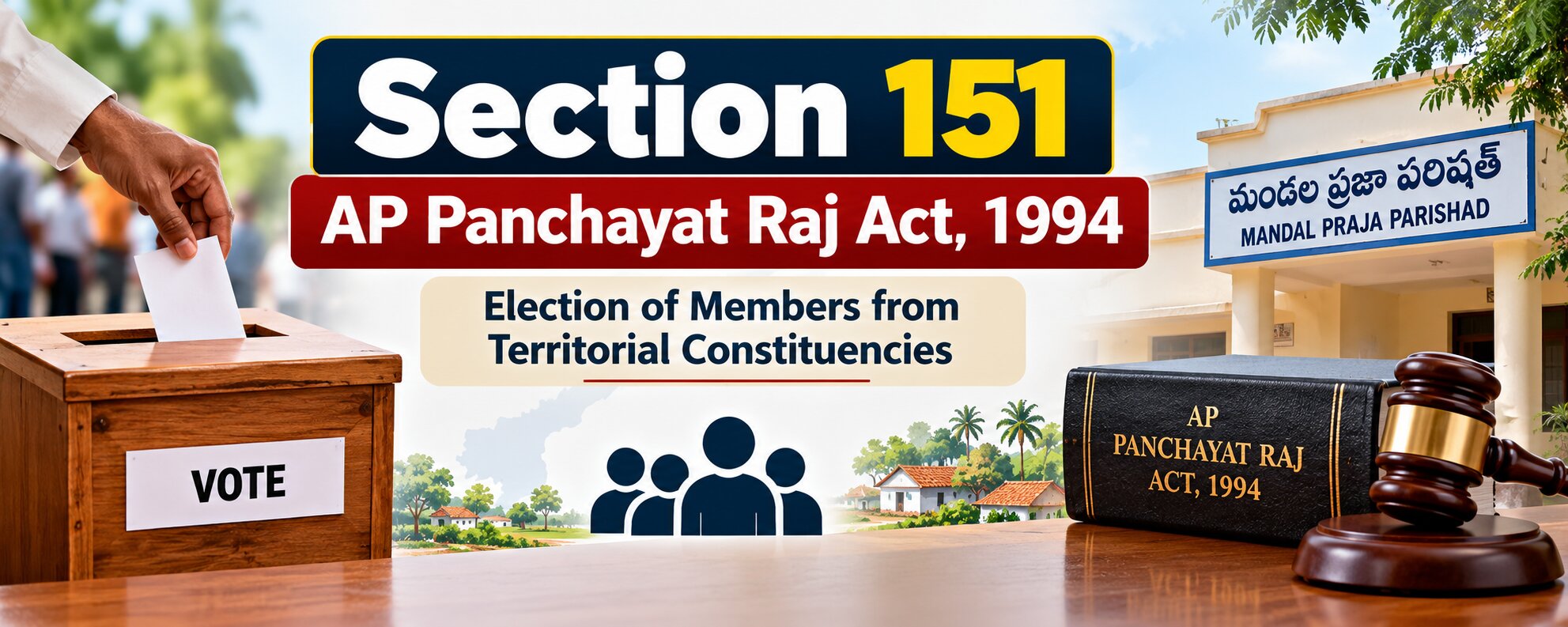
Section 151: Election of members from territorial constituencies
Section 151(1)
One member shall be elected to the Mandal Parishad from each territorial constituency specified in Section 150 by the method of secret ballot by the persons who are registered voters in the territorial constituency concerned:
Provided that a registered voter in the Mandal Parishad shall be entitled to contest from any territorial constituency of the Mandal Parishad.
Section 151(2)
For purposes of preparation and publication of the electoral roll for the elections to the office of member under this section, the provisions of Sections 11 and 12 shall mutatis mutandis apply, subject to such rules as may be made in this behalf.
Explained:
Section 151 of the Andhra Pradesh Panchayat Raj Act, 1994, deals with the election of members from territorial constituencies to the Mandal Parishad, also referred to in the amended legislation as the Mandal Praja Parishad. The provision establishes the legal basis for electing representatives from designated territorial constituencies through a secret ballot and explains how electoral rolls for these elections are to be prepared and published.
The purpose of this provision is to ensure that eligible voters have an opportunity to elect their representatives at the mandal level. It also connects the electoral process with the rules governing voter registration and electoral rolls under Sections 11 and 12 of the Act.
For citizens, candidates, election officials and law students, understanding Section 151 is important because it clarifies who elects Mandal Parishad members, how voting takes place and what legal provisions govern the preparation of electoral rolls.
1. Section 151(1): Election from Territorial Constituencies
The first subsection provides that one member must be elected from each territorial constituency identified under Section 150 of the Act. The election is conducted through a secret ballot by registered voters belonging to the relevant territorial constituency.
This provision establishes three important principles.
Election of one member: Each territorial constituency elects one member to represent its interests in the Mandal Parishad. This creates a direct connection between voters in a constituency and their elected representative.
Secret ballot system: Voting takes place through a secret ballot, protecting voters from undue influence and allowing them to exercise their choice freely. The secrecy of the ballot is an important safeguard for democratic elections.
Voting rights of registered electors: The right to vote in the constituency election is linked to registration in the electoral roll applicable to that constituency. Voter registration is therefore essential to the lawful conduct of the election.
The territorial constituencies referred to in this subsection are formed under Section 150, which addresses the division of the Mandal Parishad area into constituencies. Section 151 should consequently be read alongside Section 150 when examining the election of Mandal Parishad members.
2. Proviso to Section 151(1): Eligibility to Contest
The proviso states that a registered voter in the Mandal Parishad is entitled to contest from any territorial constituency within that Mandal Parishad.
This provision distinguishes between the right to vote and eligibility to contest an election. Voting takes place among registered voters of the particular constituency, whereas the proviso permits a registered voter of the Mandal Parishad to contest from any territorial constituency within that Mandal Parishad.
However, this provision should not be interpreted as removing other statutory requirements. A candidate must still satisfy the applicable qualifications and must not be disqualified under the relevant provisions of election law.
For example, if a person is registered as a voter in one territorial constituency of a Mandal Parishad, the proviso permits that person to contest from another territorial constituency within the same Mandal Parishad, subject to the applicable legal requirements.
3. Section 151(2): Preparation and Publication of Electoral Rolls
The second subsection deals with the preparation and publication of electoral rolls for elections to the office of Mandal Parishad member.
It incorporates Sections 11 and 12 of the Act mutatis mutandis. This Latin expression means that the relevant provisions apply with the necessary modifications to suit the circumstances of Mandal Parishad elections.
Section 11 concerns the preparation and publication of electoral rolls for a Gram Panchayat, while Section 12 addresses the rearrangement and republication of electoral rolls. Their application under Section 151(2) provides a statutory framework for preparing and updating the electoral rolls used in these elections.
Electoral rolls are important because they identify the persons entitled to vote. Errors in voter registration, incorrect entries or omissions may affect an individual’s ability to exercise electoral rights. Such issues must be addressed through the procedures and remedies available under the applicable election laws and rules.
The subsection also makes the process subject to rules prescribed for this purpose. Therefore, the Act must be read together with the relevant election rules and applicable notifications when determining the practical procedure for preparing and publishing electoral rolls.
Important Judicial Decisions Relevant to Section 151
The following Supreme Court decisions explain general principles of Indian election law that may be relevant when interpreting disputes concerning elections under Section 151. They should not be treated as judgments directly deciding the meaning of this particular section unless a specific ruling confirms that connection.
1. N. P. Ponnuswami v. Returning Officer, Namakkal Constituency (1952)
The Supreme Court considered the constitutional framework governing challenges to elections and emphasised the importance of following the statutory election process. The judgment is a foundational authority on the principle that election disputes should ordinarily be addressed through the remedies prescribed by election law.
Its general significance lies in the need to use the appropriate statutory procedure when challenging an election rather than bypassing the election dispute mechanism.
2. Mohinder Singh Gill v. Chief Election Commissioner (1978)
This landmark decision examined the powers of election authorities and the constitutional principles governing the conduct of elections. The Supreme Court recognised the importance of maintaining the integrity of the electoral process and ensuring that election authorities act within the framework of the law.
The principles discussed in this case are relevant when considering whether electoral decisions have been made lawfully and whether election authorities have exercised their powers appropriately.
3. Election Commission of India v. Ashok Kumar (2000)
The Supreme Court explained the circumstances in which judicial intervention may be permissible during an ongoing election. The judgment emphasised that judicial interference should not unnecessarily interrupt or obstruct the election process, while preserving the availability of appropriate judicial review in legally justified circumstances.
This principle may be relevant when disputes concerning electoral procedures or decisions arise during local-body elections.
These decisions provide general legal guidance. Anyone relying on them in litigation concerning Section 151 should examine the precise facts, applicable statutory provisions and subsequent judicial developments.
Practical Importance of Section 151
Section 151 plays an important role in establishing representative local government at the Mandal Parishad level. It provides the framework for constituency-based elections, protects the secrecy of voting and links electoral rolls to statutory procedures.
For candidates, the provision clarifies the territorial scope within which they may contest, subject to other legal qualifications. For voters, it establishes the basis for electing a representative from their constituency. For election officials, it highlights the importance of maintaining accurate electoral rolls and following the prescribed procedures.
Conclusion
Section 151 of the Andhra Pradesh Panchayat Raj Act, 1994, is an important provision governing the election of Mandal Parishad members from territorial constituencies. Its two subsections address the election of representatives through secret ballot and the preparation and publication of electoral rolls.
Read together with Sections 11, 12 and 150, the provision forms part of the statutory framework for democratic representation at the mandal level. Understanding its requirements helps voters, candidates and legal practitioners assess election procedures and identify the appropriate legal remedies when disputes arise.
Leave a Reply