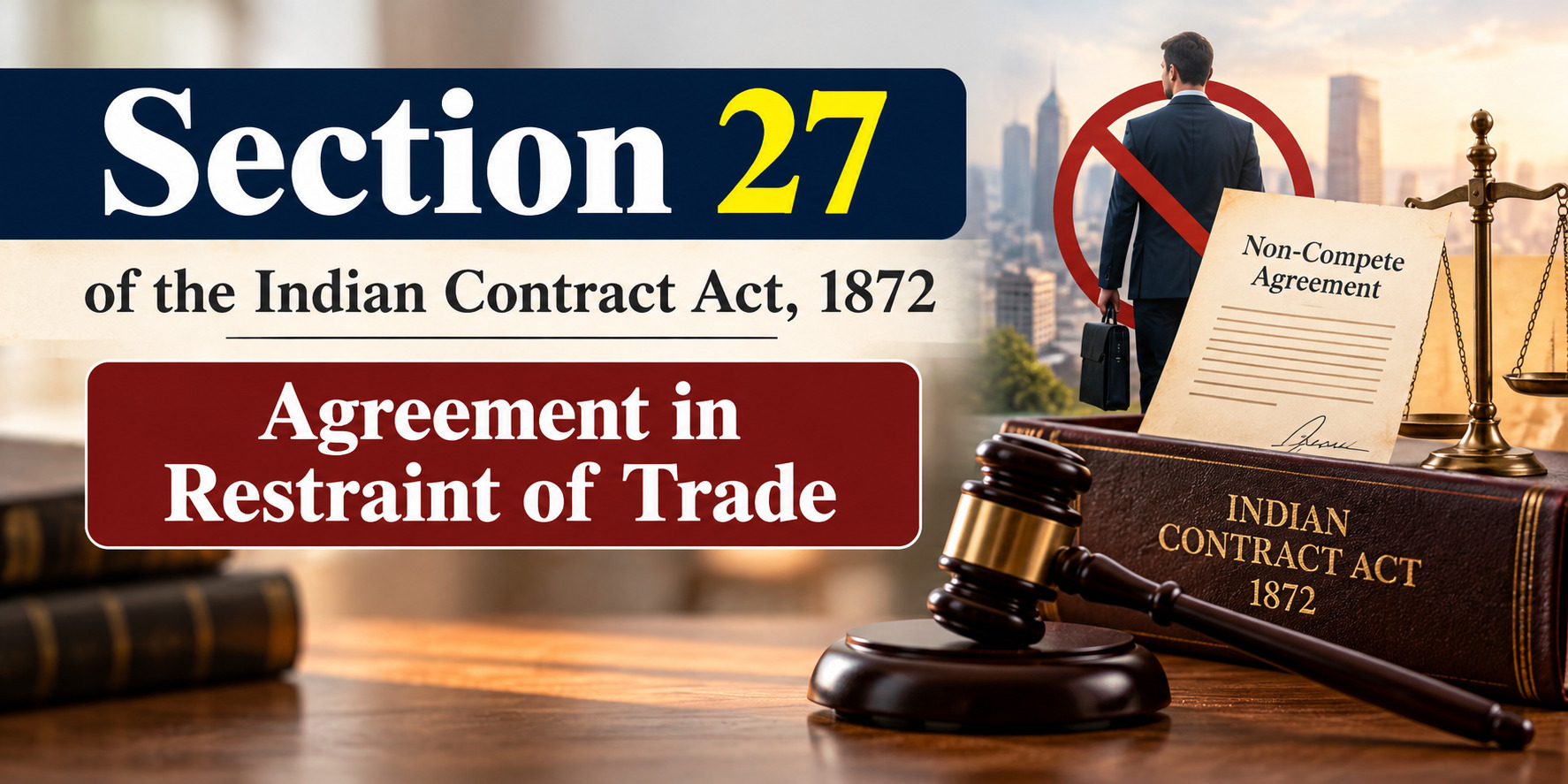
Section 27 of the Indian Contract Act, 1872 deals with agreements that restrict a person from carrying on a lawful profession, trade or business. The provision generally declares such agreements void to the extent of the restraint. The statutory provision also contains an important exception relating to the sale of goodwill.
Meaning of Section 27
Section 27 provides that an agreement by which a person is restrained from exercising a lawful profession, trade or business is void to that extent. Unlike some other contractual principles, Indian law does not generally make the validity of a restraint dependent merely on whether the restriction appears reasonable or limited.
The principal exception applies where the goodwill of a business is sold. The seller may agree not to carry on a similar business within specified reasonable local limits, provided the purchaser continues the business.
Employment Agreements and Restrictive Covenants
A distinction is generally made between restrictions operating during the period of employment and restrictions operating after employment ends. A negative covenant requiring an employee to work exclusively for the employer during the contractual period may not ordinarily be treated as a restraint of trade under Section 27, provided the covenant is not unconscionable, excessively harsh or unreasonable.
However, a contractual restriction preventing an employee from carrying on a profession or joining another business after termination of employment can attract Section 27.
Important Judgments
1. Niranjan Shankar Golikari v. Century Spinning & Manufacturing Co. Ltd. (1967)
The Supreme Court held that a negative covenant operating during the period of employment was not necessarily a restraint of trade. The Court considered the contractual period and the nature of the restriction while examining its validity.
2. Gujarat Bottling Co. Ltd. v. Coca Cola Co. (1995)
The Supreme Court considered restrictive covenants in a commercial franchise arrangement and recognised that a restriction operating during the subsistence of a commercial agreement may serve the purpose of the agreement and not necessarily amount to a prohibited restraint of trade.
3. Percept D’Mark (India) Pvt. Ltd. v. Zaheer Khan (2006)
The Supreme Court reaffirmed the strict approach to post-contractual restraints under Section 27 and held that the test of reasonableness or partial restraint cannot ordinarily be imported to validate a restraint falling within Section 27, except where the statutory exception applies.
Conclusion
Section 27 protects a person’s freedom to pursue a lawful profession, trade or business. While certain restrictions may operate validly during an existing contractual relationship, particularly where they are connected with the performance of the contract, post-contractual restraints require careful examination under Section 27. The exact validity of a restrictive covenant depends on its wording, duration, purpose, contractual context and whether it falls within the statutory exception.





Leave a Reply