
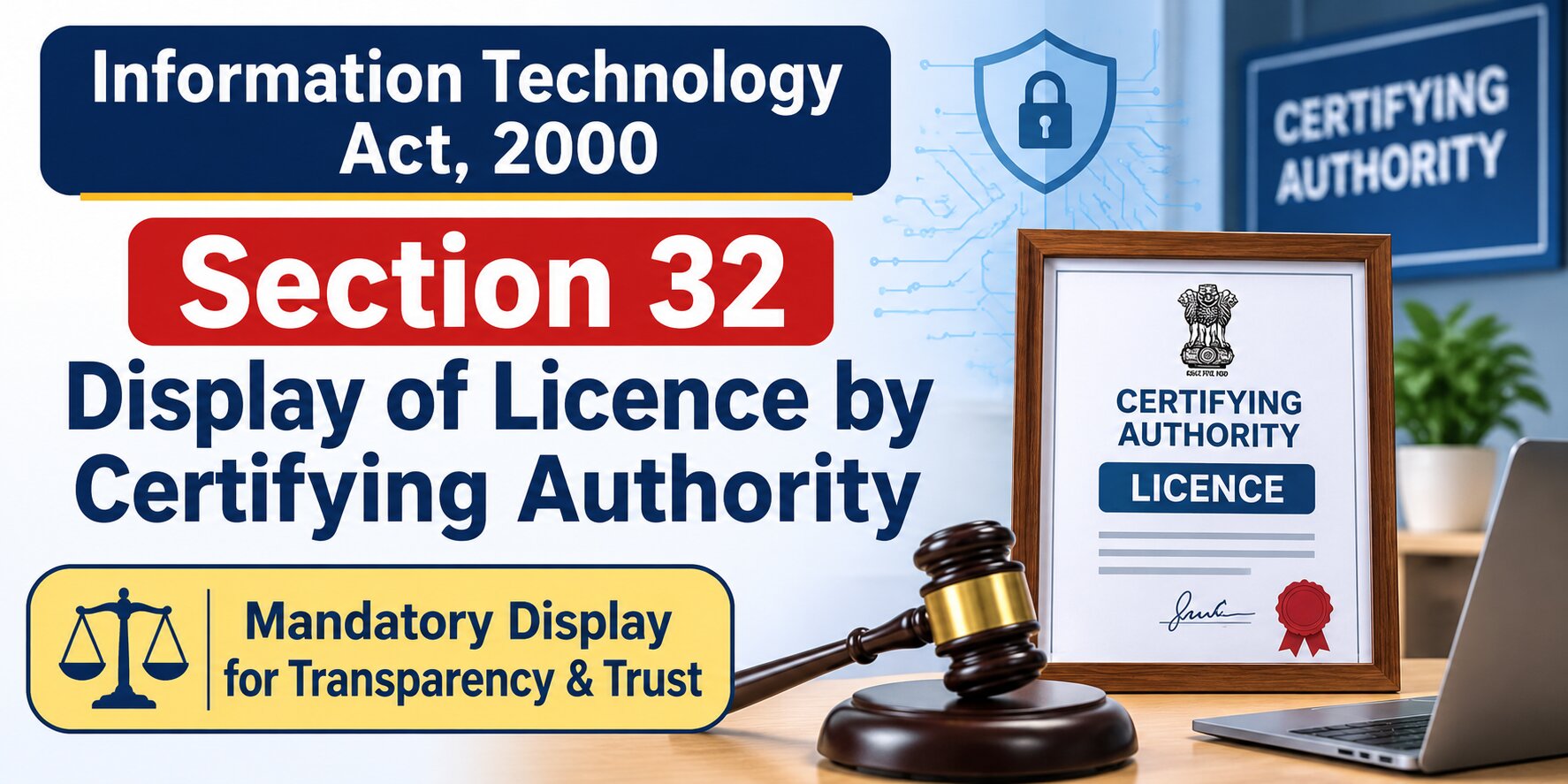
Section 32 of IT Act 2000: Display of licence
“Every Certifying Authority shall display its licence at a conspicuous place of the premises in which it carries on its business.”
Explained:
1. Meaning of Certifying Authority
A Certifying Authority is an entity licensed under the Information Technology Act, 2000, to issue electronic signature certificates in accordance with the prescribed legal requirements.
These authorities help establish the identity of individuals or organisations using electronic signatures. Their services are important for secure electronic transactions and digital authentication.
2. Mandatory display of licence
Section 32 makes it compulsory for every Certifying Authority to display its licence. This is not merely an optional administrative practice; it is a statutory obligation.
The licence demonstrates that the authority has received the necessary regulatory permission to conduct its certification activities.
3. Display at a conspicuous place
The expression “conspicuous place” means a clearly visible and accessible location within the business premises.
The licence should be displayed in such a way that visitors, customers and other interested persons can easily notice it. Keeping the licence hidden or placing it in an inaccessible location would defeat the purpose of this requirement.
4. Transparency and public confidence
The main objective of Section 32 is to promote transparency in the functioning of Certifying Authorities. Public display of the licence allows customers to identify whether an organisation operates under the statutory licensing framework.
It also strengthens accountability and helps users make informed decisions before obtaining electronic signature certification services.
Importance of Section 32 in Digital Governance
Section 32 supports the credibility of India’s electronic signature certification framework in several ways:
- Regulatory transparency: It enables customers to identify licensed Certifying Authorities.
- Public awareness: Visitors can verify that the organisation operates under a licence issued under the Act.
- Accountability: It reinforces the responsibility of Certifying Authorities to comply with statutory requirements.
- Trust in electronic transactions: It contributes to confidence in the institutions providing electronic signature certification services.
- Regulatory compliance: It establishes a clear legal obligation for licensed authorities to display their licences at their business premises.
Important Judgments
There are no widely reported Supreme Court judgments directly interpreting the specific display-of-licence requirement under Section 32. However, the following judgments provide relevant legal context concerning electronic records and digital transactions.
1. State of Maharashtra v. Dr. Praful B. Desai (2003)
The Supreme Court recognised the use of video conferencing in judicial proceedings and considered how technology could be accommodated within existing legal procedures.
Relevance: The judgment demonstrates the growing legal acceptance of technology in formal proceedings.
2. Anvar P.V. v. P.K. Basheer (2014)
The Supreme Court examined the admissibility of electronic records under Section 65B of the Indian Evidence Act, 1872.
Relevance: The judgment highlights the importance of reliability and proper authentication when electronic records are used as evidence.
3. Arjun Panditrao Khotkar v. Kailash Kushanrao Gorantyal (2020)
The Supreme Court clarified the requirements for producing electronic evidence under Section 65B of the Indian Evidence Act, 1872.
Relevance: The decision reinforces the importance of maintaining appropriate procedures for electronic records. These judgments concern the broader electronic evidence framework, not a direct interpretation of Section 32.
Difference Between Sections 31, 32 and 33
| Section | Subject |
|---|---|
| Section 31 | Certifying Authority to ensure compliance with the Act and applicable rules. |
| Section 32 | Display of licence by Certifying Authority. |
| Section 33 | Surrender of licence after suspension or revocation. |
Conclusion
Section 32 of the Information Technology Act, 2000, establishes a simple but important legal requirement for Certifying Authorities in India. By making the display of licences compulsory at a conspicuous place within business premises, the provision promotes transparency, regulatory compliance and public confidence in electronic signature certification services.
Although the provision contains only one sentence, it forms part of the broader regulatory framework governing Certifying Authorities. Understanding Sections 30, 31, 32 and 33 together helps explain the responsibilities and regulatory obligations imposed on these authorities.


Leave a Reply