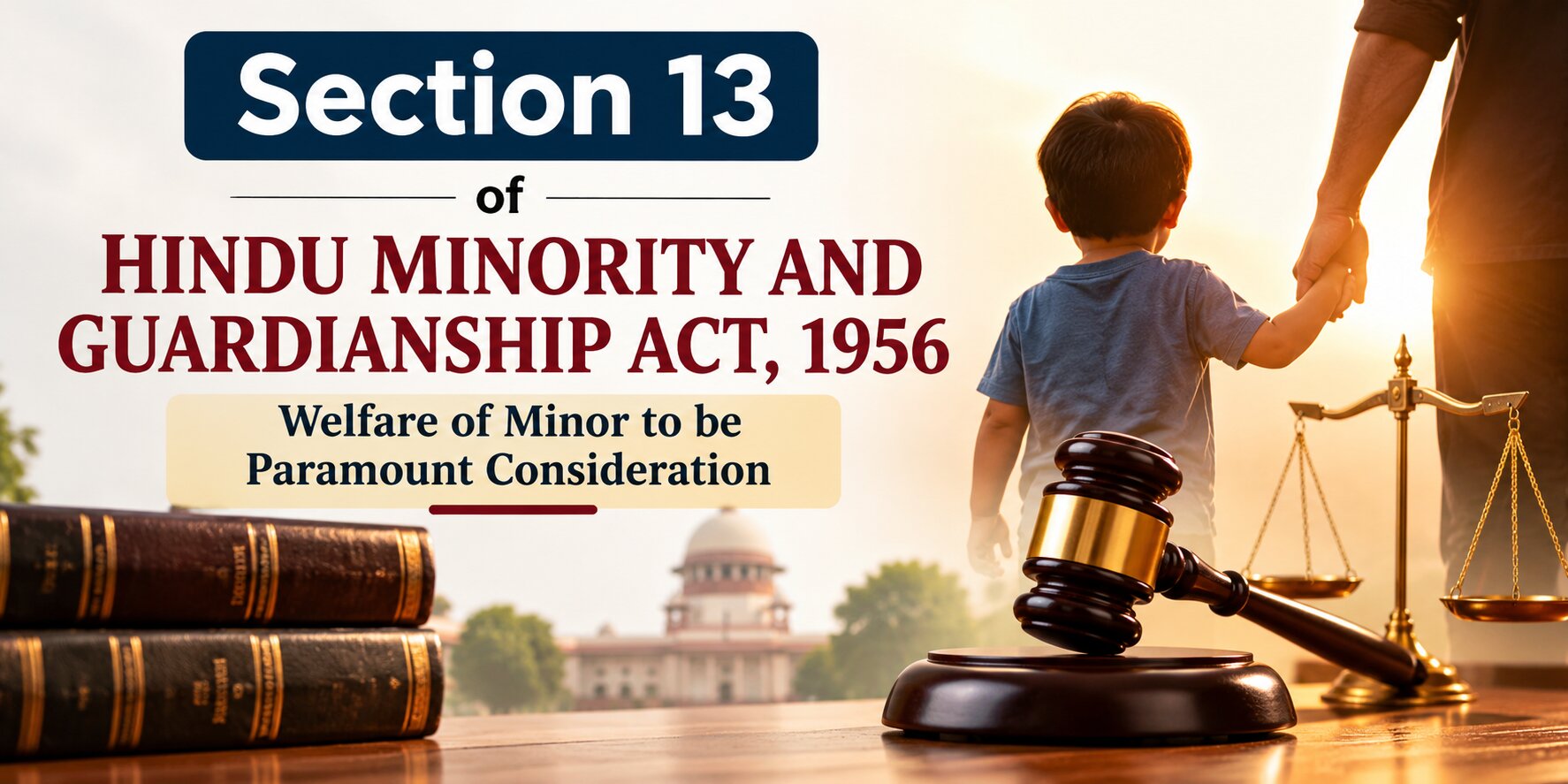
Section 13 of HMGA: Welfare of minor to be paramount consideration
Section 13(1)
In the appointment of declaration of any person as guardian of a Hindu minor by a court, the welfare of the minor shall be the paramount consideration.
Section 13(2)
No person shall be entitled to the guardianship by virtue of the provisions of this Act or of any law relating to guardianship in marriage among Hindus, if the court is of opinion that his or her guardianship will not be for the welfare of the minor.
Explained:
Section 13(1): Welfare of the Minor as the Paramount Consideration
Section 13(1) directs courts to treat the welfare of the child as the most important factor when appointing or declaring a guardian. The term “paramount consideration” means that the child’s best interests take priority over competing claims made by parents or other relatives.
The provision does not limit welfare to financial security or physical comfort. Courts may consider several aspects of a child’s life, including:
- Physical safety, health, and emotional stability.
- Educational opportunities and intellectual development.
- Moral upbringing and a supportive family environment.
- The child’s relationship with parents and other family members.
- The ability of the proposed guardian to provide consistent care.
- The child’s wishes, where the child is mature enough to express an intelligent preference.
For example, a father or mother may claim guardianship based on their legal status. However, if the evidence indicates that placing the child with that parent would seriously harm the child’s welfare, the court can consider another suitable arrangement.
Therefore, Section 13(1) requires an individual assessment of the child’s circumstances rather than an automatic decision based solely on family relationships.
Section 13(2): Legal Entitlement Does Not Guarantee Guardianship
Section 13(2) reinforces the principle established in subsection (1). A person cannot insist on guardianship merely because the Hindu Minority and Guardianship Act, 1956, or another applicable law recognises that person’s legal entitlement.
The court must examine whether granting guardianship to the individual would actually promote the minor’s welfare.
For instance, if a parent is involved in conduct that places the child at risk, the court may examine the relevant evidence before deciding whether that parent should receive guardianship or custody. Similarly, a relative who has the financial resources to support a child does not automatically become the most appropriate guardian.
The court considers the circumstances of the particular case, including the child’s safety, emotional needs, education, and living arrangements.
Subsection (2) is particularly important because it prevents guardianship from being treated as an absolute parental right. The child’s welfare remains the controlling consideration.
Important Judgments
Indian courts have repeatedly explained that the welfare principle must guide decisions involving the guardianship and custody of minors.
1. Gaurav Nagpal v. Sumedha Nagpal (2009) 1 SCC 42
In this important Supreme Court judgment, the Court explained that the word “welfare” must be interpreted broadly. A child’s welfare includes physical well-being as well as moral, ethical, and emotional development.
The Court made it clear that custody disputes should not be decided merely by comparing the legal rights of parents. Instead, the court must determine which arrangement best serves the child’s overall interests.
Legal significance: The judgment established that Section 13 must be understood in a child-centred manner, with the child’s overall development taking priority over competing parental claims.
2. Nil Ratan Kundu v. Abhijit Kundu (2008) 9 SCC 413
In this case, the Supreme Court emphasised that child custody disputes require a sensitive and practical assessment of the child’s circumstances. The Court considered the importance of examining the surrounding facts, including matters relevant to the child’s safety and well-being.
The judgment explained that custody cases cannot be resolved solely by applying statutory provisions mechanically. Courts must approach such disputes with a human perspective and give proper importance to the welfare of the minor.
Legal significance: The decision reinforces that the child’s best interests, rather than the legal entitlement of a particular parent or relative, must guide the court’s decision.
3. Vivek Singh v. Romani Singh (2017) 3 SCC 231
In this case, the Supreme Court considered the welfare of a minor child in a parental custody dispute. The judgment highlighted the importance of a child’s emotional needs and the role of a stable, supportive environment in healthy development.
The Court recognised that welfare involves more than physical comfort or financial provision. The emotional relationship between a child and the parents may also be relevant when determining an appropriate custody arrangement.
Legal significance: The judgment supports a holistic understanding of child welfare, including emotional security, personal development, and the child’s need for appropriate parental care.
4. Rosy Jacob v. Jacob A. Chakramakkal (1973) 1 SCC 840
This Supreme Court decision is an important authority in Indian child custody law. It emphasised that custody arrangements must be considered in light of the child’s welfare and that decisions concerning minors should remain responsive to their changing circumstances.
The judgment supports the principle that custody is not simply a matter of enforcing the competing rights of parents. The child’s interests must remain central to the court’s approach.
Legal significance: The decision is frequently discussed in connection with the welfare-based approach to child custody and guardianship.
Importance of Section 13 in Guardianship Disputes
Section 13 provides a safeguard against decisions that prioritise parental status, personal disagreements, or financial advantage over the child’s actual needs. It helps courts assess whether a proposed guardian can provide a safe, stable, and supportive environment.
The provision also works alongside the Guardians and Wards Act, 1890, particularly Section 17, which identifies relevant considerations for courts appointing guardians. The applicable legal framework and facts of each case determine the appropriate outcome.
Importantly, Section 13 does not mean that a parent automatically loses guardianship because of a disagreement, separation, or financial disadvantage. Courts must evaluate the evidence and the child’s circumstances before reaching a conclusion.
Conclusion
Section 13 of the Hindu Minority and Guardianship Act, 1956, is a fundamental provision protecting the interests of Hindu minors in guardianship proceedings. Its two subsections establish that the welfare of the child is paramount and that no person can claim guardianship as an absolute legal entitlement when that arrangement would be contrary to the child’s welfare.
The Supreme Court judgments discussed above demonstrate that child welfare includes physical safety, emotional stability, education, moral development, and a suitable family environment. Ultimately, Section 13 requires courts to place the child’s best interests at the centre of every guardianship decision.



Leave a Reply