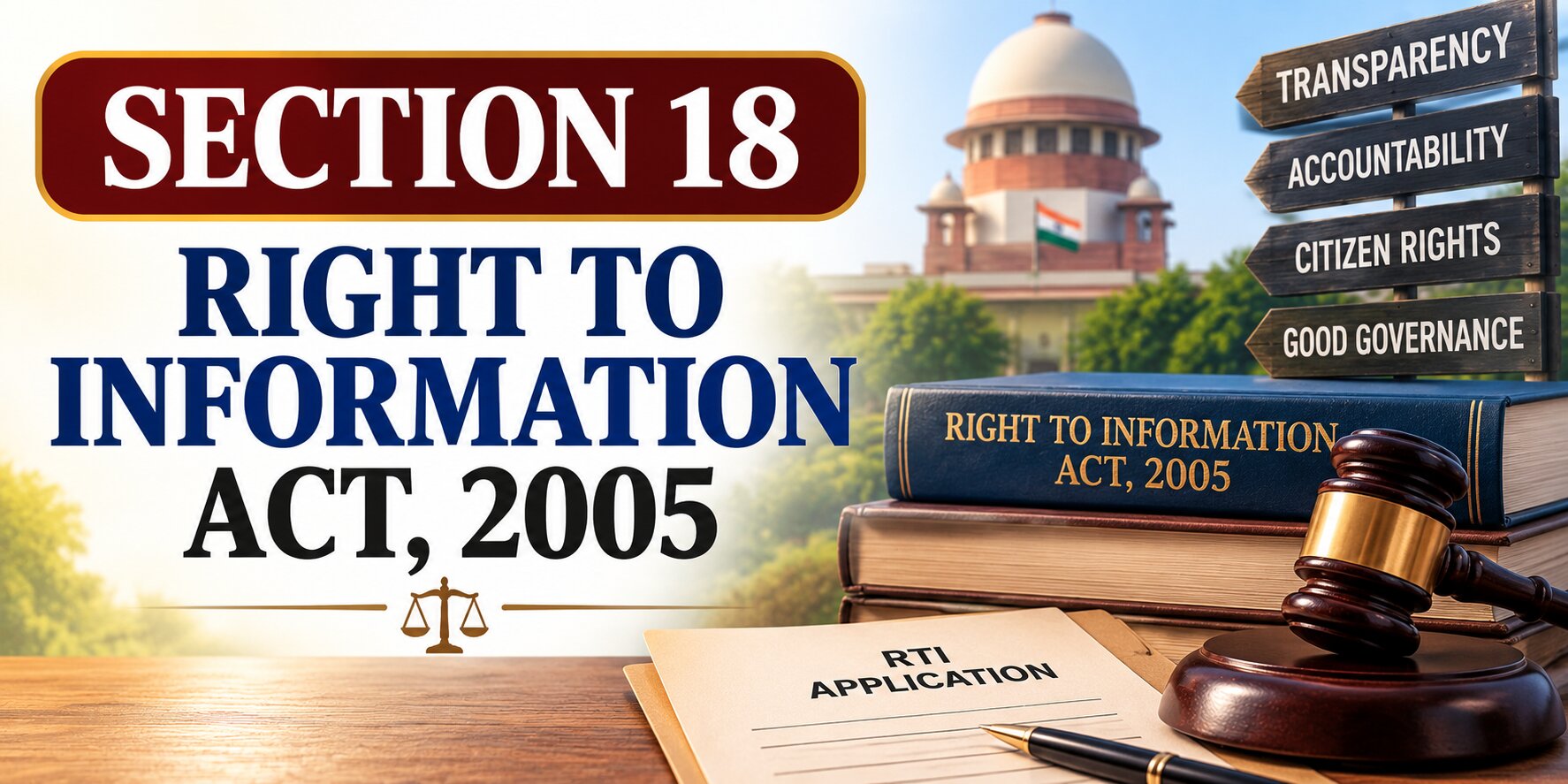
Section 18 of Right to Information Act:
Section 18(1)
Subject to the provisions of this Act, it shall be the duty of the Central Information Commission or State Information Commission, as the case may be, to receive and inquire into a complaint from any person,—
(a) who has been unable to submit a request to a Central Public Information Officer or State Public Information Officer, as the case may be, either by reason that no such officer has been appointed under this Act, or because the Central Assistant Public Information Officer or State Assistant Public Information Officer, as the case may be, has refused to accept his or her application for information or appeal under this Act for forwarding the same to the Central Public Information Officer or State Public Information Officer or senior officer specified in sub-section (1) of section 19 or the Central Information Commission or the State Information Commission, as the case may be;
(b) who has been refused access to any information requested under this Act;
(c) who has not been given a response to a request for information or access to information within the time limit specified under this Act;
(d) who has been required to pay an amount of fee which he or she considers unreasonable;
(e) who believes that he or she has been given incomplete, misleading or false information under this Act; and
(f) in respect of any other matter relating to requesting or obtaining access to records under this Act.
Section 18(2)
Where the Central Information Commission or State Information Commission, as the case may be, is satisfied that there are reasonable grounds to inquire into the matter, it may initiate an inquiry in respect thereof.
Section 18(3)
The Central Information Commission or State Information Commission, as the case may be, shall, while inquiring into any matter under this section, have the same powers as are vested in a civil Court while trying a suit under the Code of Civil Procedure, 1908 (5 of 1908), in respect of the following matters, namely:—
(a) summoning and enforcing the attendance of persons and compel them to give oral or written evidence on oath and to produce the documents or things;
(b) requiring the discovery and inspection of documents;
(c) receiving evidence on affidavit;
(d) requisitioning any public record or copies thereof from any Court or office;
(e) issuing summons for examination of witnesses or documents; and
(f) any other matter which may be prescribed.
Section 18(4)
Notwithstanding anything inconsistent contained in any other Act of Parliament or State Legislature, as the case may be, the Central Information Commission or the State Information Commission, as the case may be, may, during the inquiry of any complaint under this Act, examine any record to which this Act applies which is under the control of the public authority, and no such record may be withheld from it on any grounds.
Explained:
Section 18 of the Right to Information Act, 2005 explains the powers and functions of the Central Information Commission and State Information Commissions in dealing with complaints relating to access to information. This provision plays an important role in promoting transparency, accountability and good governance in public authorities.
When Can a Complaint Be Filed Under Section 18?
A person may approach the appropriate Information Commission when an RTI application cannot be submitted because no Public Information Officer has been appointed, or when an Assistant Public Information Officer refuses to accept the application. Complaints may also arise when access to information is denied, a response is not received within the prescribed period, an unreasonable fee is demanded, or incomplete, misleading or false information is supplied.
Section 18(2) authorises the Commission to initiate an inquiry when reasonable grounds exist. During the inquiry, Section 18(3) gives the Commission certain powers of a civil court, including summoning witnesses, requiring the production and inspection of documents, receiving evidence on affidavit and requisitioning public records.
Under Section 18(4), the Commission may examine relevant records controlled by a public authority, and such records cannot be withheld from it on any grounds during the inquiry, subject to the statutory wording.
Important Judgments on Section 18
1. Chief Information Commissioner v. State of Manipur (2011)
The Supreme Court clarified the distinction between a complaint under Section 18 and an appeal under Section 19. It held that the Commission cannot use its complaint jurisdiction under Section 18 to direct disclosure of information in the same manner as it can in an appeal under Section 19.
2. Namit Sharma v. Union of India (2012)
The Supreme Court examined the constitutional validity and functioning of Information Commissions under the RTI Act. The judgment discussed the nature of the Commission’s adjudicatory functions and the legal framework governing its operation. The decision was subsequently reconsidered in 2013.
Conclusion
Section 18 provides an important mechanism for addressing complaints about difficulties in obtaining information under the RTI Act. However, applicants should understand the distinction between filing a complaint under Section 18 and pursuing an appeal under Section 19, particularly when the primary objective is to obtain the requested records.
Leave a Reply